

A supplement pouch is not recyclable everywhere because its main film is PE. Check the finished bag—body, zipper, labels, inks, coatings and any inner components—then check an established collection and processing route where it will be sold. A multi-layer pouch and a PE-family pouch may require different decisions, but neither deserves an unconditional recycling claim from a material name or product photograph alone.
This is a US-focused guide for brands buying flexible packaging for human dietary supplements. The question is whether a particular printed retail pouch has a supportable recovery route and consumer instruction. It does not turn a brand's label into a certification, rank every material's total environmental impact, or decide the product's food-contact and shelf-life requirements. The FTC Green Guides provide the US environmental-claims framework; the APR Design Guide for PE flexible packaging helps designers examine the whole package. Recheck both before final artwork approval.
Identify the exact bag before asking where it goes
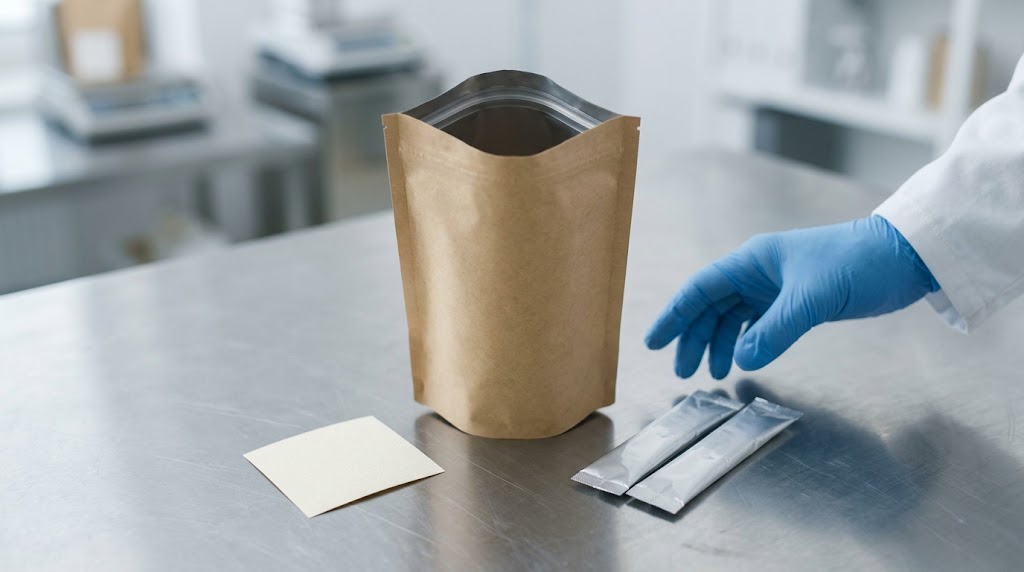
Get the supplier's finished construction and a physical sample. A printed supplement pouch may include an outer print layer, adhesive, barrier treatment, inner sealant, zipper, label, tear feature or window. A brand using an outer bag for wrapped doses has a separate inner-pack question. Do not assume that the recycling answer for the outer pouch also applies to the inner stick packs or sachets. List each component the consumer will actually dispose of, including any peelable label that the instructions assume will be removed.
The material claim must refer to a particular version. A transparent blank sample can differ from the printed commercial pouch, and a component can change between production runs. Ask the supplier for a layer list, closure and coating details, print or label system, and notice of future substitutions. If a report evaluates only flat film, it is evidence about that film under those conditions, not automatic clearance for a finished stand-up pouch with a zipper. If the brand uses several sizes or flavors, review whether all versions truly share the same construction.
| Component or condition | Question to resolve | Easy but unsafe assumption |
|---|---|---|
| Main film | What polymer families and barrier layers are in the final body? | “PE” on one line means every layer is PE |
| Zipper and seals | Do they match the proposed collection and reprocessing route? | A recyclable film makes every attachment compatible |
| Print, coating and label | Has the finished design been assessed, including coverage and adhesives? | A sustainability symbol on the artwork is evidence |
| Inner wraps or inserts | Are they separately discarded and assessed? | One label describes the entire multi-component retail unit |
| Local pathway | Who collects and processes this kind of pouch in the sales region? | Every municipal curbside bin accepts flexible film |

The name of a product line is not the specification. Mylarbag's published mushroom powder pouch record lists PE/PE, a stand-up format and 12.5 × 20.5 + 3 cm for a US project. That gives a concrete material-family example. Its page calls the bag “100% recyclable,” but the public record does not establish collection access for every US buyer, nor a separate assessment of every printed component shown. Use the configuration as a starting question, not a consumer instruction copied into a new brand's artwork.
Distinguish PE-family design from a verified recycling outcome
Designing primarily around a single polymer family can simplify an assessment compared with a laminate combining unlike layers. The difference matters, but it is not the end of the analysis. The APR's PE flexible guidance considers how the complete package enters a recycling stream and assesses design features, not just the main film. A brand should determine whether its exact coating, color, label and closure meet the relevant criteria. A marketing description such as “mono-material” may be useful if it accurately describes the structure; it does not say where a consumer can take the empty pouch.
A separate published capsule stand-up pouch lists MATOPP/VMPET/PE. That material record differs from the PE/PE project and calls for its own end-of-life review. Do not tell consumers to peel a laminated bag apart if the components are bonded and no such instruction is supported. Do not infer that a metallic-looking printed pouch contains aluminum foil just from a photograph. A supplier's structure and actual disposal-route evidence should settle the technical description.

If the supplier proposes a PE-family alternative, ask what changed besides the film name. Was the zipper changed, did the print coverage or adhesive change, and has the consumer's opening method stayed the same? Does the new bag still work on the packing line and protect the actual product under the brand's storage program? The environmental decision cannot require the brand to accept a product failure. A package that causes more rejected supplement units may create waste outside the bag itself. Confirm the product and packing criteria before a recycling claim is finalized.
Find the collection route for the market you actually serve
There are several different ideas hidden in “recyclable”: a structure designed for a recycling process, a consumer collection point, actual sorting and reprocessing, and an appropriate claim on a specific market's package. A favorable result at one stage does not prove the others. In the United States, flexible plastic bags, wraps and films are generally not accepted in most curbside programs; How2Recycle's Store Drop-off explanation describes a separate route for eligible films at participating locations. The word eligible matters. A random supplement pouch should not print a Store Drop-off label because a supermarket nearby has a plastic-film bin.
Contact the relevant labeling or assessment program and evaluate the finished bag. Verify current collection guidance for the actual selling regions and the program's requirements for residues, labels and film. A brand shipping nationally has a different claim challenge from one selling only in a region with a documented program. The EPA's recycling guidance likewise advises checking local programs for accepted plastics. Do not instruct every consumer to put flexible film in curbside bins; an incorrect instruction can contaminate a collection stream.
The FTC's guidance says marketers should qualify recyclable claims where appropriate facilities are not available to at least 60 percent of consumers or communities where the item is sold. That is a claims threshold in a particular context, not a substitute for showing that the specific printed pouch is accepted and recovered through an established program. Claims can be more limited when access is lower. The brand's reviewer should document the evidence and wording for its intended US market rather than relying on a supplier's global product headline.
Make disposal instructions match the complete selling unit
Supplements often introduce more than one item into a package: outer retail pouch, individual sachets, printed label, scoop or other accessory. The instruction on the back should identify which component it describes. If the outer pouch has a verified route but inner wraps do not, one chasing-arrows symbol beside the whole retail unit can mislead. If a brand asks consumers to remove a paper label, check whether people can actually do it without tools and whether the program's assessment assumes removal. The APR guide does not simply presume extra consumer preparation beyond normal use.
Visible residue and small accessories need a practical answer. A pouch that held loose powder may retain fines in gussets or around a zipper. A brand should ask its assessment partner what level of cleaning and preparation the specific route expects; do not publish an instruction to wash a bag that creates another problem or is not required. If the package held separately wrapped sticks, the outer bag may be relatively clean while the inner wrappers have a separate fate. Describe actual components instead of saying “all packaging recyclable.”

Keep print and disposal decisions together. A pouch may have enough visual space for a small instruction, but the exact wording must be approved for the bag's assessed version. Reserve the area on the dieline away from folds, seams, zipper and trim. Check the filled back panel at shelf scale; a statement hidden under a gusset does not give a consumer usable guidance. When artwork is shared across markets, the end-of-life instruction may need to change with local collection access. A factory can accurately print one global design that is inappropriate for part of the distribution map.
Review the claim before putting it on a new pouch
Start with the claim itself. “Made with a PE-family structure,” “designed for a specified collection route” and “recyclable” communicate different things. An environmental claim may apply to the bag body, a removable component or the whole unit. Identify the subject. Ask whether the statement is supported by current evidence for the finished printed pack, in the regions where it will be sold. If the evidence is narrow, use appropriately narrow language; if it is incomplete, defer the claim rather than designing a badge first.
Do not treat a resin code, a triangle, a green color or a certification-style icon as a shortcut. A resin mark identifies a plastic family; it is not a guarantee that a local curbside service accepts a pouch. A particular third-party label should be used only under its actual program's approval and usage rules. The brand should retain the approved wording, proof, version of the bag and evidence supporting it, then revisit them when components or collection rules change. The supplier can supply construction and testing data; it should not invent a national disposal route on behalf of the brand.
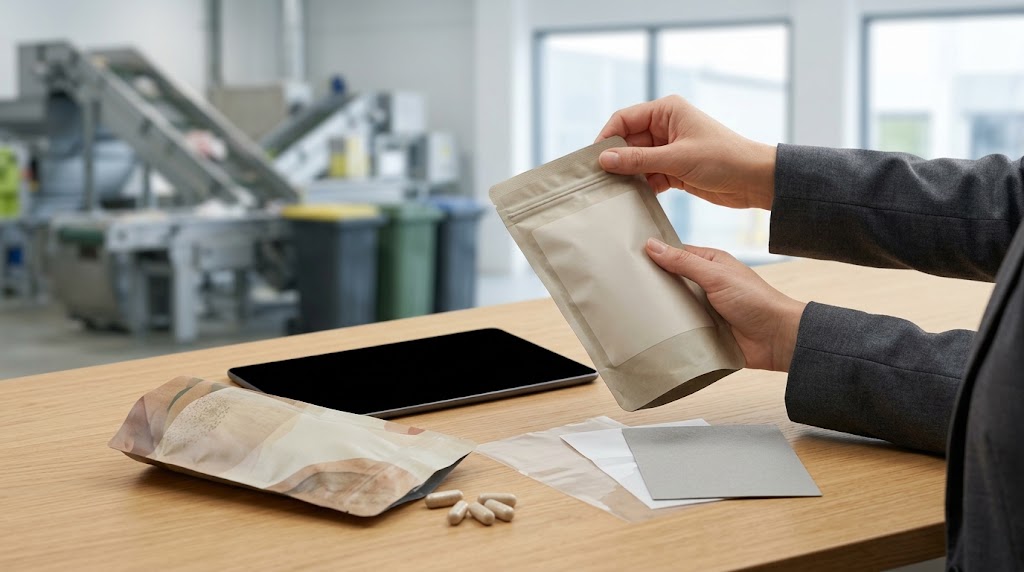
For an operational review, make a two-column checklist: evidence held, decision still needed. A supplier's PE/PE specification might be held, while the zipper compatibility or collection program is still pending. A finished-pouch assessment might be held, while the wording for an export market is not. Do not turn a pending item into “probably fine” to meet a print deadline. It is often possible to print the essential product information now and add a qualified end-of-life message in a later verified artwork version, subject to the brand's label process.
Run a component audit on a physical, opened pouch
Put the finished retail unit on a worktable and unpack it as a consumer would. Is the tear strip detached and discarded separately? Does the zipper remain on the empty pouch? Is a large paper label permanently adhered to the back? Does the bag contain a sachet, scoop or desiccant that needs a separate instruction? A supplier's layer diagram may omit the post-filling items a co-packer adds. Photograph the unit before and after opening, then update the component list. This simple step prevents a recovery assessment of the empty bag body from being applied to the entire selling unit.
Take a second look at the design versions actually on the market. A subscription refill may use a plain PE-family pouch with a small label, while the retail version has heavy metallic artwork and a different zipper. The bags may share a color palette but differ materially. A small trial batch may use a hand-applied label that is replaced with direct print at scale. If an environmental claim is printed on every design, ask whether the evidence covers each design. Version control is not a cosmetic detail; the claim lives on the physical version consumers buy.
The product's form affects the empty-bag state too. A capsule pouch may be relatively easy to empty. Fine powder can collect in folds. A sticky gummy supplement may leave residue. Do not assume a recovery program accepts all of those bags in the same condition, or that consumers will undertake elaborate cleaning. Ask the relevant program or assessor how residue and normal emptying are handled. The brand should consider whether the proposed consumer instruction is realistic and safe for the actual product, then keep it short enough to be read on a small back panel.
Verify access, not just a map of possible locations
An online locator can identify places to investigate, but a pin on a map is not proof that a location currently accepts the exact package. For an important US sales region, the brand can check the program's present instructions, the participating retailer's current acceptance and any restrictions on printed flexible pouches. Record when the check was made and what format was reviewed. Collection systems and store participation may change; claims on a long-running print order need a reasonable recheck plan.
For national ecommerce, the problem is broader than the brand's home ZIP code. An instruction appropriate near the factory can be misleading for customers across the country. The FTC's threshold and qualification guidance is about the consumers or communities where the product is sold. Ask the reviewer what geographic evidence supports the proposed unqualified or qualified language. If the brand sells in Canada, Europe or Australia as well, commission a market-specific review instead of assuming a US Store Drop-off designation translates directly. The phrase “recyclable in the US” can also be too broad if the route is limited or the package has not been assessed.
Even when a collection route exists, check what happens to the collected material under the program's stated process. A recyclable claim should not rest on a theoretical chemical possibility if no established route handles this form. Ask the assessor whether the bag's color, print and attached components affect sorting or reprocessing. Document its conclusion and any conditions. The result may be “candidate for redesign” rather than a printable claim, which is still useful procurement information. It tells the supplier which component must change in the next sample.
Draft the exact claim only after the evidence packet is assembled
The brand's proposed wording should answer four questions: what item, what attribute, what location and what consumer action? “Recyclable pouch” is a whole-bag statement. “The outer PE pouch is eligible for a specified US collection program where available” is narrower but still needs evidence for eligibility and access. “This film is PE” is a material description and should not be dressed up to imply an approved route. These examples illustrate the difference in claim scope; they are not ready-to-print legal templates.
Show the exact proof to the assessor or qualified claim reviewer, including symbols and the surrounding copy. A symbol may convey an environmental benefit even if the sentence nearby is cautious. If a brand uses a recognized labeling program, follow that program's permission and final-artwork process; do not paste its mark into an AI mockup and treat it as approved. Check the front, reverse and ecommerce product images for consistency. A web listing saying “100% recyclable” while the pouch has a narrow conditional instruction creates another unsupported impression.
Maintain an evidence folder that a new purchasing manager can understand. Include the supplier's final component specification, physical sample or photographs, assessment and geographic basis, approved claim wording, artwork revision, production date and change notifications. Keep a named owner for rechecking collection access and component changes. This is also helpful when the brand evaluates a different bag size: the old approval can identify which questions must be reopened, but it should not automatically transfer to a changed zipper, barrier coating or label. The aim is a traceable answer for the pack the customer holds, not a permanent green badge attached to the product line.
If the collection program changes after printing, record which finished-bag lots carry the old instruction and where they are still being sold. The brand's reviewer can decide whether a web listing, consumer service answer or future artwork needs to change and whether existing inventory requires action. Do not quietly tell a supplier to keep printing the old label while waiting for a replacement route. A date on the evidence packet helps the team distinguish what was known at approval from what is available now. This process does not guarantee a permanent recycling option, but it gives the brand a way to correct an outdated statement without losing track of the bags in circulation.
Compare alternatives without repeating the material-selection guide
If the finished pouch does not have a supportable route, do not force a recyclable claim. The brand may keep an approved, well-performing structure while it develops a viable alternative. It may reduce unnecessary bag size, obsolete printed stock or excess secondary packaging without promising a recycling outcome. It may test a PE-family design for a specific program after assessing all components. A compostable candidate is a different end-of-life proposition that needs separate evidence and facilities. None of these options makes a specific material universally superior.
The previously planned material-selection article asks which structures to trial for a particular supplement and environmental objective. This article asks what can be said about the final printed pouch's collection and recovery. That distinction matters for buyers: a material decision can be provisionally approved for technical testing while the claim remains unapproved. Keep the two gates separate in the project record so a successful filling trial is not mistaken for permission to print a recycling badge.
| Gate | Owner's question | Evidence needed before advancement |
|---|---|---|
| Bag construction | What are the complete layers and components? | Supplier's final versioned specification |
| Product fit | Does the filled bag work for this supplement? | Brand and packer's trial and storage criteria |
| Design assessment | Can the whole package enter a specified process? | Appropriate program or technical evaluation |
| Market access | Is that collection route available where sold? | Current geographic evidence and relevant rules |
| Consumer wording | What exact instruction is supportable? | Reviewed claim, approved artwork and change control |

Recommended packaging configuration to discuss
If a brand wants to explore a PE-family supplement pouch, request a complete construction and physical sample with the intended zipper, print and label—not merely a film swatch. Compare it against the currently approved pack in the real fill and storage program, then seek the appropriate finished-pouch recovery assessment for the US sales regions. Mylarbag's published PE/PE wellness project can frame a structure conversation; the supplement packaging range can frame a sample request. Neither URL alone authorizes an unqualified recycling claim on a new product.
Frequently asked questions
Are all supplement pouches recyclable?
No. The answer depends on the complete printed bag, its components and a verified collection and processing route for the market where it is sold. A pouch used for capsules and one used for powder may also differ in residual contents and consumer preparation.
Is a PE/PE supplement pouch accepted in curbside recycling?
Do not assume that. Many US curbside programs do not accept flexible films. Some eligible films may use a participating store drop-off route, but the finished pouch must meet the program's criteria. Check the actual package and current local guidance before printing instructions.
Does a recyclable outer pouch make individual stick packs recyclable?
No. The outer pouch and inner packs are separate packaging components. Review each construction and route, then make the label clear about which item the instruction covers. A single unqualified symbol may imply more than the evidence supports.
Is a resin code enough to claim recyclability?
No. It identifies a material family but does not establish that the finished pouch can be collected, sorted and reprocessed in an established program where sold. Check additional components, collection access and the exact wording of the claim.
Should I tell customers to put flexible pouches in the household recycling bin?
Only if a verified local program accepts that exact package through that route and the instruction is appropriate for the sales area. General US guidance for eligible film often points to separate store drop-off, not curbside. Avoid giving a universal disposal instruction.
What should I ask a supplier claiming a pouch is recyclable?
Ask for the final structure including zipper, coatings and label; the specific finished-pouch design assessment; the intended collection route and market; and how substitutions are controlled. Have the brand's reviewer approve any on-pack statement. A product-page headline is not the evidence packet.
Make the recycling answer version-specific
Send the actual printed bag or approved drawing, the complete component list, sales markets, product-contact and storage requirements, and desired consumer instruction to the relevant supplier and assessment program. Mylarbag can discuss a candidate supplement pouch and provide its proposed construction for review. Keep the product-fit result, recycling-route evidence and artwork approval together for that version. If the bag changes, revisit the affected parts of the answer before calling the new pouch recyclable.