
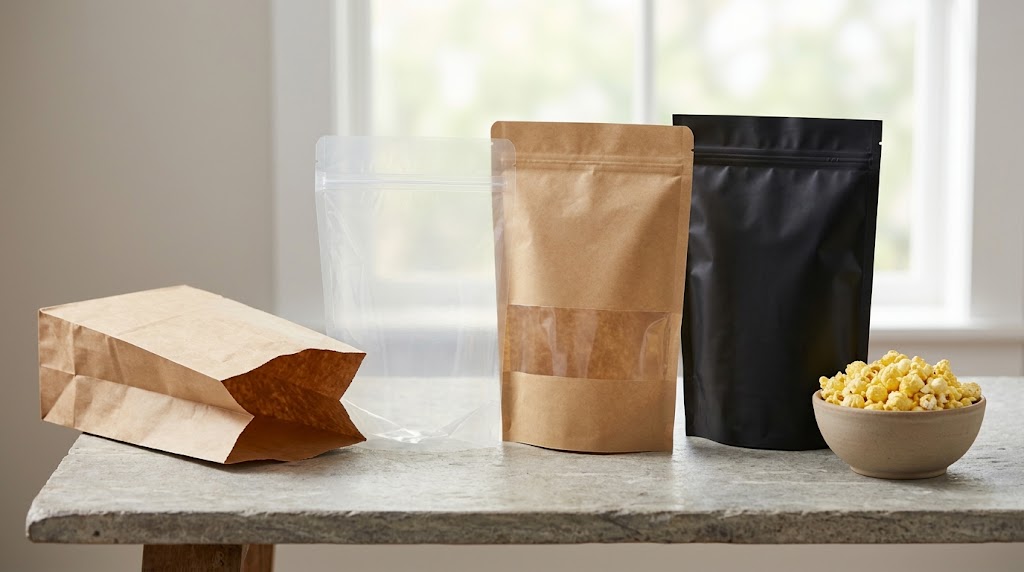
There is no single disposal answer for every bag sold with popcorn. A paper serving bag, a clear plastic pouch, a paper-look laminate with a window, and a metallized retail pouch can appear in the same category but contain different materials. The residue left after eating and the collection service available to a customer also matter. A recycling symbol or the word “compostable” should follow evidence for the exact finished package, not the color of its front panel.
The short answer: first identify the complete bag construction, including coatings, window, zipper, ink and sealant. Then check whether an appropriate local recycler or composter accepts that item in its post-use condition. A package designed around one polymer is not automatically accepted curbside; a paper-like laminate is not automatically paper recyclable; and industrial compostability does not imply home compostability. Give consumers an instruction only when the product-specific evidence and collection route support it.
This guide covers commercial packaging bags for already-popped popcorn eaten by people, with emphasis on sealed retail pouches. It does not cover microwave cooking bags or their chemistry. An open paper serving bag is included only to explain why a broad query such as “can popcorn bags be composted?” has more than one answer.
Begin With the Exact Bag, Not the Product Name
Ask the packaging supplier for a construction sheet. Record every layer, the food-contact surface, adhesives, coatings, window, zipper, label, ink and any separate outer wrapper. A “kraft” exterior may sit over a polymer sealant. A shiny face may be metallized plastic rather than aluminum foil. A clear pouch may be a single-polymer family or a multilayer laminate. Those differences cannot be settled by a photograph or by the broad noun “plastic.”
| What a customer sees | What still needs proof | Why it affects disposal |
|---|---|---|
| Brown paper-like face | Whether it is plain paper, coated paper, or a paper/plastic laminate | Collection and pulping or compost suitability differ |
| Clear plastic pouch | Resin families, coatings, zipper, labels and actual local acceptance | “Clear” is an appearance, not a resin code |
| Silver or matte metallic face | Metallized film, foil layer or decorative printing | Different structures may not follow the same stream |
| Windowed kraft-look pouch | Window material and its attachment to the surrounding layers | A visible paper face does not describe the complete pack |
| Compostable wording | Certification scope, tested finished item and intended facility | A certified film alone may not cover added zipper, print and adhesive |
Do not assume that a bag marked with one material abbreviation is the complete article if the window, ink or zipper was added later. Ask whether the entire commercial SKU or only the base film was assessed. If production swaps a supplier, changes a window or uses a different laminate, revisit the disposal statement. An attractive front-of-pack claim can become misleading when a new component is not in the evidence file.
Post-use condition is part of the question
Popcorn can leave loose crumbs, oil and seasoning in a pouch. A multi-serve zipper may retain particles. Some collection programs specify that accepted packaging be empty and sufficiently clean or dry; others exclude flexible film entirely. The U.S. EPA's recycling FAQ recommends checking with the local provider because accepted materials vary, and it discusses cleaning food residue before recycling. Follow the actual receiving program's instruction rather than telling every customer to wash a laminate that has no collection route.
The same caution applies to paper. Food-soiled paper may have a composting route in one municipality and no route in another. An oil-resistant treatment or polymer lining can change the item's status. A bag that seems empty after a few shakes may still contain enough grease to be rejected by a particular paper program. Ask the collector for its written rule when preparing a label.
Distinguish Design, Collection and Actual Processing
The statement “designed for recycling” describes the package's material strategy. “Accepted in a collection program” describes available consumer access and that program's rules. “Actually recycled” describes downstream sorting and processing. Those are separate claims. A mono-PE or mono-PP design can be a candidate for an appropriate flexible-film stream, but its layers, coatings, zipper and contamination still need review. Do not put a household curbside symbol on it merely because the same polymer family appears throughout.
The EPA's municipal acceptance terminology lists plastic film under retail or grocery collection-bin routes and explicitly says to confirm local acceptance. The EPA common-recyclables guide likewise directs people to ask about local film take-back. These are U.S. examples, not a guarantee that a particular popcorn pouch qualifies for a store drop-off. Local sites may impose material and cleanliness exclusions.
| Construction family to investigate | Potential route to ask about | Approval evidence still required |
|---|---|---|
| Predominantly one compatible polymer family | A local film collection or another defined program | Full-layer bill of materials, program criteria and condition after use |
| Paper bag without a problematic lining | Local paper recycling or accepted organics route | Treatment/coating identity, grease condition and program rule |
| Paper/plastic laminate | A specialized program, if one exists | Separation and processing route for the complete bag |
| Metallized or foil laminate | A specifically accepting program, if available | Exact structure and written acceptance; do not assume curbside |
| Certified compostable finished item | A composter that accepts the exact class of packaging | Valid certification scope and current facility acceptance |
This table does not designate a material as universally recyclable or compostable. If no appropriate local option exists for a consumer, say so plainly in market-specific instructions. An overly broad “recycle me” message can contaminate a collection stream when residents place an unaccepted laminate in it.
Compostable, Biodegradable and Paper-Look Mean Different Things
Industrial compostability is a claim about the finished item's behavior under defined controlled conditions. Home compostability concerns a different environment and should not be implied by an industrial certification. Biobased feedstock does not by itself prove either. A pouch containing paper is not necessarily suitable for composting when it also includes polymer, adhesive, ink and a zipper.
ASTM D6400-26 is a U.S. specification concerning labeling of plastic materials and products, including packaging, as compostable in aerobic municipal or industrial facilities. It does not declare every plastic pouch compostable, and it is not a universal home-compost test. The BPI product directory allows verification of items certified for commercial compostability. Check the exact product identity and version rather than accepting a logo placed on an unrelated resin sample. A facility still decides what it will receive.
For U.S. environmental marketing, the FTC Green Guides summary says compostable claims require competent and reliable scientific evidence for all materials in the product or package, and that facility-availability limitations should be qualified. It also discusses qualification of recyclable claims when facilities are not available to a substantial majority of consumers where sold. These are claim principles, not a certification program for this bag. Other markets have their own rules; have the brand's claim reviewer examine the specific destination and artwork.
A practical decision path for a used pouch
- Identify the SKU and structure. Read the manufacturer's bill of materials rather than judging by sheen or a generic resin nickname.
- Assess the whole item. Include window, zipper, coatings, adhesive, ink, labels and any separate components. Establish whether the parts can and should be separated under a real consumer instruction.
- Check the condition after use. Is the bag empty? Is it oily, wet or full of seasoning? Do not prescribe a cleaning step unless it matches the receiving program's conditions.
- Check collection access. Ask the relevant municipality, store program or composter whether it accepts this exact flexible-package category and material in the sales area.
- Review the claim. Use only wording supported by structure, evidence and realistic access. If the route varies geographically, qualify the instruction and direct people to their local program.
Apply the Method to a Real Popcorn Case
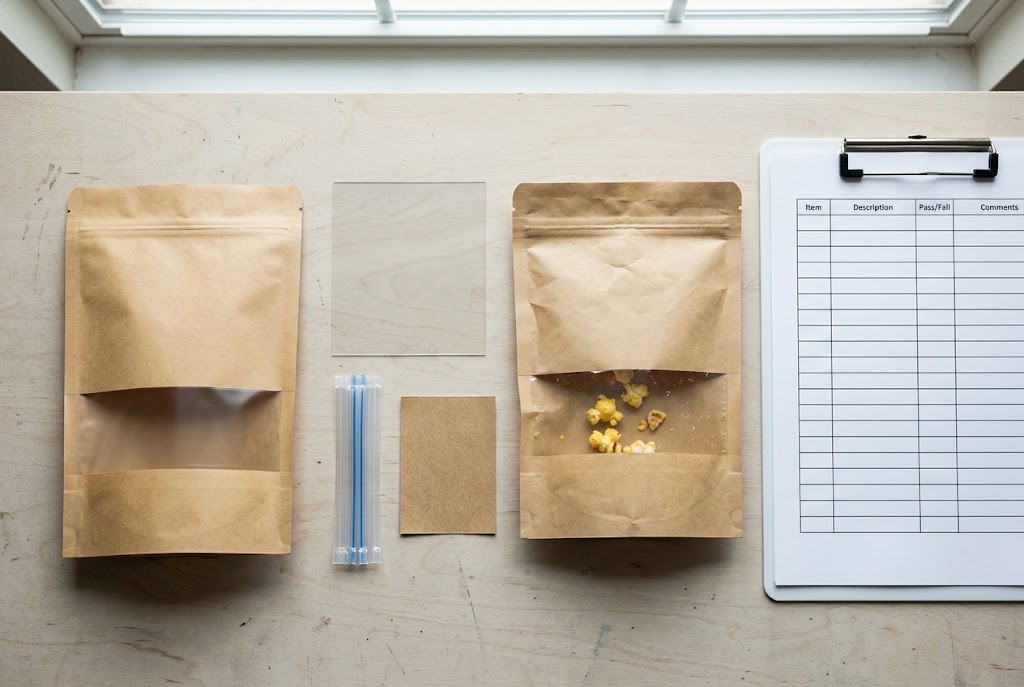
Mylarbag's published U.S. gourmet-popcorn pouch is a matte black, kraft-look windowed stand-up format. Its public key-features field lists MATOPP/kraft paper/PE and gravure printing; the page also describes a 140-micron construction. That is enough to show why the word “paper” on the front is incomplete. A customer needs to know the entire laminate, clear window, inks, adhesive and closure before discussing an end-of-life route.
The product page does not identify a local recycling program for the pack or provide a certification of the exact finished item as compostable. Its protective and branding language is not a disposal instruction. It would be unsound to call this case “recyclable with paper” or “compostable kraft” from appearance or a short material field. Use it to ask more precise questions of the converter and the collection partner.

This case also demonstrates a trade-off. The window can help a shopper inspect the product, while an additional material region complicates the evidence needed for a simple disposal claim. That is an engineering question, not a reason to remove every window. Ask what the brand values, what the pack needs to protect, and what a qualified end-of-life route can realistically take. A layer-by-layer material specification is the starting point; the decision here is about the post-use system.
Write a Claim That Matches the Sales Geography
A packaging supplier can propose a mono-material construction or a compostable candidate. The brand still needs the exact evidence and a claim suitable for the markets where the finished popcorn is sold. It should identify the claim's subject: the whole pouch, film panel, removable label, or another component. An unqualified symbol on the front may imply that the entire pack can use a common route. If only a component qualifies, say which one and how a person can actually separate it.
| Draft statement | Question before approval | More responsible direction |
|---|---|---|
| “100% recyclable popcorn bag” | Is every component compatible and is collection available where sold? | State the supported material and route, with applicable regional qualification |
| “Compostable” | Was the full printed and zipped item certified for the intended setting? | Specify commercial or home context only when evidence supports it and access is real |
| “Paper bag” | Does the contact and window structure include polymer layers? | Describe the actual construction without implying paper-stream acceptance |
| “Biodegradable” | Under which conditions, timeframe and evidence? | Avoid a broad claim without a substantiated, relevant disposal context |
| “Check locally” | Is there a plausible qualifying route at all? | Give the exact material and component instruction, then direct the consumer to the receiving program |
Do not use “check locally” as camouflage for a claim that has no evidence. If a bag is not known to be accepted, the label should not imply certainty through a bright recycling icon and a tiny disclaimer elsewhere. Coordinate with the brand's legal and environmental-claims reviewers in the destination market. The FTC guidance is a useful U.S. starting point, not a universal license to print a symbol.

Supplier and collection-partner checklist
Ask the supplier for the exact layer schedule, component list, pouch revision, inks and adhesives, window and zipper specifications, test or certification records for the complete item, and change-control process. Ask the collector for its written accepted-material list, contamination and preparation rules, geographic service coverage, and whether the program accepts printed flexible pouches with these components. If the answer is “only clean PE shopping bags,” do not assume an oily multilayer popcorn pouch qualifies.
Keep approval evidence with the artwork revision. If a window is enlarged, an adhesive changes, or a compostability certificate expires, revisit the claim before the next print order. A claim that was defensible for a controlled local pilot can become inappropriate when the brand enters a new market without the same collection service.
Audit an instruction across two sales areas
Imagine the same approved pouch will be sold through one retailer with a documented film take-back program and another retailer whose customers have only a curbside cart. The material specification is unchanged, yet the feasible consumer route may differ. Before printing a national instruction, ask both receiving systems whether they accept the exact printed, post-consumer pouch, including its zipper and expected oil residue. Keep the dated answers and any exclusions with the artwork file. If acceptance is limited to selected locations or requires a clean-and-dry condition that users can reasonably meet, the instruction needs that qualification and a way to find participating sites.
Now suppose the brand removes the zipper to improve compatibility but keeps a paper-look layer. That single change does not establish film-bin acceptance; the laminate and window remain to be assessed. Conversely, a bag that is technically compatible with one recycler may still lack accessible collection in the second sales area. Ask separately whether the new structure still meets food quality and seal requirements. Reducing one disposal barrier is useful only when the resulting retail pack remains fit for the popcorn and its distribution route.
For an alternative package discussion, the popcorn packaging bag page shows available format families. Use a sample brief that includes product quality, food-contact suitability, closure, collection evidence and intended sales geography. A disposal improvement that causes high product loss or sealing rejects needs a whole-system review rather than a single favorable icon.
Frequently Asked Questions
Can popcorn bags be recycled?
Some may have an appropriate route, but there is no universal yes. Identify the exact pouch structure and components, remove product as required, then check a local program's accepted-material and cleanliness rules. A package designed around one polymer is only a candidate until the collection route for that used item is confirmed.
Can popcorn bags be composted?
Only if the exact finished bag is suitable for the claimed composting environment and the receiving program accepts it. Paper appearance and biobased content do not prove compostability. Check evidence for film, window, zipper, print and adhesive together; distinguish industrial from home conditions and confirm local access.
Are kraft popcorn pouches paper recyclable?
Not necessarily. “Kraft” may describe an exterior layer or a paper-like print, while the pouch can include a polymer sealant and clear window. Ask for a layer schedule and check the paper program's specific acceptance rules. Do not put a paper-recycling instruction on a laminate based on its brown color.
Are clear plastic popcorn bags recyclable?
Transparency does not identify the resin or the local route. A clear bag might use several layers or a coating, and a zipper or label can affect assessment. Obtain the exact construction and ask the collection partner about flexible film and post-use condition. Do not assume curbside acceptance from appearance.
Can I put a popcorn pouch in a grocery-store film bin?
Only if that bin's program accepts the exact material and condition. Store take-back programs often specify allowed film types and cleanliness. A greasy, metallized, paper-laminated or otherwise incompatible pouch may be excluded. Read the program's posted instructions or ask its operator before directing consumers there.
Does a recycling triangle mean the whole bag is recyclable?
No. A resin identification or graphic mark can describe a material without showing that the full printed pouch, zipper, window and residue can be collected and processed locally. Match any claim to the entire item and the collection geography. Do not treat a logo alone as a substitute for supplier documentation and program acceptance.
Are metallized popcorn bags recyclable?
Do not assume a common flexible-film route. Metallized plastic and foil-containing laminates have different structures, and local programs vary. Ask for the exact construction and written acceptance by a program that will receive the used bag. A shiny appearance does not tell you which structure it is.
Is an industrially compostable pouch home compostable?
No such inference should be made. Industrial composting uses different conditions and an industrial specification does not automatically cover a home pile. Check the exact item's certification and scope, and then confirm whether the intended facility accepts it. Any home-compost claim needs its own relevant evidence.
Does food residue matter for recycling?
Yes, collection programs can set preparation and cleanliness rules. Popcorn oil, seasoning and crumbs may matter even when the bag's polymer family is otherwise suitable. Follow the receiving program's instruction rather than a generic internet rule. If the bag cannot realistically be prepared or collected as required, qualify or omit the claim.
Can a compostable bag go in a plastic recycling bin?
Do not direct it there without an explicit program rule. A commercially compostable plastic can be a different material from the films a recycler accepts. The correct route is the one specified for the exact certified item by a receiving composter or other program. Clear consumer instructions reduce mis-sorting.
What evidence should a brand request before printing “compostable”?
Request current documentation for the finished commercial SKU, including print, window, zipper, adhesive and material revisions; verify the stated industrial or home scope with the certifier; and check realistic facility access in the sales area. Have the final wording reviewed for the destination market. A certificate for a raw resin alone is not the whole-pack claim file.
Does a paper serving bag have the same answer as a sealed retail pouch?
No. Their structures, food residue and disposal programs can differ. An open serving bag may be a simple or treated paper article, while a sealed retail pouch often has multiple functional layers. Verify each one separately. This guide focuses on the sealed pouch used for already-popped popcorn, with serving bags only as a comparison.