
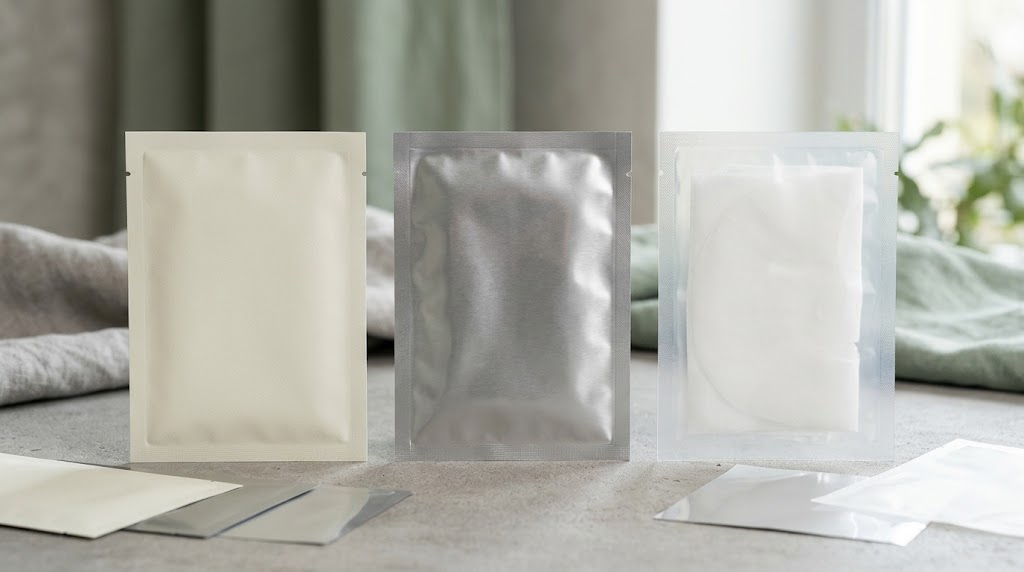
An opaque sachet and a transparent sachet can both hold a wet facial mask. Their different looks tell you little about how either one will behave with a particular serum. The outside film may carry the print, another layer may supply a barrier, and the inside layer has to contact the formula and form a dependable seal. A window, notch or weak corner can change the finished package even when the flat-film report looks impressive.
The short answer: choose sheet mask packaging materials from the actual product brief. Identify the complete laminate and its contact surface; compare oxygen and water-vapor data only under stated test conditions; trial the real serum against the final pouch construction; then evaluate seals and filled packs after handling and storage. A film data sheet is a screening input, not a ready-made approval of a wet cosmetic or its expiry date.
This guide is about single-use, serum-containing cosmetic sheet or hydrogel masks. It is not about protective face masks, nor a universal recipe for every lotion, powder or refill. Brands planning face mask packaging can use it to prepare a material brief and ask suppliers for evidence that matches the intended product.
Begin With the Serum and the Finished-Pack Job
“Wet mask” is not a material specification. One SKU may contain a water-rich serum with a fragrance; another may contain oils or ingredients the formulation team considers sensitive to light or oxygen. The mask substrate, backing, fold and target liquid dose also affect how the pouch flexes and where liquid collects. The package may sit in a retail carton or travel directly through parcel distribution. These details determine which material properties are worth measuring.
List potential failure endpoints before choosing a film. They may include visible liquid loss, a change in odor or appearance, a shifted fill amount, a weakened seal, delamination, a changed mask texture, or a formula-specific stability or microbiological result. The formulation owner decides which endpoints matter and how to measure them. Moisture loss and oxygen exposure are possible concerns, but it is a mistake to declare either one the limiting cause without product evidence.
| Brief question | Why it changes material selection | Evidence to request or plan |
|---|---|---|
| What exactly contacts the pouch? | The serum, wet sheet and any backing may touch the inner surface differently | Full formula or appropriate compatibility sample, contact-layer identity and exposure plan |
| Is the product sensitive to light? | A clear display choice and an opaque structure are different design routes | Product-specific light stability and the proposed pack's optical properties |
| What storage period and conditions are being evaluated? | Film transmission changes with test conditions; product stability has more than one endpoint | Target conditions, retained-pack plan and agreed acceptance criteria |
| How is the unit filled and sealed? | Contact layer and top-seal window must run with the real process | Pouch or rollstock form, sealing equipment and filled-trial samples |
| Where will the pack travel? | Folds, edges and pressure may challenge a finished bag | Carton layout and representative route exposure |
| Is there a window, hang hole or unusual shape? | The final pack includes more than a flat unmodified film panel | Complete drawing and a converted-pouch evaluation |
Do not begin by asking a supplier for “the highest barrier” at any price. The best candidate must also tolerate filling, maintain its converted seams, meet the consumer opening brief and suit the formula. A thick or opaque structure that cannot be sealed consistently on the chosen line is a poor choice. So is a beautiful clear sachet whose final package has never been studied under the intended storage conditions.
Read the Whole Laminate, Including Its Contact Surface
A typical printed flexible pouch can contain an outer print-support layer, an adhesive or other joining system, a functional barrier layer where needed, and an inner contact and heat-seal layer. The exact construction must be confirmed from the supplier's specification. Some structures combine functions in one layer; others add coatings or a window. An abbreviation such as PET/AL/PE names material families but does not give every layer's grade, thickness, adhesive, processing history or suitability with a particular serum.
| Element to identify | Its likely job | What the shorthand leaves open |
|---|---|---|
| Outer web | Carries graphics and contributes handling stiffness | Ink system, coatings, print orientation and scuff performance |
| Lamination interface | Joins webs into the intended structure | Adhesive type, cure state and bond behavior after serum contact or flexing |
| Barrier component, if present | Changes transmission of selected gases, vapor or light | Actual measured transmission, defects and performance after converting |
| Inner web or coating | Contacts the cosmetic and usually participates in heat sealing | Specific grade, formula compatibility and seal window on the intended machine |
| Added feature | Window, notch, hang hole or shaped edge serves display or opening | How the finished pack and nearby seals behave with the feature |
Only the final structure can be assessed as the final structure. If a report covers a base film before printing, adding a coating, changing the adhesive or cutting a window, it does not automatically describe the revised bag. Ask the supplier to give each trial structure a version identifier and keep that identifier on samples and reports.
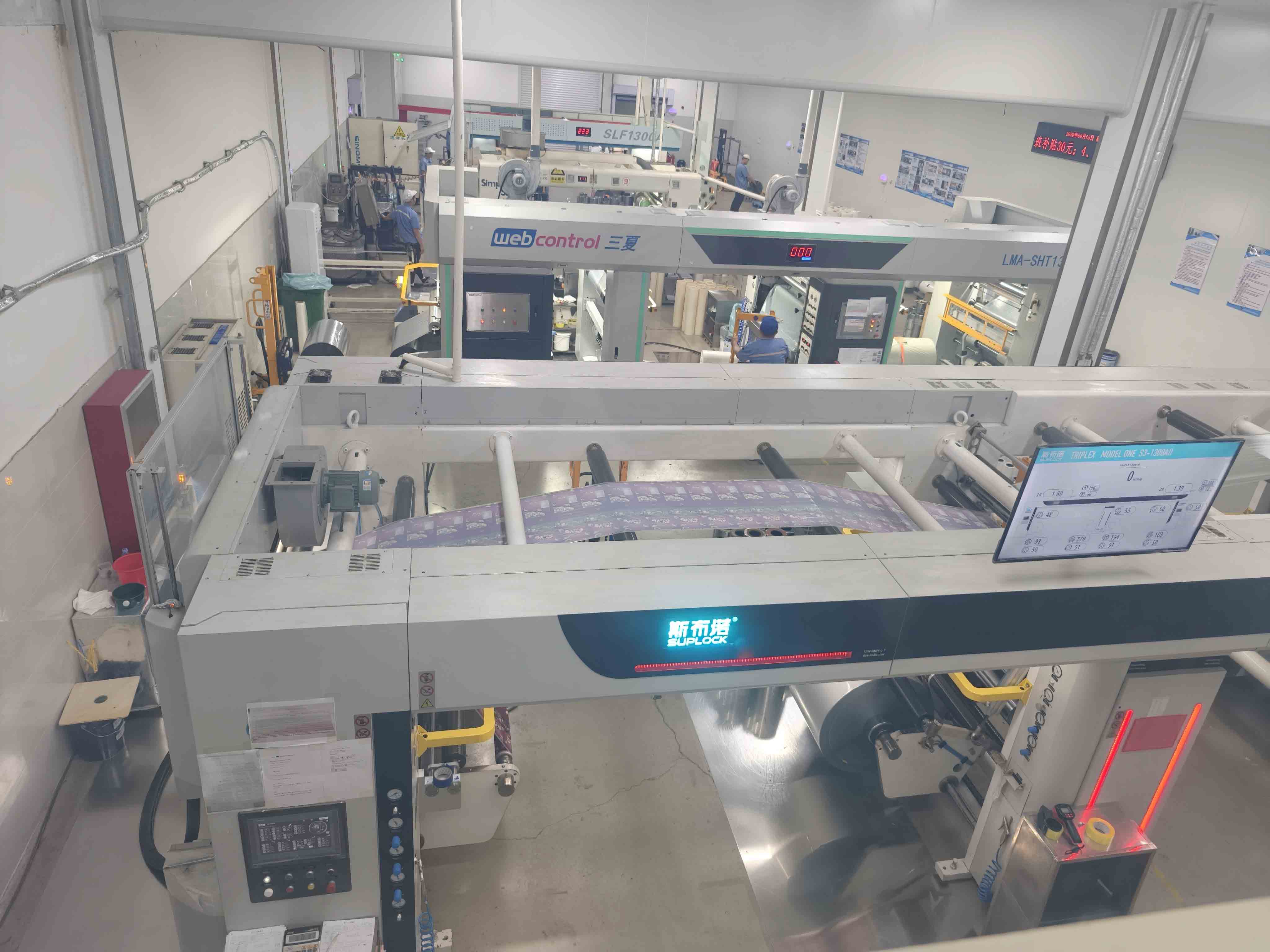
Why converting and curing belong in the discussion
Printed, joined film still has to become pouches. Slitting, folding, cutting a notch and heat-sealing edges can expose a structure to stresses absent from a flat test specimen. The top seal is made later by the filler after the wet product enters. A material may therefore pass a film screening step and still need significant work at the empty-pouch and filled-pouch stages.
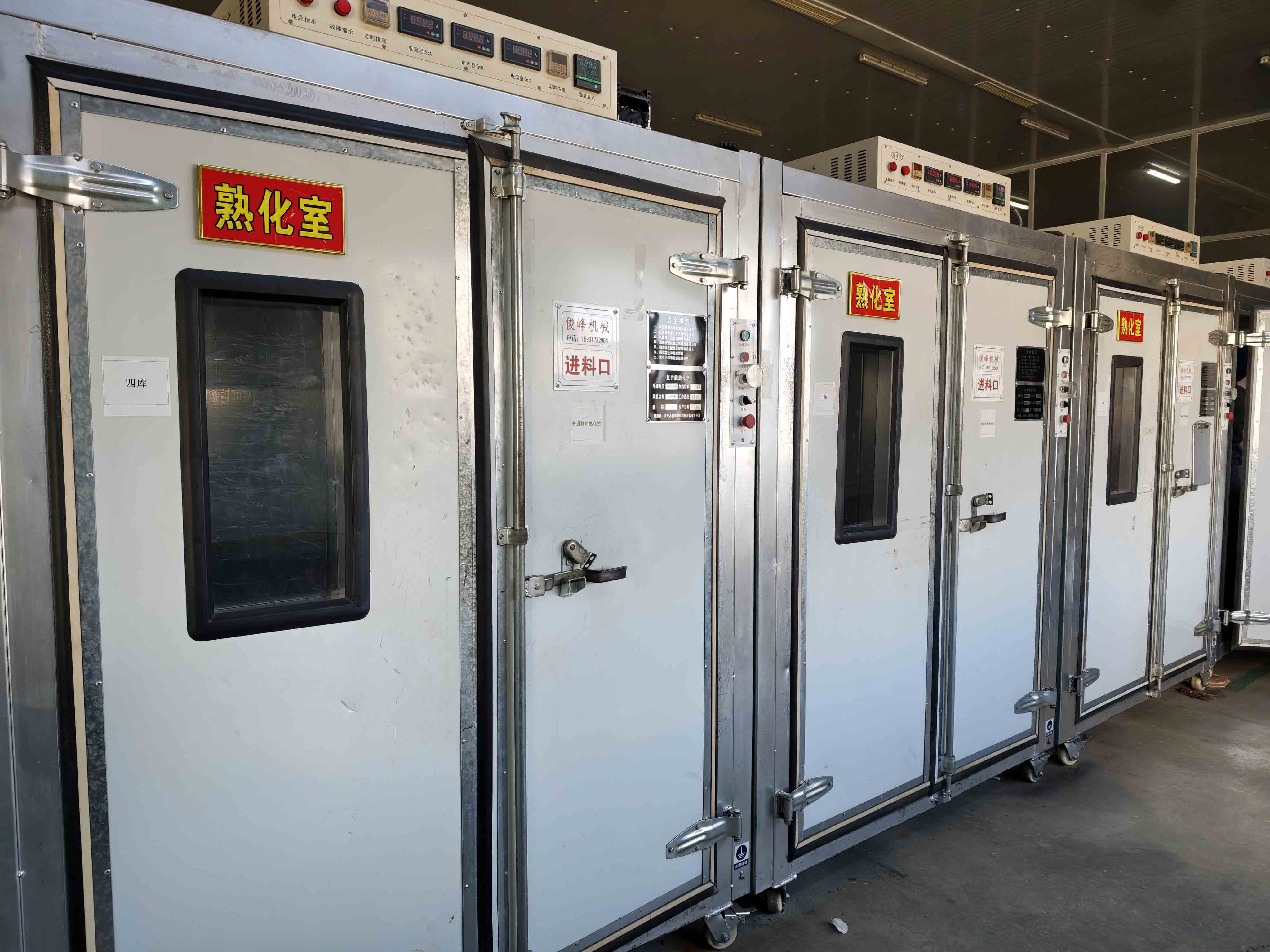
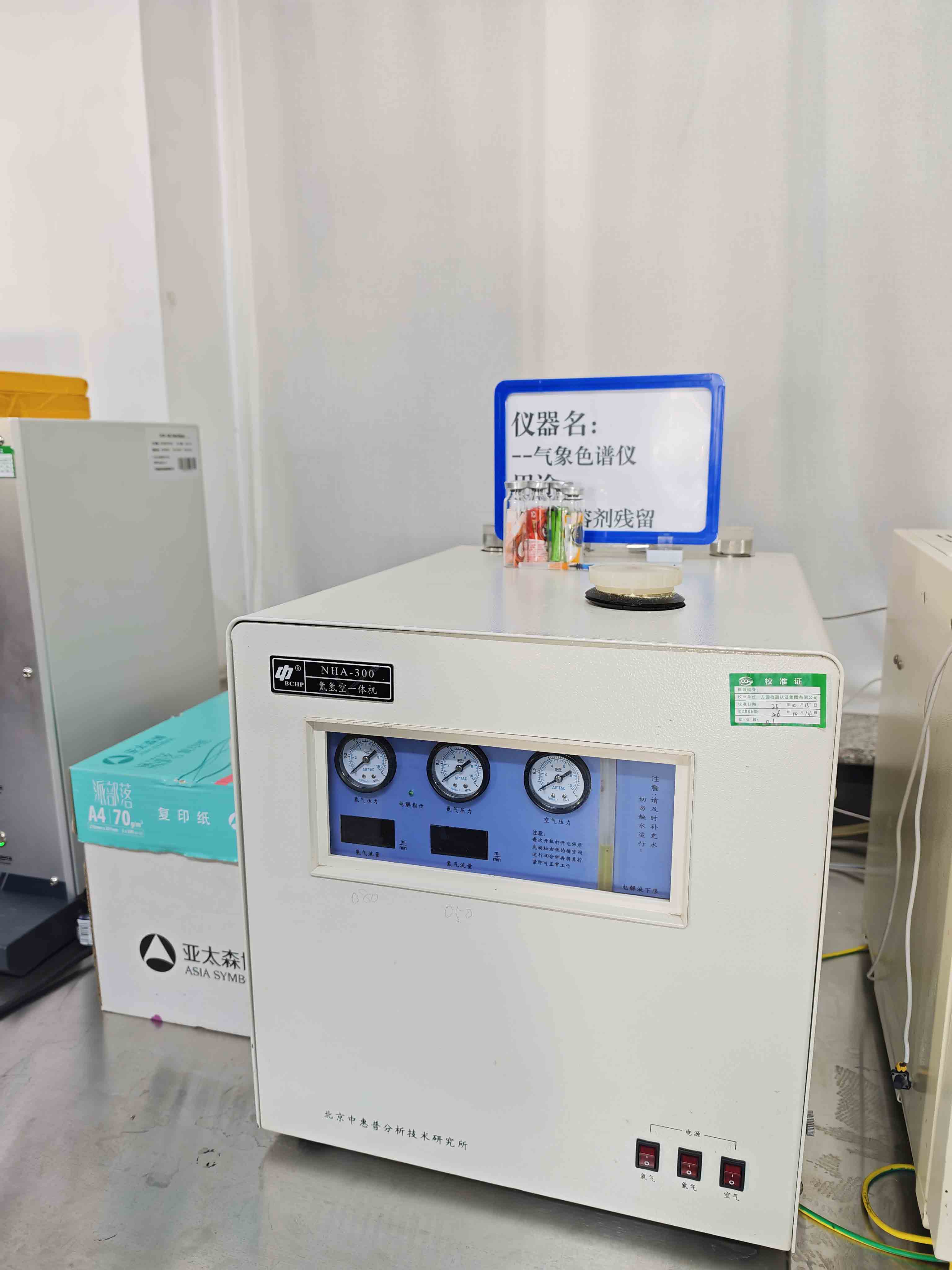
Where an adhesive laminate needs controlled curing, the supplier should define its release and sampling criteria for the specific system. Do not infer cure time from a photograph or assume that every solvent-free and solvent-based process has identical requirements. If the formulation team has concerns about odor, extractables or possible transfer, ask for relevant documentation and design a suitable review of the final material. The presence of a laboratory instrument does not itself establish compatibility.
Compare Candidate Families Without Ranking Their Names
The terms “clear,” “metallized,” “foil” and “mono-material” identify broad approaches, not interchangeable test results. They also say nothing by themselves about which side faces the serum. Request real constructions, not samples selected only for appearance.
| Candidate family | Reason to consider it | Questions before approval |
|---|---|---|
| Clear polymer laminate or coated clear film | Visibility of a mask or a particular retail design | Does the formula need light protection? What do the specified oxygen and water-vapor results and filled-pack observations show? |
| Metallized-film laminate | An opaque or reflective appearance with a deposited metal layer | Which metallized web, coating, sealant and test conditions were used? What happens after the actual pouch is converted and handled? |
| Aluminum-foil-containing laminate | An opaque construction considered when demanding barrier or light-screening needs are documented | What is the full structure and condition of the foil after making and handling the pouch? Do the seals, folds and corners remain acceptable? |
| Predominantly one-polymer construction | A possible route to a simpler material family when performance and local recovery goals both matter | Are coatings, adhesives, print, contact and seal properties suitable, and does any real collection system accept the finished used pack? |
A shiny silver surface does not identify a continuous aluminum-foil layer. A metallized polymer and a separate foil layer are different constructions. The word “Mylar” on a quote is not a substitute for a layer-by-layer description. Likewise, “food grade” or “cosmetic grade” written in marketing copy is not a finished-pack compatibility study. Ask what specification and actual evidence the terms refer to.
Transparent options need care with light-related claims; opaque options need care with unmeasured claims of perfect protection. The correct comparison is a set of candidate structures against a defined product and test plan. For a formula that is visibly affected by light in development, an opaque candidate might be prioritized for trial. For a product whose presentation requires visibility, a clear candidate might be trialed with a suitable stability plan. Neither choice makes a promised shelf life by itself.
A window and a notch are part of the material decision
If a sachet has a clear window, record the window material, its size and position, and every interface introduced by the design. A barrier result from an opaque panel cannot simply be assigned to the transparent area. If the notch moves closer to a functional seal or a fold, check opening and integrity on real filled units. A hang hole belongs in a nonfunctional area with adequate material around it; its position should be approved on a drawing and on a converted sample.
Think in terms of the route a liquid could take out of the pouch and the route oxygen, water vapor or light could take in or out. Flat panel transmission addresses only part of that picture. Seal edges, fitments, damage and a different window are separate paths. That is why the product team should examine both coupon data and final converted samples.
Read OTR and WVTR Reports as Measurements, Not Promises
Oxygen transmission rate, or OTR, is a measured rate through the tested material under specified conditions. Water-vapor transmission rate, or WVTR, is another measured rate under its own test conditions. They address different transport processes. Neither is a direct leak test, a light-transmission result or a cosmetic preservation study.
The official scope for ASTM D3985-24 covers measurement of oxygen transmission through specified plastic films, laminates and related sheet materials using a coulometric sensor. ASTM itself notes that OTR is not the sole determinant of package protection and that other tests are needed to relate it to performance. ASTM F1249-25 covers measurement of water-vapor transmission through applicable flexible barrier sheet and film materials using a modulated infrared sensor; its page calls for agreed sampling, test conditions and acceptance criteria when data are used between buyer and seller.
Ask for the report, not just the smallest number on a brochure. At minimum, record the following for each candidate:
- The exact film or laminate identifier, layer sequence, thickness where provided, batch and whether the sample was printed, coated, cured or converted.
- The standard or other method, its edition, specimen preparation and the laboratory's reported units.
- Test temperature, humidity and applicable gas or vapor conditions. A result without conditions cannot be compared fairly to one measured under a different set.
- Number of specimens, range or variability where reported, detection or quantitation limit when relevant, and the date of testing.
- The buyer's intended acceptance criterion and why that criterion is linked to the actual cosmetic product rather than borrowed from an unrelated food or powder.
Do not add a less-than sign to a laboratory's detection limit and call it “zero transmission.” A result below a method's reporting limit is a bounded measurement under that method, not proof that no molecule can pass through an entire commercial pouch. Do not compare one supplier's value on an unfinished film with another supplier's value on a completed laminate and announce a winner.

A report-reading example without invented numbers
Imagine two proposed laminates. The first supplier submits an OTR result for a plain web, while the second submits an OTR result for its printed and laminated film under another set of conditions. The figures cannot be placed in a simple ranking table until the team understands specimen construction, method and conditions. Even if both reports are comparable, a better flat-film result may not be decisive if one converted sachet has an unsuitable seal or a window outside the tested specimen.
For a water-rich serum, WVTR may be relevant to changes in fill amount or concentration, but measured transmission through a film does not say how a particular formula will behave. Initial fill, exposed pouch area, seals, temperature and storage period also matter. Work backward from a product endpoint the formulation team can observe. That is more useful than picking the lowest published rate with no acceptance basis.
Keep optical and mechanical properties in separate columns. A formula's light sensitivity calls for product testing and a way to assess the proposed pack's light exposure; neither OTR nor WVTR measures that. A mask folded tightly against a sharp edge may need additional evaluation of pouch damage after handling. These checks are not contradictions of a good film report; they are different questions.
Use the Real Serum to Challenge Contact and Bonding
The inner surface sees more than water. A formula may include ingredients that affect its interaction with a polymer or with the finished laminate over time. The formulation and safety teams should decide which changes matter for the product: odor, color, visible haze, tackiness, swelling, delamination, changes in serum appearance, loss of a sensitive ingredient, or another analytical endpoint. Do not label an interaction a failure until it is assessed against a defined acceptance criterion and suitable control.
Request the supplier's intended contact layer and supporting information for the exact construction. Ask whether inks, adhesives or coatings could come into contact with the formula through the design or process, including reverse print, roll storage, cut edges and a seal made on the final line. Those questions call for technical review, not a claim that every layer automatically migrates. If targeted analytical work is needed, the responsible specialists should select the analytes, conditions and laboratory methods for the product.
The FDA's cosmetic GMP inspection checklist treats the container and primary packaging as part of cosmetic manufacturing control. It asks whether primary packaging is handled to avoid contamination and whether finished products and retained samples meet specifications. The FDA's microbiological safety page lists inadequate protective packaging among possible contributors to contamination. These sources establish why packaging belongs in the quality plan; they do not certify a particular layer or replace an appropriate preservation system.
Make the contact trial comparable
Use the same formulation lot when comparing candidate constructions if practical. Make filled samples with the intended mask substrate and both normal and relevant boundary fill conditions. Keep a clearly identified reference or control chosen by the formulation team. Record the exposure schedule, orientation, light and temperature conditions, and the version of every pouch. Photograph and weigh units when those observations relate to the endpoint, and use the laboratory checks the product team considers necessary.
| Observation | Question it helps answer | Limitation |
|---|---|---|
| Inner-film appearance and feel after exposure | Did the surface visibly change? | Appearance cannot identify every chemical interaction |
| Bond condition at interfaces | Did the laminate remain joined under the selected exposure? | A short exposure cannot establish years of performance |
| Serum odor, color and other selected attributes | Did the product change relative to the defined control? | A difference needs root-cause work; the pouch may not be the cause |
| Seal appearance and strength after contact | Did the intended seal remain usable? | Strength alone does not prove no liquid escape |
| Complete-pouch mass and liquid containment | Did the filled unit retain contents under the selected conditions? | No single condition represents every storage and transit route |
A changed formula, fragrance, filling process or supplier layer can invalidate a prior contact assessment. Record the material revision on the retained units so a later complaint can be traced. The final approved construction should match the trialed one, not merely share a marketing name with it.
Seal Tests and Leak Tests Answer Different Questions
The pouch maker can evaluate converted side and bottom seals; the filler makes the final top seal on a wet product. Both need to be reviewed on the final structure. A contact layer that seals well in an empty laboratory strip may behave differently when serum splashes onto the working seal land. The filled-product trial must check whether the line can keep that land clear and produce a consistent closure.
ASTM F88/F88M-23 describes a method for measuring seal strength in flexible barrier materials. It can support process comparison and control when the test setup, sample locations and criteria are defined. The standard's public description also makes clear that a strip measurement does not reproduce every aspect of a person opening an entire package. It is not a direct search for every channel, puncture or leak in a filled sachet.
For a mask pack, combine appropriate seal-strength information with inspection of the complete perimeter, a filled-pouch leak challenge suited to the design, and a consumer-opening trial. The formulation team also needs its product-specific stability and safety observations. Avoid a universal sealing temperature or universal minimum force: film sealants, jaw geometry, dwell, pressure, equipment and intended opening all influence an appropriate window.
| Evidence level | Typical sample | What it supports | Who should own the result |
|---|---|---|---|
| Flat film | Defined laminate coupon | OTR, WVTR or other material screening under stated conditions | Material supplier and evaluating brand team |
| Empty converted pouch | Production-representative bag | Dimensions, window, notch, side/bottom seal and visual defects | Pouch supplier, with brand approval criteria |
| Filled and finally sealed sachet | Actual mask and serum on intended line | Top seal, contact, liquid containment and opening | Filler and cosmetic brand, with pouch supplier support |
| Shipped and retained product | Final retail and outer package | Route damage, ongoing product and pouch condition | Cosmetic brand and its quality partners |
The table is a handoff map, not a regulatory testing schedule. The brand decides which stages and acceptance criteria fit its product and target market. If the filled sachet leaks, locate the defect before assigning it to the laminate's panel barrier: a top-seal channel, damaged side seam, puncture and fitment problem call for different corrections.
Two Real Cosmetic Pouches Show Why the Specification Matters
Published case pages for other skincare packaging pouches can help a buyer learn which fields to request. They cannot be turned into head-to-head laboratory evidence when the products, pouch shapes and tests differ.
| Public adjacent case | Fields the page identifies | Why it does not settle a sheet-mask choice |
|---|---|---|
| Philippines cosmetic and soap pouch | PET/AL/PE, three-side-seal format, zipper, gravure printing and Spot UV | The published project concerns cosmetic/soap packaging, not a validated wet single-mask fill. The zipper serves a different use pattern. |
| Philippines 30 g skincare cream pouch | MOPP/VMPET/PE, round die-cut spout format and gravure printing | The formula is a cream and the spout is a reclosable dispensing feature. No comparable serum-contact or flat-sachet test data are published. |
The first structure names an aluminum-foil layer; the second names a metallized PET layer. That difference is useful for writing a request for samples. It does not rank their performance in a wet sheet-mask sachet. Their geometry, contents, openings and unpublished test conditions differ. Neither page documents a wet sheet-mask customer project or supplies matched OTR, WVTR, leak or storage results for this use.
Notice what the public fields omit: the exact proposed mask serum, the inner-layer grade, test conditions, converted corner and top-seal results, and a product-specific retention study. Request those items for a new project rather than repeating absolute marketing statements from an unrelated product page. A single-use mask does not acquire a zipper or spout simply because one of these real adjacent pouches has one.
Build a Version-Controlled Material Approval File
The fastest useful supplier conversation has a narrow purpose: decide which constructions merit filled-product trials. Ask for two or three documented candidates with the same intended pouch size and seal layout when possible. A sample of each should be tied to a technical description, not shipped as three anonymous silver bags.
Send the pouch supplier:
- The actual mask type and fold, serum information appropriate for a compatibility review, target fill and the intended filler equipment.
- The desired pouch format, opening, print, window or no-window decision, and any carton or shipping constraints.
- The product team's proposed storage study and any known concerns about light, odor, liquid loss or seal contamination.
- The destination market and the person responsible for cosmetic safety and labeling decisions.
Request back for each candidate:
- A complete layer and feature description with version, inner contact/seal material, available thickness information and sample lot.
- Relevant OTR and WVTR reports with method, conditions, units, specimen identity and test date, where those properties matter to the product brief.
- Empty-pouch drawings and samples; the proposed sealing information as a starting point for the filler's validation.
- Documents supporting claims about the supplied construction, with clear distinctions between a raw film, an empty pouch and a finished cosmetic.
Agree with the brand and filler on the decision gate: fit and clean sealing first, then formula contact and filled-pack integrity under intended conditions, then the product-specific storage study. A supplier can help revise a laminate or seam if the trial fails. The brand should not approve a new date, recyclable claim or safety statement merely because a film data sheet looks promising.
If you are ready to compare constructions, share that brief through Mylarbag's face mask packaging page. Its plastic film and barrier-layer pages show material families to discuss. Ask for identified samples and evidence for the particular wet cosmetic, then let the final filled-product results decide.
Frequently Asked Questions
Is “Mylar” the same thing as aluminum foil?
No material nickname tells you a complete sachet construction. Ask for the exact outer, barrier, adhesive or coating, and inner contact/seal layers. A silver look may come from different constructions. A quote that says only “Mylar bag” cannot tell the formulation team what touches the serum or which report applies to the final pouch. Use a layer-by-layer version code before comparing samples.
Is a metallized film always weaker than an aluminum-foil laminate?
That is not a useful blanket ranking. They are different candidate structures, and the required protection depends on the product. Ask for reports measured under comparable conditions and inspect converted, filled pouches. A foil-containing panel may be relevant when light protection is important, but a panel result does not erase the need to examine folds, seals, windows and handling. Do not infer a particular mask's stability from the material name alone.
Can we use a clear window to show the folded sheet?
Possibly, if the brand needs visibility and the final design meets its product requirements. Treat the transparent area and its interfaces as part of the package, not a hole in the review plan. Record its material and position, assess light-related concerns with the formula, and check filled-pack integrity after handling. A report for the opaque panel cannot stand in for the entire windowed sachet.
Does “FDA approved” or “food grade” mean a sachet is approved for our serum?
Do not treat either phrase as a substitute for a precise document and intended use. The FDA explains that, apart from color additives, cosmetic products and ingredients generally do not receive premarket approval, while firms remain responsible for cosmetic safety. A supplier's food-contact documentation, if relevant to a component, still does not by itself establish compatibility with this cosmetic formulation or approval of the finished product. Ask what material and jurisdiction each document covers, then have the cosmetic safety team review the actual pack and formula.
If OTR and WVTR are low, can we claim a longer expiry date?
No date follows automatically from those film measurements. They do not measure microbiological preservation, formula changes, damage at a converted edge, liquid leakage or performance of the final top seal. Use them to screen materials, then study the finished cosmetic in its production-representative pouch across the proposed storage period. Any claimed date belongs to that complete evidence package and the responsible brand.
What is the difference between seal strength and leak resistance?
Seal-strength testing measures the force needed to separate a sampled seal under a defined method. Leak evaluation challenges the closed package for an escape path under specified conditions. A seal can produce a strong strip result while another part of the pouch has a channel or puncture. Conversely, a pack that passes one leak challenge still needs acceptable opening behavior and performance in its actual route. Specify both questions where the product requires them.
Is a mono-material sheet-mask sachet automatically recyclable?
No. “Mono-material” is a structural direction, not proof that a used, serum-wet small pouch is accepted by local collection and sorting. Coatings, closures, labels, residues and market-specific infrastructure matter. First establish that the candidate protects and contains the cosmetic; then check the exact finished pack against an actual recovery route and support any consumer-facing claim. The disposal guide in this series will examine that decision in detail once written and published.
When should we repeat a material trial?
Review a change whenever it could alter contact, barrier, sealing or filled-pack handling. Examples include a new serum or fragrance, mask substrate or backing, inner-layer grade, adhesive, coating, foil or metallized web, window, pouch geometry, print process, filling equipment or shipping carton. A documented change assessment may show that some evidence remains relevant; it should not silently transfer every old result to a new version.
Choose Evidence That Matches the Sachet on the Shelf
A good material discussion ends with named samples and decisions the team can reproduce. Know the full structure. Read film reports under their stated conditions. Challenge the actual serum against the contact surface. Check the empty pouch, the finally sealed wet unit and the route it will travel. Only then can the brand decide whether a candidate is ready for a longer product study.
The reward is practical: fewer vague requests for “maximum barrier,” fewer misleading comparisons between unlike films, and a clearer handoff between the pouch maker, filler and cosmetic quality team. Start with an identified sheet mask packaging sample, and approve the construction only against the product and evidence you really have.
Source notes
- ASTM D3985-24: oxygen gas transmission rate through plastic film and sheeting — method scope and limits of OTR as a sole determinant of package protection.
- ASTM F1249-25: water-vapor transmission rate through flexible barrier materials — method scope and importance of agreed conditions and criteria.
- ASTM F88/F88M-23: seal strength of flexible barrier materials — scope of seal-strength measurement and its limits as an opening simulation.
- FDA: Cosmetic GMP Guidelines/Inspection Checklist — primary packaging, production, testing and record considerations.
- FDA: Microbiological Safety and Cosmetics — responsibility for product safety and potential contamination pathways.