
To ship chocolate-covered strawberries, treat them as a fresh-fruit product in a temperature-controlled distribution system. Start with sound, properly handled berries; let the coating set under your food operation’s procedure; place each berry in an appropriately documented food-contact cup or fitted cavity so the fruit and coating cannot rub against a neighbor; close a rigid retail box; and immobilize that box inside an insulated shipper with conditioned coolant kept separate from the fruit. Select a route and delivery handoff that your packed product has actually passed in a representative trial. A decorative box, a flexible film, or a next-day label alone cannot establish that the berries will arrive in acceptable condition.
This guide is for producers and packaging buyers in the United States planning shipments of fresh strawberries dipped in chocolate. It is not a shelf-life determination, a commercial food-safety plan, or a promise that any given carrier service will keep a specific product safe. The food business is responsible for its ingredient handling, time and temperature criteria, applicable local requirements, labeling, and distribution validation. A packaging supplier can help specify physical components, but cannot infer the condition of an untested food shipment from a package photograph.
Why dipped strawberries need a different shipping plan from chocolate bars
The strawberry remains a highly perishable fruit after it is coated. The chocolate changes the surface appearance and eating experience; it does not turn the interior fruit into a shelf-stable chocolate bar. The FDA’s produce guidance specifically identifies strawberries among perishable produce to keep in a clean refrigerator at 40°F (4°C) or below. That is a useful handling reference for fresh fruit, not a published validation of the temperature, shelf life or shipping duration of every finished chocolate-dipped berry.
The two parts of the product also respond differently to moisture and temperature changes. The berry can bruise, release juice or deteriorate; the shell can chip, soften or show a dull surface. Moving a cold package into warm, humid air may produce condensation. Callebaut’s guidance for chocolate confections discusses condensation and sugar bloom when chocolate is moved from cold storage. Its pure-chocolate storage range must not be adopted as the shipping setpoint for a fresh-fruit product. A fruit producer needs a finished-product procedure and observations from the actual assembly.
A standard chocolate-bar mailing method therefore misses three issues. First, berries are softer and less geometrically uniform than a bar. Second, a box that looks attractive on a counter may allow fruit to roll, touch the lid or strike its neighbor when the parcel changes orientation. Third, keeping a product cold requires more than a high-barrier wrapper: an insulated enclosure, a suitable coolant arrangement, limited transit time and a reliable recipient handoff all matter. The FedEx perishable-shipping guide describes coolant, an insulated container and an outer corrugated box as separate parts of a cold or frozen shipment.
The practical goal is to protect food quality and the product’s validated handling conditions at the same time. A box can prevent crushing without controlling temperature. A gel pack can help manage heat exposure without preventing a loose berry from sliding across a tray. A fast service can reduce exposure without compensating for a long uncooled period before carrier pickup or after delivery. Design and test the complete route rather than optimizing one component in isolation.
Begin with the berries and the food-handling process
Packaging begins before the first berry goes into a cup. Select fruit according to your approved receiving and preparation procedure. Remove visibly damaged or rotten fruit rather than hiding it under a coating. The FDA advises consumers to wash produce under running water before preparation and to dry it with a clean cloth or paper towel; it also notes that washing reduces, but does not eliminate, microorganisms. A commercial operation must use its own applicable food-safety procedures and local regulatory requirements rather than treating a short consumer instruction as its complete processing plan.
Drying matters to the packaging outcome as well as to the dipping process. Visible water on the berry can interfere with a neat coating and can add free moisture to the closed box. Let the finished coating set under the producer’s documented process before placing the fruit against cups, dividers or a lid. Do not close warm, wet or visibly sweating berries in a tight bag simply because the bag is described as “high barrier.” Film may restrain liquid movement in one place while leaving moisture and temperature problems in the finished pack unresolved.
Record the interval between production, cooling, packing and carrier handoff in a trial. A thermometer reading from a storage room does not show what happened to the fruit during decorating, boxing and labeling. Different recipes, berries, toppings and production volumes may change the process. In particular, a topping containing milk, nuts, soy, wheat or another relevant allergen needs a label and cross-contact review appropriate to the real recipe and sales market; see the FDA food-allergy information. Packaging artwork should not be approved from an illustrative photograph.
There is no defensible universal “safe for two days” claim in this article. The usable sale window and any discard rule belong to the producer’s product-specific assessment. A carrier’s scheduled delivery time is not the same thing as a validated shelf life, and a visually attractive berry is not proof that all handling conditions were met.
Choose a food-contact cup or tray and a rigid box
The best packaging for a particular chocolate-covered strawberry is the combination that keeps every berry separated and stationary while the assembled product meets its food-contact and distribution requirements. In many layouts that means a cup or a formed cavity, a rigid paperboard or plastic retail box, and an insulated outer shipper for the actual trip. The precise material, dimensions, spacing and closure cannot be specified from “one dozen berries” alone: berry size, leaf or stem treatment, coating thickness, drizzle, toppings and the number of layers all change the fit.
Use the largest representative berries in a physical fit trial, not only the prettiest average-size berries from a photo shoot. Place them in the proposed cups or cavities and close the lid. Check whether a tall berry or decoration touches the lid, whether the base bears too much weight on one small point, and whether adjacent shells make contact after a gentle handling simulation. A shallow gift box may work for same-day hand delivery but leave too little vertical clearance in a parcel. Conversely, a tall box with large empty spaces can let the entire insert lift or shift unless the insert is retained.
The material that actually touches the fruit or coating requires documentation for that intended food-contact use. In the U.S., the FDA explains that the regulatory status of a food-contact article depends on its individual components and authorized conditions of use. Ask the cup or tray supplier for the applicable material description, contact surface, food types, time and temperature conditions, and a relevant guaranty or supporting documentation where appropriate. The appearance of a glossy window, paper cup or clear liner cannot establish clearance. Also check inks, adhesives or decorations if their placement creates a plausible contact path.
Keep the retail box’s job distinct from the shipper’s job. The box and insert present the berries and reduce direct motion or compression. The insulated enclosure and coolant address route exposure. The corrugated outer case resists handling forces and carries the shipping label. A windowed carton can be useful for presentation, but its window is not a cold-chain system; a perfectly folded lid is not a temperature record.
| Component | What to specify and check | What it cannot prove by itself |
|---|---|---|
| Cup, liner or cavity touching the berry | Intended food-contact use; berry clearance; base support; easy removal without scraping the shell | That the entire dipped product has a particular shelf life |
| Insert and retail box | Count, cavity spacing, vertical clearance, lid fit, resistance to shifting and cold/humidity exposure | That the parcel will stay cold or survive a drop |
| Insulated enclosure | Internal fit around the retail box; closure; material thickness and expected route exposure | A universal temperature hold time without the actual payload and ambient profile |
| Conditioned coolant and separation | Quantity and placement established in a trial; leak resistance; a barrier from the retail food pack | That the berries cannot freeze or condense |
| Corrugated outer case | Fit, void fill, closure and readable carrier label | That scheduled transit equals actual delivery or immediate retrieval |
How to package chocolate-covered strawberries in a box
Lay out a single layer first. Give each berry its own support and enough room that the chocolate shells do not rub. A light cup may help presentation and removal, but it can still slide inside a large cavity; check the assembled unit. If you use a molded insert, verify that it cannot jump out of the carton when the box is tipped. If you use a loose paper pad or absorbent element, ask whether it is intended to touch food and whether it could stick to a moist berry. Do not assume that a generic tissue paper, colored shred or decorative confetti is suitable for direct contact.
Close the lid and examine it from the side without forcing it down. A raised topper or leafy crown may become the highest point. If the lid presses on that feature, vibration can transfer the load into the berry or break the chocolate. A transparent lid also reveals smearing quickly, which is useful for inspection but not a substitute for sufficient clearance. Photograph the accepted sample from the top and side with a ruler in frame; keep the dimensions in your internal specification rather than claiming a common catalog size fits every batch.
If a two-layer presentation is proposed, validate both layers as an assembly. A sheet between layers does not automatically carry the upper layer’s weight. The lower strawberries may be crushed by a pad or tray that bears on their decoration. A first shipping program is easier to diagnose with a single layer because the location of movement, impact or moisture is more visible at receipt.
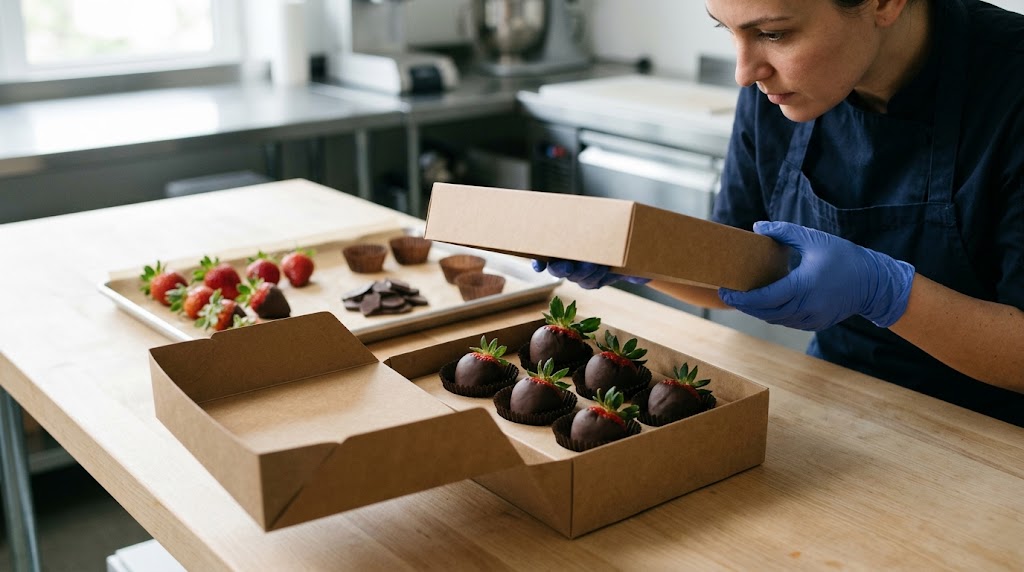
Build the insulated shipment around the retail box
Use the packed berry box as the payload when sizing the insulated shipper. Put the box in a configuration that keeps it level as much as practical, but assume the parcel may be handled in different orientations. The FedEx guide tells shippers to pack for orientation changes and separately describes an insulated container, coolant, outer box, optional liner and absorbent materials. Those are carrier packing examples; the shipper remains responsible for the food product and the actual configuration.
The coolant needs its own space. Gel packs are commonly used for chilled perishables; FedEx distinguishes them from dry ice used to keep items frozen and specifies extra rules for dry ice. For fresh dipped berries, do not assume that more cold is always better. Direct contact between a frozen pack and a thin retail box may produce local overcooling, wet surfaces or a damaged coating, while too little coolant or excessive air space may let the product warm on a hot route. Place a physical separation layer as called for by your trial design, protect against coolant leakage, and verify the result with the real load.
An absorbent or protective liner may help manage incidental liquid in the shipping enclosure, but keep its purpose clear. It does not “dry out” a wet strawberry, sanitize a box or validate food contact. If condensate forms within the retail pack, changing a pad in the outer shipper will not solve the underlying product or thermal-transition problem. The first response is to locate where the moisture appeared and when: on the outside of the coolant, the insulation, the retail box window, or the berries themselves.
Fit the insulated container snugly inside a corrugated outer box, filling excessive voids as appropriate. Use the carrier’s current closure and labeling instructions for the chosen service. A “perishable” notice can help identify the shipment but does not force a driver to refrigerate it. When comparing a ready-made cold shipper with a custom-size solution, measure the assembled payload plus separation, coolant and insulation, not the empty retail box alone.
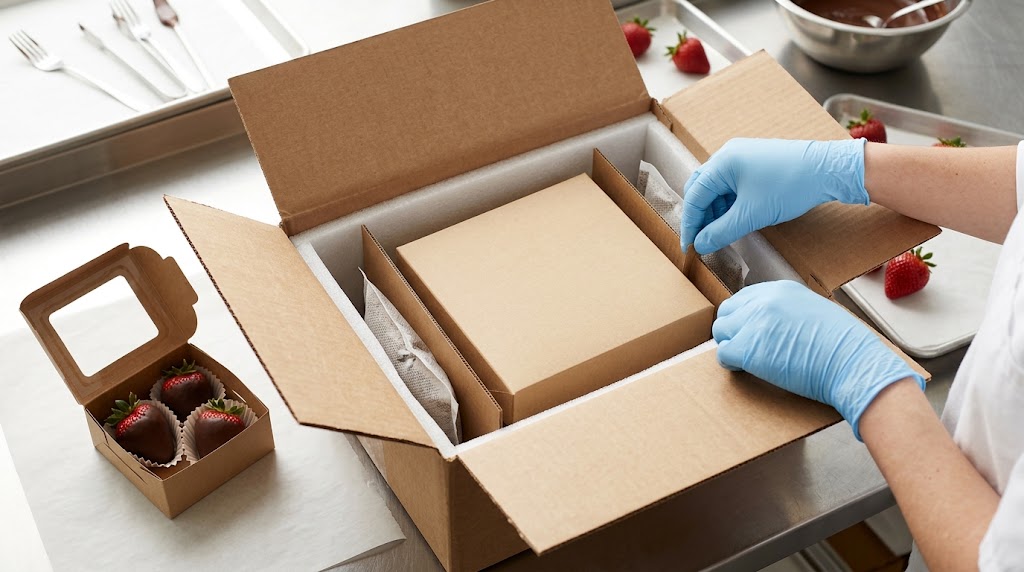
Control condensation without using a bag as a shortcut
Temperature transitions deserve a specific trial. A cold box opened immediately in warm, humid air may develop visible moisture on the chocolate or the inner lid. A berry can also release juice for reasons unrelated to external condensation. Those observations call for different corrections. Record where droplets form and whether berries, cups or coolant are wet; avoid writing off all liquid as harmless “sweating.” Discard or acceptance criteria for affected fruit must follow the producer’s procedure, not a blog caption.
Keeping a closed, cold pack closed briefly during a controlled handoff may reduce abrupt exposure to warm air, but that cannot become a generic instruction to leave fresh berries unrefrigerated. The recipient needs the producer’s actual storage directions and a prompt handoff. For delivery to an unattended address, a shaded porch is not a refrigerated holding area. Obtain a service, destination and notification process that makes timely receipt plausible; record failures in the route trial.
Do not automatically vacuum seal or tightly enclose a group of dipped berries in a flexible pouch. Such a pack could squeeze decorations and alter the microenvironment around moist fruit; the effect depends on the real film, headspace, seal, product and distribution conditions. A flexible protective layer may be useful in a specific system if a food producer validates it, but a general chocolate pouch case cannot support that claim for fresh dipped strawberries. The primary practical protection here is individual positioning plus validated chilled distribution, not a promise that a barrier film stops heat.
Choose a delivery service by the tested route
Start with the actual origin, destination, season, pickup cut-off and recipient availability. Map the time between the last controlled storage point and confirmed receipt. Then compare carrier services for that lane; choose the fastest practical service that the completed package has passed, rather than assuming “overnight” is a material property of the box. Weather, weekend closures, missed pickup, a remote destination or a delayed opening can change exposure. Check current carrier acceptance, packaging and coolant rules when booking; these can change.
A representative test shipment should use the real recipe, real berry sizes, actual count, final retail materials, coolant mass and conditioning, insulated shipper, closure method and intended carrier lane. Include a suitable temperature logger or other documented monitoring method if the producer’s assessment requires it. Put the sensor where it meaningfully represents the product, not solely on the outside of the carton; record its placement. A single temperature at delivery misses warm or cold excursions earlier in transit.
Trial routes should reflect difficult conditions that the program intends to serve. If a business sells year-round, a mild-weather successful delivery does not prove a summer route will work. Repeat when the ingredients, berry size, pack, coolant, warehouse dwell, carrier service or destination profile materially changes. A package test can assess handling damage, while a thermal trial assesses the packed load’s time-temperature behavior. Neither test alone declares a food safe; the producer must decide acceptance against its own food-safety and quality criteria.
At receipt, capture both the logger record and physical observations: carrier scan times, measured product-related temperatures under the agreed method, coolant condition, box wetness, shifted inserts, broken shells, bruised fruit, leakage and the time until the recipient placed the product under the prescribed storage conditions. Photograph the unopened shipper, each layer as opened, and the final berry box. Do not use a promotional photo taken before dispatch as an “arrival” image.
| Trial observation | Likely question to investigate | Example of a controlled next step |
|---|---|---|
| Berries moved or shells rubbed | Are cavity, cup, insert and lid clearances correct in every orientation? | Revise fit or retention; repeat handling and route trial |
| Localized cold damage or wet retail box beside coolant | Is the coolant contacting or overcooling the payload, or leaking? | Change separation/placement and remeasure the real load |
| Warm product record near end of route | Is capacity, insulation, transit or handoff insufficient for that lane? | Revise the cold system or service; repeat under representative exposure |
| Droplets inside a closed retail box | Did wet packing, berry juice or temperature transition cause moisture? | Trace the point of origin; revise handling or pack design before retest |
| Good appearance but missing temperature history | Were product criteria actually observed throughout transit? | Do not infer a validated route from appearance; gather the required record |
Where to buy small boxes for chocolate-covered strawberries
For a short run or a same-day local sale, a bakery-packaging supplier may offer stock strawberry boxes, cups and inserts in pack quantities. A dedicated strawberry-box category from BRP Box Shop is one example of a supplier route, not a recommended universal dimension or proof of chilled-shipping performance. Check local bakery-supply shops, restaurant-packaging distributors and their pickup policies if “near me” is important. Call ahead with the interior dimensions and your berry sample; a web listing’s count label is an estimate for one supplier’s example product.
If the exact box is unavailable locally, an online stock supplier may offer a size and component combination sooner than a custom production program. For repeated sales, a custom carton and insert can be specified around your actual berries and pack process. In both cases, order physical samples, test the largest expected fruit and tallest decoration, and fit the full retail box inside the proposed cold shipper. A low per-box quote can be misleading if it excludes cups, inserts, freight, cold materials, artwork or sample revisions.
Buying decisions should be separated by component. Ask a carton supplier about box board, window, print, closure and humidity performance; an insert supplier about cavity geometry and contact documentation; and the cold-shipper provider about insulation, coolant and tested assembly. A packaging partner may coordinate or quote several components, but put each supplied part and each test responsibility in writing. No catalog image demonstrates that a box has passed a real strawberry shipping route.
| Route | Best use | Questions before ordering |
|---|---|---|
| Local stock bakery supplier | Small trial, immediate physical inspection, local pickup | Are matching cups/inserts available, and can you test real berries in the sample? |
| Online stock box supplier | Repeatable stock sizes, wider range of box constructions | What are the actual interior dimensions and contact-material documents? |
| Project-specific carton/insert quote | Consistent brand layout or a fit that stock parts cannot achieve | Who owns dieline, sampling, component compatibility and revision sign-off? |
| Separate cold-shipper supplier | Insulation, coolant and outer-case sizing for a named route | What is included in the assembly, and what thermal test must the food shipper run? |
What to send when requesting a packaging quote
Prepare a concise specification. Include the number of berries per box and an observed range for their width and height after dipping and decorating; whether stems/leaves remain; the weight of the finished pack; single or multiple layers; the desired presentation and opening; where food contact occurs; the target market; and the physical inner dimensions available in the insulated shipper. Send photographs of the real product beside a ruler, but remove any confidential client artwork you do not want shared.
Ask the supplier which component it will actually provide: food-contact cup or liner, tray or insert, paperboard box, window, flexible sleeve or pouch, shipping carton, insulation and coolant are separate lines in a complete bill of materials. Obtain samples before artwork approval and recheck fit after print, folding and filling. If an insert and carton come from different companies, assign responsibility for dimensional tolerances and assembly testing. The food producer still owns ingredient processing, the chilled-shipping validation, carrier booking, labeling and recipient instructions unless an actual contract assigns part of that work elsewhere.
Mylarbag’s chocolate packaging page shows its chocolate flexible-pack work. The company has also confirmed that it can provide paperboard chocolate boxes and inserts on request, subject to the specific project quote. There is no supplied photograph or documented completed project for a fresh chocolate-covered-strawberry box here. For a strawberry project, ask Mylarbag which box, insert or optional flexible component it can quote and request the actual materials, food-contact use documents, physical samples and delivery scope in writing. Do not assume Mylarbag supplies the fruit, performs dipping, validates the cold chain, provides the insulated shipper or guarantees arrival.
A release checklist for the first real shipment
Before a launch, retain an approved sample pack and a written go/no-go record. Confirm the produce handling and production procedure; the contact documents for each touching surface; berry fit in the cups, tray and lid; the finished retail box’s retention inside the shipper; conditioned coolant and separation; the selected carrier lane; packaging and label instructions; recipient notification and storage directions; and the trial evidence for that combination. Assign someone to review excursions, leaks or delayed deliveries rather than leaving the recipient to guess.
If the trial fails, change one or more identified parts of the system and repeat the relevant test. For example, a tighter insert may solve shell abrasion while leaving a temperature excursion untouched. A thicker shipper may help the thermal result while making the retail box too small for its cushioning. A new carrier service can alter a route’s timing but still leave an unattended delivery problem. Document what changed so a subsequent successful run is not mistakenly attributed to the wrong component.
After shipment, inspect and record the actual arrival. Use appearance as one quality observation, not the sole safety criterion. Where your approved plan calls for a product temperature or logger record, compare the record with its actual acceptance rule. If the product arrives warm, leaking, moldy, badly crushed or outside the established limits, follow the business’s hold and disposal procedure. An attractive intact chocolate shell should not override that decision.
Frequently asked questions
Can I mail chocolate-covered strawberries without an insulated box?
For a commercial fresh-berry parcel, a decorative retail box alone does not manage transit temperature. Determine the food product’s handling requirements and validate an appropriate insulated system and route before mailing. The FedEx perishable guide describes an insulated container, coolant and outer corrugated box for cold shipments, but the shipper must qualify its own exact food load.
Should gel packs touch the strawberry box?
Treat separation and placement as test variables. Keep coolant leakage and direct localized cold exposure from damaging the retail pack, then measure the product-representative conditions in the completed shipper. FedEx presents gel packs as a coolant option for cold perishables; that does not specify a safe layout for every dipped-strawberry recipe or box.
Do chocolate-covered strawberries need to be refrigerated after delivery?
Follow the producer’s validated storage and use instructions and arrange prompt recipient handoff. The FDA says perishable fresh produce such as strawberries should be stored in a clean refrigerator at 40°F or below; a coating does not by itself establish shelf stability. The exact finished-product sale window is not supplied by this article.
What size box holds a dozen chocolate-covered strawberries?
There is no reliable universal size. Measure the actual dipped berries, including coating, decorations and leafy tops, then trial the largest examples in cups or cavities with the lid fully closed. Stock suppliers may describe a carton as a “dozen strawberry” box, but test interior space, retention and the cold shipper rather than relying on the nominal count.
Where can I buy chocolate-covered strawberry boxes near me?
Check a local bakery or restaurant-packaging distributor and ask for a sample with matching cups or an insert. For broader stock choice, use a specialized online box supplier; for repeated runs, request a project-specific carton and insert quote. Verify intended food contact and pack fit before buying volume. “Near me” improves pickup convenience, but it does not validate the cold shipment.
Can a Mylarbag pouch keep dipped strawberries fresh during shipping?
A flexible component could have a role in a specifically designed pack, but a bag alone does not prevent crushing, supply refrigeration or establish shelf life. Mylarbag can discuss chocolate paperboard boxes and inserts on request, and its public chocolate examples show flexible packaging; there is no documented dipped-strawberry cold-chain case here. Ask for a project-specific sample and let the food producer validate the complete route.
The useful purchase order is therefore a complete component specification backed by a trial, not a promise attached to an attractive box photo. If you are sourcing a carton, insert or flexible part for a chocolate-covered-strawberry program, share the real product dimensions, contact conditions and planned shipping assembly with Mylarbag for a written scope and sample discussion. Qualify food handling and cold delivery with your food-safety and logistics partners before offering the shipped product for sale.