
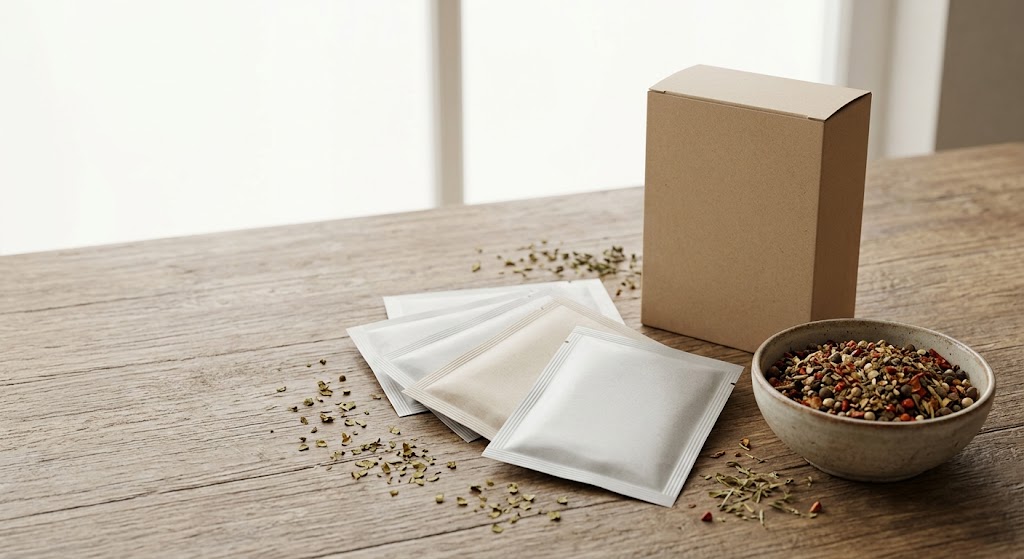
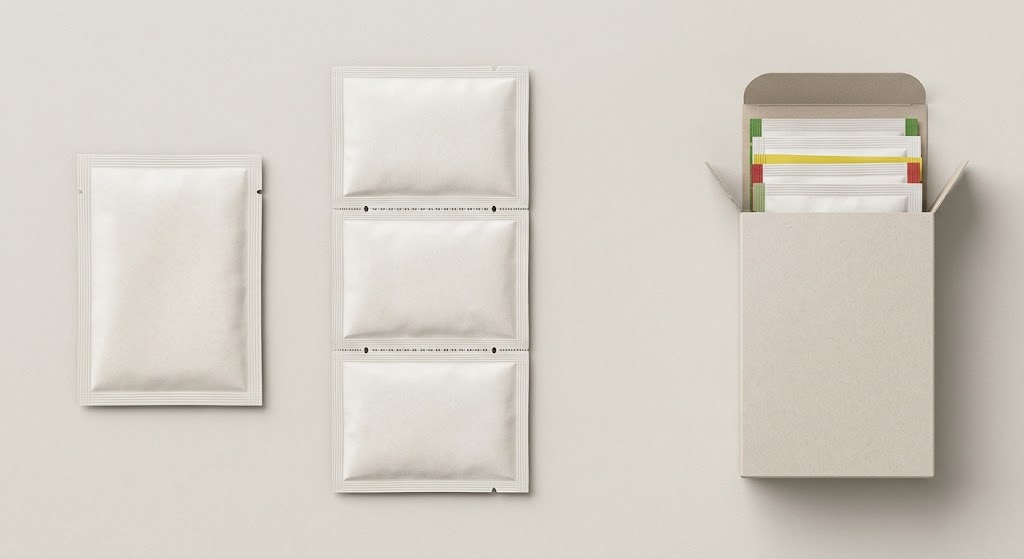
To package spice packets for resale, start with the dose and the selling unit. Decide whether the buyer receives one sealed seasoning portion, a strip of portions or a carton containing several packets. Then choose a food-contact pouch construction, measure the actual blend in sample packets, run it on the intended filler, validate the final seals and review the artwork for the market where the food will be sold. A packet that looks right when empty can be too small to fill cleanly or too hard to open when it reaches the customer.
This article is about sealed, single-use packets of dry edible seasoning: a rub for one recipe, a spice mix for a meal kit, a salt blend for a food-service portion or a branded sampler. Some buyers call these sachets, but the word also describes a porous spice bag meant to steep in broth. A permeable cooking filter and a sealed retail packet perform opposite jobs. Specify which one you need before requesting samples.
Our custom spice packaging range includes flat sachets as a product direction. The useful quote, however, begins with your fill weight, powder behavior, filling equipment, number of flavors and how the packets will be sold. Those details tell the converter much more than “small spice bag.”
1. Define the packet before you choose its shape
Write a one-sentence use case: “One 8 g dry seasoning packet is opened once and emptied into a meal, with ten packets packed inside one printed carton.” Change any part of that sentence and the package brief changes. A food-service packet dropped into a shipping case needs a different consumer display plan from a loose packet hanging at retail. A ten-flavor sample box needs careful version control even when every packet uses the same base film.
The first drawing should show the whole selling system: food; primary packet that touches it; any sleeve, strip or carton; the retail label; and the master shipper. Mark who opens each layer. A tear notch on a primary sachet matters only if the consumer can reach it and the cut does not nick the live seal. An attractive secondary carton will not repair a weak primary seal. Conversely, a technically sound sachet can still be impossible to identify once packets of several flavors are mixed in the same carton.
These are decision prompts, not standard packet specifications. A retailer, co-packer and food-service distributor may each have their own receiving, barcode and artwork rules. Ask for those requirements before the die line is approved. In particular, the legal review of an individually sold packet may differ from that of an inner unit intended only to remain inside a properly labeled multi-pack. Do not assume the carton can always carry every piece of information on behalf of the primary unit.
2. Choose a flat sachet only after checking the product and line
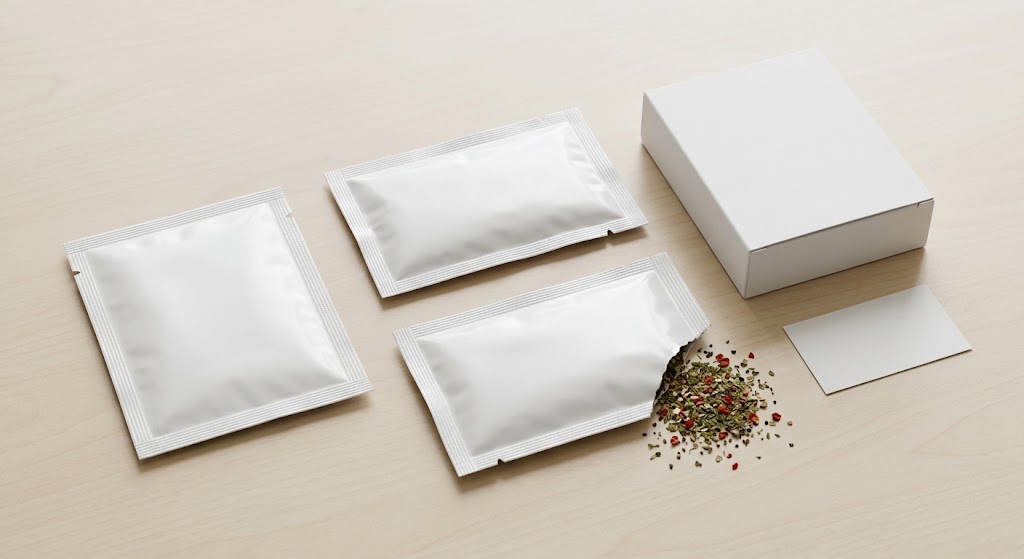
A flat three-side-seal pouch is a sensible starting candidate for many small dry portions because it leaves a broad printable face without a bottom gusset. A four-side-seal packet may suit a form-fill-seal operation using roll stock; a preformed three-side-seal pouch may suit another filler. The difference is not cosmetic. It determines what material arrives at the packing site, which seals the equipment must form, where the product enters, how registration marks are read and what dimensions the line can handle.
For a larger portion that needs to stand on a shelf, a small stand-up pouch is another candidate. It needs a bottom gusset and more room in the display case. A zipper usually adds little value to a genuinely single-use portion, although it can be appropriate for a larger multi-use refill. Ask the packaging supplier for a flat-pouch sample when that is the chosen direction; our flat pouch range is a useful format reference. Do not use a stand-up retail bag's nominal capacity to specify a flat sachet with different seals and usable area.
There is no universal “best film” for every spice packet. An opaque or metallized laminate may be considered when the blend is sensitive to light or aroma changes. A clear construction displays contents but may call for a different light-exposure study. A paper-look exterior can carry a particular visual identity while still relying on other layers underneath. Ask for the full construction, the food-contact sealant, the declared intended use, and oxygen and water-vapor transmission reports under stated conditions when those properties matter to the product. A film code or total thickness alone does not prove finished-packet shelf life.
The FDA's explanation of food-contact substances is a reminder to evaluate the material for its intended use. For an oily spice blend, a dry salt mix and a heated meal kit, the supplier needs to know the actual contact conditions before suggesting a food-contact layer. The food business should obtain the applicable documentation for its destination market and intended use rather than treating a generic “food grade” logo as a complete approval.
A real seasoning project, with a clear limit
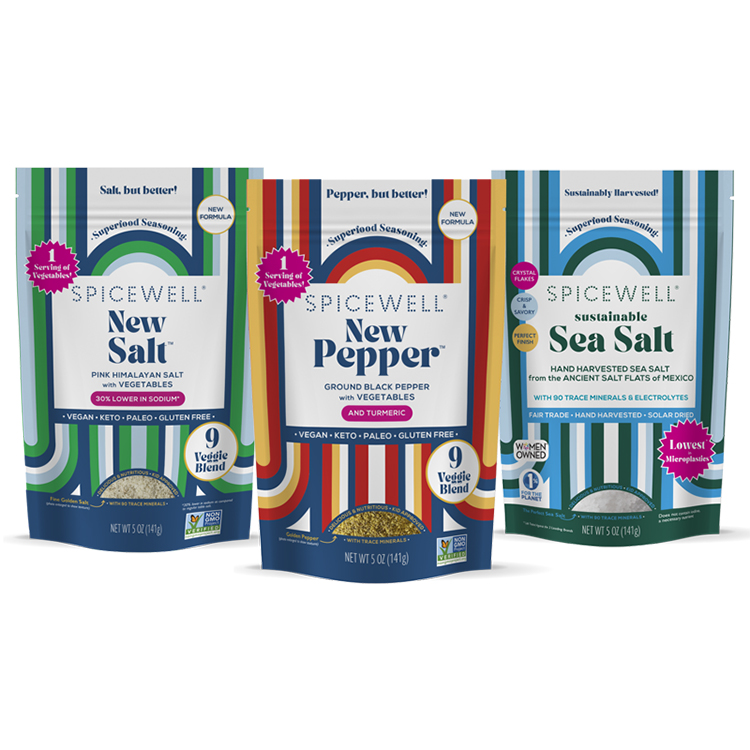
One published US gourmet-seasoning and mineral-salt pouch project records a 5 oz stand-up pouch, digital printing, a listed NK / white kraft paper / NKME / PBS construction, and dimensions of 13.3 × 20.9 + 2.5 cm. The listing describes a compostable design. It is a real adjacent example for discussing a printed seasoning line and a possible larger outer retail pack.
It is not evidence that Mylarbag has made this customer's single-serve sachets, nor that the same construction runs on a particular packet machine. The project page does not publish a measured OTR or WVTR for a packet, a shelf-life study, or a certification report that would justify transferring a compostability claim to your new design. If the proposed mini-packet changes film, ink, sealant or dimensions, ask for its own specification, samples and market-specific claim review.
Use that distinction when contacting the spice pouch supplier: request a mini-packet sample built for your filling method and a separate quote for any larger retail pouch. Two packages in the same seasoning range are still two specifications.
3. Size a packet from the actual dose and seal geometry
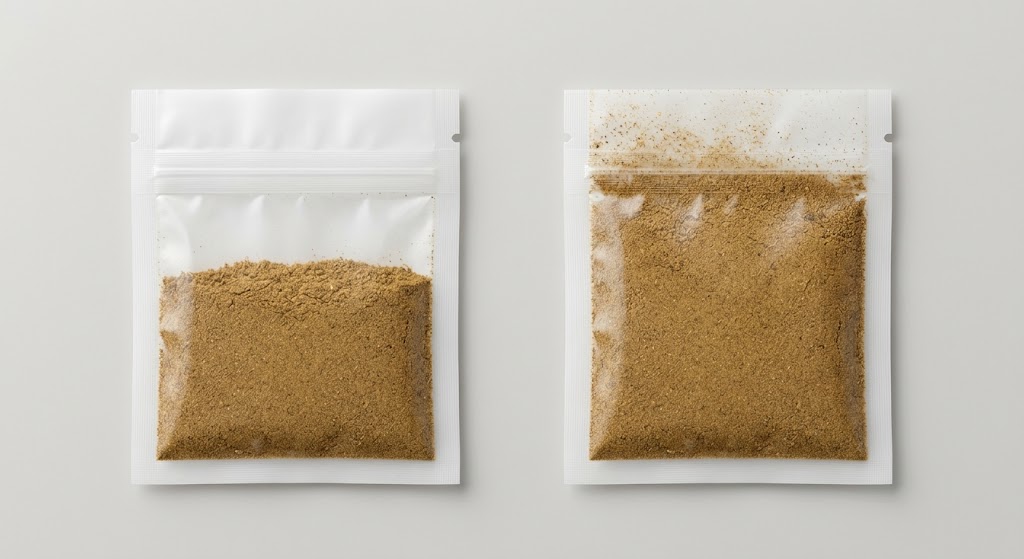
Start with the recipe's target net weight, then measure several filled samples, not just one flattened empty pouch. The same mass can occupy quite different volumes: finely ground powder may pack densely, while flakes and coarse pieces leave more air between particles. How the product falls from the dosing head, whether the portion settles, and how much headspace the sealing jaws need all affect a workable dimension. If you use a measuring cup at the bench, check the final weight on a suitable scale. Volume alone is an unreliable fill specification.
Draw the usable interior instead of reading only the outside width and height. Subtract the actual side, bottom and top seal lands; allow room for the product's settled height, the fill spout and the clean top seal band. Artwork margins, a registration eye mark and a tear notch also have to fit. A nominal 80 × 100 mm sachet, for example, does not offer an 80 × 100 mm product cavity. The actual usable area depends on the approved die line and measured seal widths. That outside dimension is an illustration for a trial, not a recommendation for an 8 g mix.
Ask the co-packer to test at the planned operating rate with the real seasoning. A run of only perfect hand-filled packets will not show how dust behaves after repeated cycles or how a seasoning with coarse and fine particles separates in the hopper. Sample from the beginning, middle and end of the trial. Reweigh, inspect the seals, and note any change in dose as the hopper level falls. Record machine settings and film lot so a later supplier change can be investigated.
If the pack contains a blend of several particles, include a check of composition as well as total weight. A packet that meets the scale target may still contain the wrong ratio of fine powder to coarse pieces if the mix segregates. The food manufacturer owns recipe mixing and dosing validation; the packaging supplier can help ensure the selected film and geometry give the machine a reasonable chance to produce clean packets.
4. Match filling equipment to powder behavior
The question is not simply whether a machine can deposit an average weight. It must form a repeatable packet with the chosen blend and film. Fine powders can cling to a fill tube or drift into the seal band. Coarse particles can catch at the opening. An oil-bearing mix may coat contacting surfaces. Flaky herbs can bridge in a narrow spout. These are reasons to share a sample of the actual product with the machine operator and pouch converter before buying a full print run.
Ask how the line meters the recipe, how it verifies dose, and what happens when it rejects a packet. Auger, volumetric-cup and weigh-based filling approaches have different practical considerations; none is automatically correct for every seasoning. The decision should follow a representative trial, a product-specific weight check and the intended throughput. Also review whether the proposed pouch arrives preformed or is made from roll stock at the packer. The web width, winding direction, print repeat, eye mark and sealant-side orientation then become part of the packaging specification.
Keep the line handoff concrete. The converter should receive the target packet size and tolerances, film construction, print files and registration details. The co-packer should receive food-contact documentation, approved artwork, expected seal settings and an inspection plan. The brand should approve a physical, filled and opened sample. If any of those parties uses a different revision, a “passed trial” can be irrelevant to the bags later delivered.
Dust is a food-handling problem as well as a seal problem
A clean seal band helps the initial closure, but it does not establish that the spice itself is safe. The FDA's spice risk profile discusses the ability of Salmonella to survive in low-moisture spices. The FDA's draft guidance for low-moisture ready-to-eat foods includes powdered spices among its examples and discusses sanitation and environmental monitoring. The latter is draft guidance, not a blanket statement that every spice-packing room must perform the same monitoring program.
The food operator should make a hazard analysis for its actual ingredients, process, facility and market. Supplier approval, validated treatments where needed, hygienic handling and applicable preventive controls sit with the food business. A strong pouch is part of the distribution system; it does not remove contamination already present in a blend. Packaging trials should take place within the operator's food-safety program, with controlled sample identification and cleaning between flavors where cross-contact matters.

5. Specify the heat seal, then test the finished packet
Small packets have little spare real estate. If spice reaches the seal area, a wide printed margin cannot make the closure sound. Agree on a clean seal band and a process window that the actual machine can hold with the selected film and product. Record jaw temperature, pressure, dwell time, line speed and cooling conditions as appropriate to the equipment. A parameter copied from another laminate is only a starting hypothesis.
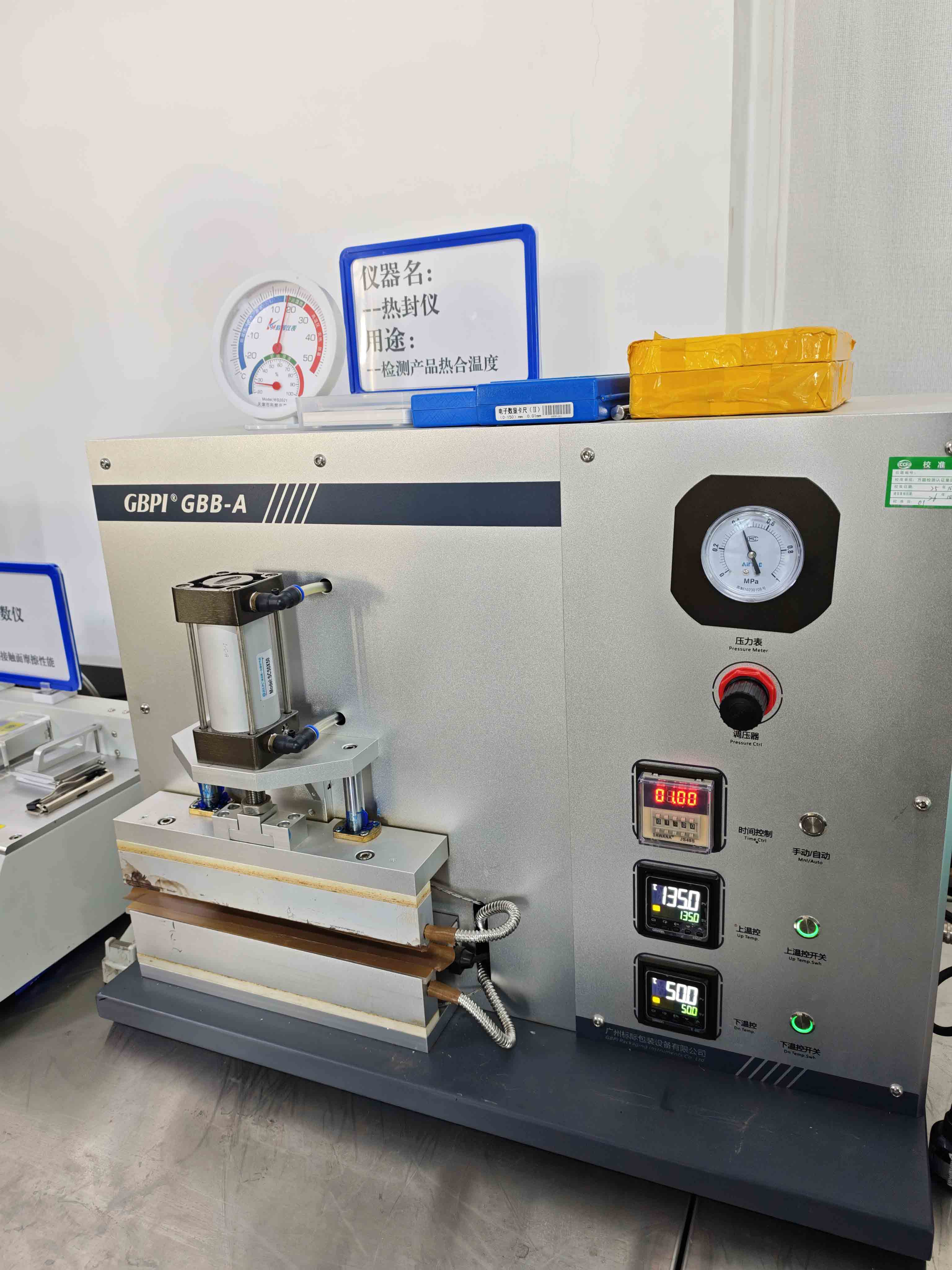
Inspect finished packets for channels, wrinkles, trapped grains and inconsistent top-seal position. Open a sample by hand to see whether it tears from the notch without scattering seasoning and whether the intended seal remains intact during normal handling. A tear notch must sit outside the effective product containment path and away from a corner that readily propagates a tear into the cavity. A notch is an opening feature; it is not proof of seal integrity.
The evidence types answer different questions. ASTM F88/F88M measures seal strength of a sampled flexible barrier material and discusses its use in process validation and control. It does not inspect every location on every packet. ASTM F3039 describes dye-penetration leak detection for nonporous packaging or flexible barrier materials under defined conditions. Whether that method suits your product and sampling plan is a project-specific decision. Do not turn one passed laboratory strip or an illustrative equipment photograph into a general leak-proof or shelf-life claim.
Set acceptance criteria with the food business and qualified testing partners before the trial. Keep records of the rejected packets as well as the good ones. An unusually low rejection count can mean the line is working well, but it can also mean the sampling or detection method misses the defect you are trying to prevent. Review the reason for rejection, isolate suspect lots, correct the process and document what changed before accepting a new run.
6. Make multi-flavor artwork traceable
Artwork is operational data when several flavors share a line. A color change alone is a weak identifier in a busy co-packing room. Give each flavor a clear product name, SKU or recipe code, approved ingredient text and the correct print revision. Confirm the location of any lot/date coding field and test whether it remains legible on the selected surface after filling and case packing. Keep the eye mark, seal area and tear notch free of critical copy.
For a US launch, have a competent label reviewer check the exact food and sales configuration. The FDA Food Labeling Guide covers core labeling topics, though FDA notes that its nutrition chapter is under revision and directs readers to current Nutrition Facts rules. FDA's allergen-labeling guidance is also relevant when a seasoning contains or may contain major allergens. Do not assume “just spices” removes ingredient, allergen, net-quantity or other review questions. The specifics depend on the formulation, claims, whether the sachet is sold alone or within a multipack, and the destination market.
The mixed-carton failure that a print proof cannot catch
Imagine a sampler with barbecue, citrus-herb and spicy garlic portions. All three fit the same nominal packet die line. The citrus-herb artwork is revised late, and the co-packer receives an older print roll for one flavor. The printed carton is correct, but one inner packet still carries an earlier ingredient statement. A lovely press proof for each flavor would not reveal the mismatch after the products are combined.
Solve this as a version-control and pack-out problem. The brand issues an approved artwork matrix; the converter identifies each print lot; the co-packer segregates flavors and verifies the right packet and count at carton assembly. Retain representative finished packets and a complete carton with the batch records. Ask where a scanning or reconciliation step will occur. The exact controls vary by operation, but the carton should never be the first place the team discovers that two packet variants look almost the same.
The factory's digital printing equipment can be relevant when a project has many flavor variants or frequent design updates. Ask for the actual minimum order, changeover economics, color proof and revision process for your job. A machine photograph does not establish that every flavor can share a price or ship on the same date, and the US 5 oz stand-up pouch example does not prove the economics of mini-sachets.

7. Pack the sachets for display and shipment
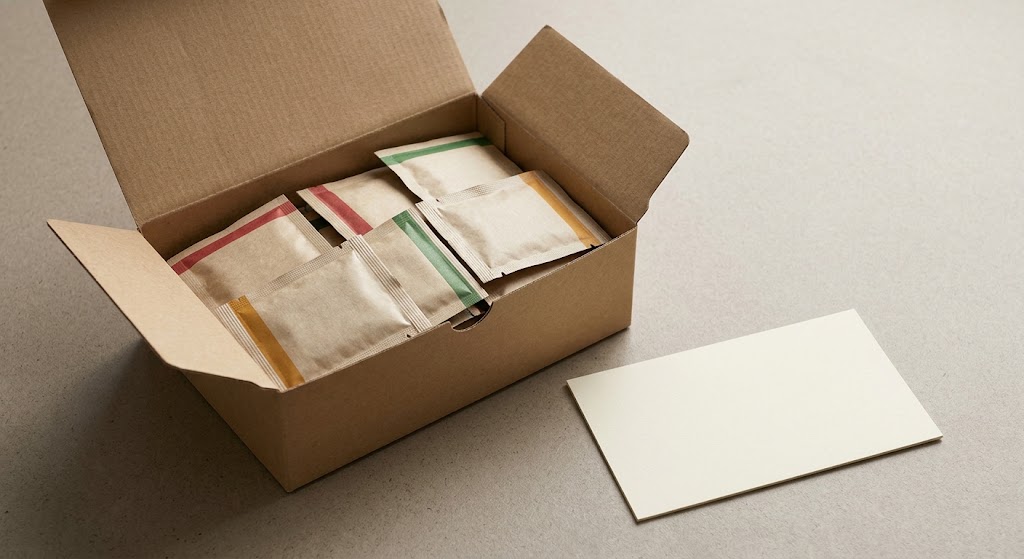
An individual sachet is thin, but a case of thousands of them is not a stack of perfectly flat sheets. Product creates a raised pocket; seals and tear notches create harder edges. Packets can bend, burst, abrade or shift when loose in a carton. Choose a count per inner carton and master shipper based on the filled packet's real thickness, orientation and route. Then open cases after a defined handling trial and inspect the bottom and corner packets, not just those on top.
For a retail carton, check whether the stated count is actually present, the flavors match the front panel, the packet can be taken out without tearing, and the last unit remains accessible. For food-service, check the case label, lot identification and what happens when staff open the carton repeatedly. For meal kits, include other ingredients and sharp utensils in the trial. A picture of empty pouches cannot settle any of these questions.
An easy numerical check helps the purchasing team see why dosing and loss matter. Suppose a trial order calls for 10,000 packets at a target of 8 g each. The nominal food fill is 80 kg before process waste. If actual average fill is 8.3 g, the extra 0.3 g across the order equals 3 kg of seasoning. That arithmetic is illustrative, not a permitted tolerance or a recommended target. Legal net-quantity rules, equipment variation, recipe cost and the chosen acceptance method all need separate review. Avoid solving giveaway solely by dialing the machine down until underweight packets appear.
Record material usage too. A quote based only on empty packet cost omits printing waste, trial rolls, setup, rejected packs, secondary cartons and freight. Ask the supplier which of those items are included. A lower unit price on a large run can be poor value if several seasonal flavors change before the inventory is used. A smaller digitally printed run can make sense for a launch, but the decision depends on the actual total cost per sellable, compliant packet rather than a generic rule that one printing method is always cheaper.
8. Build a supplier brief that can be quoted and sampled
Buyers often request a “high-barrier 10 g spice sachet” before they know whether the blend fits the proposed cavity or the co-packer accepts the film. Reverse that order. Send the recipe's physical sample and a concise specification brief, obtain a few candidate constructions and sizes, then run a controlled comparison. Narrow the options only after the brand has filled, sealed, opened, labeled and shipped representative samples.
Include the following in your inquiry:
- Product: dry seasoning description, ingredient and allergen information needed for the material and line review, particle range, oiliness and intended quality endpoints. Do not send a confidential formula unless the supplier needs it and your commercial terms permit it.
- Portion: target net weight, acceptable filling range decided by the food business, number of servings per sales unit and expected annual volume by flavor.
- Format: individual packet, strip, sampler or food-service case; target outside size if known; intended tear direction; secondary carton and shipping route.
- Packing line: co-packer name or equipment constraints, preformed pouch versus roll stock, fill method, line speed, registration, seal width and the party that performs the final top seal.
- Materials: desired appearance, required food-contact documentation, barrier data and conditions, any window or paper-look request, and the destination market for claims review.
- Artwork: number of SKUs, approved design revisions, legal text responsibility, print method discussion, eye marks and fields for traceability codes.
- Evidence: samples, test reports relevant to the selected design, dimensional tolerances, expected lead time, carton configuration and the buyer's own filled-pack acceptance plan.
Ask for the quote to distinguish material, pouch conversion, printing, samples or tooling, and shipping where relevant. If the supplier changes a film layer, tear feature, sealant or packet dimension after the trial, request a revised spec and repeat the affected checks. The final decision is about the finished packet produced on the real line, not just the cheapest empty sachet in a catalog.
If you have a dry seasoning blend and a target portion, the Mylarbag spice packaging team can discuss flat-packet candidates and any larger outer pouch that belongs in the same range. Send the actual fill sample, flavor count and packer's machine requirements. That makes the first sample round a useful engineering decision instead of a guessing exercise.
Keep a reference set of the approved empty packet, a normally filled and sealed packet, one opened packet, and the assembled sales unit. Label each with the food and packaging revisions used in the trial. When production material arrives, compare it with that set before the first commercial run; when cartons come off the line, retain samples under the food operator's record plan. The reference set does not replace testing, but it gives everyone a concrete version to compare if a later pouch, print or fill complaint appears.
Frequently asked questions
What is the best way to package spice packets for resale?
Define the selling unit and target dose first. Trial a suitable food-contact flat sachet or other format with the real dry blend on the intended line. Confirm fill variation, clean seals, openability, labeling, carton assembly and distribution handling before ordering production print. The “best” configuration depends on the product and sales route.
Is a spice sachet the same as a spice bag for broth?
No. In this guide, a sachet is a sealed packet that keeps a dry seasoning portion contained until it is torn open. A broth spice bag or filter sachet is intentionally permeable so liquid can contact its contents. Tell the supplier which application you mean; the material, seam and food-use requirements differ.
How many grams of seasoning fit in a small flat packet?
There is no dependable gram figure from the outside dimensions alone. Fine powders, coarse rubs and fluffy herbs occupy different volumes at the same weight. The usable cavity is also smaller than the nominal size because seals and the clean filling zone take space. Fill real samples at the target weight and test them on the intended equipment.
Should a single-use seasoning packet have a zipper?
Usually the buyer opens a single-use portion once and empties it, so an accessible tear feature and reliable initial seal are more relevant than a resealable zipper. A larger multi-use refill may need a zipper. Specify the actual consumer behavior before adding a closure that consumes space and changes the line trial.
Can one printed packet design serve several spice flavors?
A shared base design may be possible, but every flavor still needs correct identity and any required ingredient, allergen and other label information. Use an approved SKU/artwork matrix, distinguish print revisions and verify the packet mix inside each carton. A sticker or color change is not a substitute for a market-specific label review.
Does a strong heat seal make a spice packet safe or shelf stable?
No. A tested seal is only one part of a finished package and food-safety system. The food business must control ingredient hazards and the filling environment, assess the actual film and food-contact use, and study its own packaged product under justified storage conditions. Seal-strength and leak methods answer defined packaging questions; neither proves a universal shelf-life claim.