

For a chocolate brand, sustainable packaging starts with the finished selling unit, not a material name. List every layer around the chocolate, decide what protection and handling each layer provides, then compare a small number of plausible structures on the same bar, portion or assortment. Ask each supplier for a complete material specification and a physical sample. Test product quality and packing performance before approving a lighter or simpler construction. Make an environmental claim only when its wording, the finished pack and the intended sales market are supported by evidence.
That process may point toward a right-sized pouch, a different inner wrap, a removable outer sleeve or a more compatible material family. It does not automatically point toward brown paper, a compostable film or a pouch described as “mono-material.” A chocolate package must still protect flavor, shape and usable shelf life under the distribution conditions that apply to that product. This guide shows how to compare options and ask for proof; the separate question of which wrapper belongs in a household's local collection program is addressed by the specific pack and location, rather than a broad category label.
Start with the whole chocolate pack, not the front panel
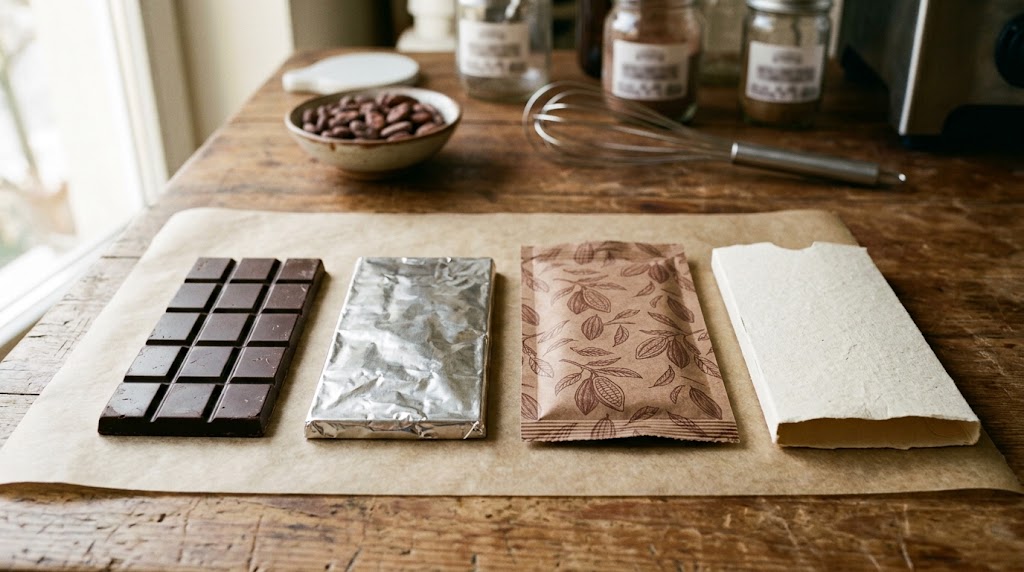
A chocolate bar may have an inner wrap, a printed sleeve and a shipping carton. Loose pieces may sit directly in a sealed pouch. A gift assortment may add a tray and a rigid outer box. A sustainability discussion that counts only the visible sleeve misses the layer that contacts the food and may carry most of the barrier requirement. Start by laying every physical component on a table and asking what happens when one is removed.
For each part, record its material, size, mass, contact role and end-of-life claim. Include labels, zipper tracks, windows, adhesive layers, inks and any insert that leaves with the customer. If a bar arrives in a separate retail pouch after being wrapped in foil and paper, all three components belong in the comparison. If an outer sleeve is merely decorative, it may be a candidate for simplification; if it carries required information or protects a fragile corner, removing it may create another problem. The aim is a defensible design change, not the shortest parts list at any cost.
| Component in the actual selling unit | Its job | A useful reduction question | What could go wrong if it changes? |
|---|---|---|---|
| Food-contact inner wrap or sealant | Separates chocolate from the environment and other materials | Can one correctly specified layer do the necessary work? | Migration, odor, handling or barrier mismatch |
| Printed pouch or outer wrap | Holds the portion and communicates product information | Can dimensions, artwork and format be simplified? | Poor fill, seals, legibility or product protection |
| Paper sleeve, carton or insert | Identification, stiffness, gifting or separation | Does the buyer still need this layer? | Lost information, damage or an awkward opening |
| Window, zipper, label and adhesive | Visibility, repeat access or identification | Is each feature needed on this SKU? | Incompatible construction, leakage, residue or consumer confusion |
| Retail and shipping group pack | Prevents movement and damage in distribution | Can its fit or count improve? | More breakage or waste in transit |
The published 3 oz artisan chocolate project illustrates why the outside can be deceptive. It has a white kraft-paper appearance, while the public material list is MATT OPP/white kraft/VMPET/PE. A paper look does not make the finished package paper-only. The public page's title calls it a stand-up pouch, but its format field says three-side-seal flat pouch; request a current drawing before treating that photograph as a structural template. The listed dimensions are for that project, not a universal bar size.

The photograph is a starting point for a component audit, not a criticism of paper or metallized film. Multi-layer construction may have been chosen for a real purpose. A redesigned package should be judged against the actual product, not by the assumption that fewer named layers must always work better. Obtain a current specification and a filled sample for any option under review.
Decide what the chocolate must survive
Chocolate's needs differ by product and route. A dense plain bar sold locally, a delicate filled piece, a single-serve sample and a multi-serving bag of bites have different breakage, aroma, opening and storage patterns. Write the intended shelf, fulfillment and household-use conditions before asking for an “eco-friendly chocolate bag.” Define the initial seal, expected handling and exposure to odor, light, moisture and temperature changes. If shipping heat or impact is a major problem, a change of film by itself does not replace a separate distribution trial.
Callebaut's chocolate storage guidance emphasizes stable conditions and avoiding shocks and condensation. Fraunhofer IVV's ChocoPack research page describes work on paper/card with specialized coatings and chocolate tests against oxygen, moisture, temperature and light. The research illustrates why a promising material must be evaluated with the chocolate itself. It is not a certificate that a paper proposal will give any other bar a particular shelf life.
The environmental comparison also needs to account for avoidable product loss. A lighter pouch is not a useful improvement if corners fracture frequently, fat or sugar bloom makes inventory unsaleable under the planned route, or weak seals result in discarded units. That is a risk to measure, not a claim that one package has a smaller total footprint. EPA's sustainable materials management approach asks users to look across production, use and waste management rather than choosing a material by a single attribute. For an individual brand, a simple record of damage, returns and unsold stock is a good start before a more formal assessment.

The public 12 g sachet case lists MATOPP/VMPET/PE, gravure printing and an 8 × 8.5 cm three-side-seal format. A single-serve unit may reduce leftover chocolate for a tasting event, but it can also increase packaging per gram compared with a larger unit. Neither outcome is universal. Compare your actual occasions, pack counts and product losses before using “less waste” in a customer-facing sentence.
Compare proposals with the same product and questions
There is no meaningful material comparison when one quote is for a loose bar inside a printed pouch and another is for an inner wrap, outer sleeve and carton. Put each candidate around the same amount of chocolate, with equivalent required information and a stated sales channel. Then ask what would change in material mass, protective performance, packing speed, shelf presentation and disposal evidence. Record the required food-contact and print construction separately from an informal supplier category.
| Candidate to investigate | Potential design opportunity | Evidence and test still needed |
|---|---|---|
| Right-sized flexible pouch with fewer optional features | Reduce unnecessary headspace, excess film or unused zipper on a single-use pack | Filled dimensions, seal area, handling trial, total pack mass and current structure |
| PP-family or PE-family pouch designed with recycling in mind | Align major layers and components with a chosen design guide | Complete laminate, adhesives, ink, closures, sorting behavior, market access and acceptance; not a blanket “recyclable” label |
| Paper sleeve or paperboard exterior with a separate functional inner wrap | Separate printed presentation from food-contact protection and perhaps simplify a decorative layer | Both components' construction, total mass, product protection and market-specific claims |
| Coated paper or other proposed primary wrap | Explore a different protective architecture for a bar | Food-contact evidence, coating/adhesive details, fold/seal performance and actual chocolate storage trial |
| Compostable or recycled-content proposal | Pursue a defined material attribute when it suits the use | Scope of claim, exact components, suitable facilities or process evidence and food-contact suitability |
The table is an investigation list, not a ranking from “best” to “worst.” A multilayer barrier might still be necessary for a particular chocolate and route; a well-designed PP-family pouch may be promising without being accepted in the intended collection network. A paper sleeve can be easy to identify visually while concealing a different inner wrap. Decide what improvement the proposal claims to make, then build the evidence needed for that specific claim.
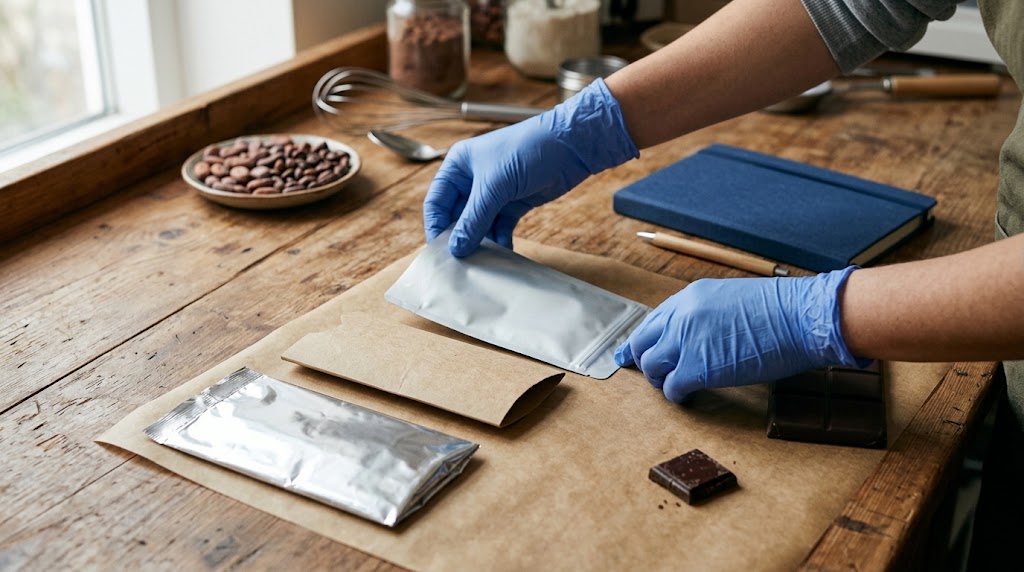
Ask the supplier to put all candidates in the same comparison grid: named material layers, finished dimensions, thickness or mass, surface treatment, closures, contact face, production quantity and sample version. A supplier may suggest a mono-family structure as a development route, not as a promise that a specific finished bar pouch is universally recyclable. Keep the quote, drawing, compliance documents and filled sample together so later artwork or a zipper change cannot silently invalidate the initial comparison.
A “mono-material” brief still has many design decisions
The term often describes a pack designed around one polymer family, such as PP or PE. It is a useful design intention, but a real package also has print, adhesive, barrier treatment, zipper, labels and seams. Their amounts and compatibility matter. The Association of Plastic Recyclers' Design Guide assesses package features and explicitly separates design for recycling from access, acceptance and markets for recovered material. Its framework helps a buyer ask for more than a resin acronym; it does not automatically approve a particular chocolate pouch.
The Mylarbag bean-to-bar flat pouch case is titled “100% Recyclable” and “Mono-PP” on its public product page. Its published structure is BOPP/PMP822/CPP, with gravure printing and Spot UV listed. Those are useful starting facts for a supplier discussion. They do not by themselves establish the status of the complete printed pouch in every place it is sold, how a local program accepts it, or whether the same result applies to a revised construction. Treat the title as a project label, not your own finished-pack claim.

Ask for an exact drawing and specification for the proposed order, including the layer proportions and details of any barrier and printing. Ask how the converter evaluated the zipper, label, adhesive, inks and any window against an identified recycling-design protocol. If they have test results, request the named structure and conditions, not a generic certificate bearing a similar film family. For a U.S. claim, have the brand's reviewer also check relevant collection access and marketing guidance for the markets where the SKU is sold. A design guide result and a truthful consumer-facing claim are related but distinct decisions.
The same discipline applies when considering a different film family. A transparent PE-based proposal may have different visual and protective properties from the current pack. A PP-family proposal might affect print, stiffness or line handling. Do not transfer results from a coffee bag or another chocolatier's bar. Run the product you actually sell through a filled-pack trial, then retain the version that was reviewed.
Paper, compostable and recycled content: ask narrower questions
Paper has a recognizable feel and can work well as an outer sleeve or carton. But a paper-looking pouch may contain plastic, metallized film or a functional coating. Even a genuinely fiber-based wrapper may need a specific barrier treatment, adhesive or inner surface for chocolate. Fraunhofer's coated-fiber research is a reminder that “paper” is a starting material description, not a completed performance or recovery result. Ask whether the paper is an outer component, part of a bonded laminate or the actual food-contact wrap; then review the full construction.
Compostability is another distinct pathway. The claim must address the finished package and the intended conditions, not simply one film sample before printing, adding a label or fitting a closure. FTC's Green Guides summary describes the need for competent and reliable evidence, timely and safe breakdown, and qualification when the relevant facilities are not widely available. A supplier's certification may be useful evidence for a named material, but the brand still needs to understand whether it covers the complete printed pack, home versus industrial composting, the sales market and the actual disposal pathway. Do not combine the words “biodegradable” and “compostable” as though they mean the same test.
Recycled content describes the source of some material in a pack; it is not evidence that the package can be recycled after use. If a plastic contact layer contains post-consumer recycled material, ask for the process, content proportion, layer placement and documentation appropriate to that use. FDA guidance on recycled plastics in food packaging discusses contamination and migration considerations in evaluating a recycling process. A percentage printed on a generic bag sample does not settle the suitability of your chocolate's actual contact layer. Nor does a forest-themed design make a paper component responsibly sourced without documentation that matches that component.
There is no need to choose among these terms before understanding the pack's job. “Paper,” “recycled,” “compostable,” “recyclable” and “reduced material” answer different questions. A sensible supplier comparison keeps each attribute in its own column, with a document owner and evidence date. That prevents a proof of one narrow attribute from being repurposed into a general “planet-friendly” label.
Replace vague environmental language with evidence-led wording
In the United States, the FTC warns against broad, unqualified general environmental benefit claims such as “eco-friendly.” Its Green Guides summary asks marketers to make clear, prominent and specific qualifications. For unqualified “recyclable” claims, the guidance discusses appropriate facilities available to a substantial majority of consumers or communities where the product is sold, described as at least 60 percent in the summary. That is a marketing-claim threshold within this guidance, not a declaration that a package bearing a PP name will actually be collected in a particular town. Other markets may have different rules.
Make a claim ledger before the design team adds leaf icons, chasing arrows or an “eco” badge. State exactly which object and attribute the words refer to. Identify the test, calculation, certification or market check that supports them, and the current version of the package to which they apply. If an outer carton is paper-based but an inner wrapper is laminated, wording on the whole package must not suggest every layer shares the same attribute. Likewise, a pouch with some recycled content is not necessarily a recyclable pouch.
| Proposed wording on a pack or site | First evidence question | More precise direction while evidence is reviewed |
|---|---|---|
| “Eco-friendly chocolate packaging” | What specific, meaningful benefit and trade-offs are proven? | Name the documented attribute and its scope rather than a blanket benefit. |
| “100% recyclable pouch” | Does the exact finished pouch meet design, access, acceptance and claim requirements where sold? | Describe a material or design proposal internally; publish a qualified claim only after review. |
| “Compostable wrapper” | Which complete structure and home or industrial conditions were tested? | State the verified component and route, with necessary facility qualifications. |
| “Made with recycled content” | Which layer, source and percentage are documented? | State the measured proportion and whether it applies to the pack or one component. |
| “Less packaging” | Compared with which baseline pack and measured mass or volume? | Name the previous/current units and the quantified comparison when true. |
The examples are a review method, not ready-to-print legal copy. The review owner should check current U.S. federal and state requirements, sales channels and any other markets before approval. A sustainability report, product page title or supplier presentation is helpful background, but it does not automatically support the exact words on your SKU. Save final artwork with the evidence that was approved, then revisit it if material, closure, print or destination changes.
Reduce material without designing in more damage
Sometimes the most practical change is a smaller pouch or fewer unnecessary components. Measure the existing finished unit first: pouch weight, sleeve, inserts, labels and any retail display parts. Note how many chocolate pieces or grams it holds, how many units ship together, and how much void the fill leaves. Then prototype a more compact version using the same product and information. Do not shrink a seal area blindly or remove padding needed to keep delicate corners intact.
The test can be simple but should be repeatable. Fill a realistic number of samples on the normal line or workbench. Record the actual packaging mass, unfilled headspace, seal cleanliness, opening usability and any product loss or damage. Check the printed barcode and required information on the filled unit. If a zipper is removed from a single-serve pack, confirm that the selling and eating occasion genuinely requires only one opening. If an outer sleeve is removed, make sure the remaining pack still identifies the variant and carries required information.
Create one comparison sheet per trial, with the date, material version and the same chocolate batch for the baseline and candidate. Record how many units were filled, how many were rejected for a dirty or incomplete seal, and what happened after the pack was handled in its intended retail orientation. Photograph the front, back, top seal and opened unit. The observations do not by themselves establish a statistically reliable shelf-life improvement, but they show whether a proposal deserves a longer controlled study. If the candidate changes an inner wrap, keep the outer format constant for the first comparison so a broken corner is easier to trace to the changed component.
The numbers also keep a source-reduction claim honest. A lighter film that produces more filling rejects may consume extra material before any package reaches a customer. A larger shipping case used to protect a smaller retail bag may offset some of the intended reduction. Record those outcomes alongside the measured retail pack mass and ask what belongs in the comparison boundary. The brand can then decide whether to report a narrow result, such as a verified change in pack weight, or wait for a broader assessment before making an environmental comparison.
An apparent reduction in packaging per unit can shift material elsewhere. A very small sachet may need a larger multipack carton; a delicate bar in a lighter pouch may need more shipping protection. Count the system that will be sold and moved, not merely the piece placed in a marketing photograph. EPA's waste-management hierarchy places emphasis on source reduction, but that principle still needs a functional package for this product. A written comparison of total components and observed losses is more useful than declaring a winner from a scale reading alone.
For a multi-flavor range, use one comparison template across every SKU. The published 3 oz chocolate gallery shows four visual variants. A consistent size and material proposal can simplify a review, but a nut inclusion, fragile bar shape or different fill may still need its own test. Do not assume the attractive four-pack photograph proves equal performance, material mass or shelf life for every flavor.

Give the supplier a testable wholesale brief
An “eco-friendly chocolate packaging wholesale” request is too broad to quote responsibly. Give the supplier a real bar or a dimensionally faithful sample, target net quantity, current pack assembly and planned selling unit. Specify whether the chocolate contacts the pouch directly or has its own inner wrap. State the storage, retail and delivery conditions, quantities by flavor, desired print and closure, and the sales markets where any environmental wording may appear. Ask for proposed alternatives with an itemized list of changed components, not a menu of attractive material names.
For each candidate, request a current structure drawing, layer descriptions, finished size and weight, intended food-contact face, food-contact evidence for the proposed use, physical unprinted and printed samples, and the information supporting any proposed environmental claim. Ask the supplier to name the design guide or test protocol used if it describes a pouch as designed for recycling. If it proposes compostability or recycled content, ask what the evidence covers and who will verify the final printed structure. Treat quotes for setup, sampling, minimum quantities and lead time as project-specific current information; none is universal.
| Stage | Buyer provides | Supplier or brand reviewer returns |
|---|---|---|
| Current pack audit | All components, actual chocolate, current drawings and losses | Baseline construction and mass record |
| Option brief | A specific reduction or material-family goal and sales markets | Candidate layer stack, closures, print and quote assumptions |
| Food-contact review | Product/contact conditions and which face touches food | Current documents for the exact proposed use |
| Filled trial | Representative SKUs, normal filling and planned handling | Fit, seal, breakage, usability and storage observations |
| Claim review | Intended wording and target markets | Evidence ledger, qualifications and final artwork decision |
The final decision is a comparison, not a contest between color swatches. One option may reduce material but complicate filling; another may protect better but require a different end-of-life message. Record what has been demonstrated and what remains unknown. Hold a small approval meeting with product, quality, operations and marketing before changing an established pack. This prevents a revised pouch from entering production with one team assuming “recyclable” was already checked by another.
For a custom flexible chocolate pouch, review Mylarbag's chocolate packaging options and contact the team with the actual item, current pack, proposed change, quantities and market. Request a current drawing and physical sample. The three published chocolate projects show different appearance and constructions; none alone proves a broad environmental claim for a new order. If the project includes a rigid gift box, molded tray or direct-contact foil inner wrap, specify and verify those components with the appropriate suppliers as part of the same finished-pack review.
Frequently asked questions
What is the most sustainable packaging for chocolate bars?
There is no universal material winner. Start with the actual bar, protection needs and selling route, then compare complete packs for component count, mass, product loss, food-contact suitability and evidence for the proposed recovery or reduction claim. A paper sleeve over a functional inner wrap and a well-specified pouch are different systems. Test each candidate on the chocolate and market where it will be used.
Are mono-PP chocolate pouches recyclable?
A PP-family construction can be designed with recycling compatibility in mind, but the named polymer alone does not establish recyclability for a finished, printed pouch. Assess inks, barriers, adhesives, closures and labels, then collection access, acceptance and marketing claims for the sales market. Ask for the exact structure and evidence. Blog 11's component-by-component disposal question is separate from selecting a design proposal.
Is kraft paper chocolate packaging always eco-friendly?
No. Kraft appearance might be an outer paper layer on a laminate or a separate sleeve over a different food-contact wrap. Request the full material stack and weigh the complete pack. Paper can serve a useful function, but appearance does not prove compostability, recyclability, a smaller footprint or sufficient chocolate protection.
Can a chocolate pouch be compostable?
Some constructions are proposed for composting, but a specific claim needs evidence for the complete printed package and the conditions under which it can be composted. Check any closure, label and adhesive, the distinction between home and industrial conditions, facility availability where sold, and food-contact suitability. Do not turn a certificate for an unprinted film into a blanket claim for a finished pouch.
Does recycled content mean the wrapper is recyclable?
No. Recycled content concerns the origin and measured share of material in the package; recyclable concerns the used item's design and collection/processing route. For food-contact plastic, ask for documentation appropriate to the exact layer and intended chocolate use. Keep the two possible claims separate on artwork and in supplier files.
How can I reduce packaging without damaging chocolate?
Measure the current selling unit and identify a dispensable layer, excess headspace or unnecessary closure. Prototype a revised package with the real product, then compare seal quality, handling, opening, storage observations and breakage using the same route. Include any extra display or shipping component caused by the change. Only describe a measured reduction against a stated baseline.
What should I ask a wholesale supplier before making a green claim?
Ask for the exact structure and version, all major components, the food-contact face, a physical filled sample, any design-guide assessment, relevant collection or composting evidence and a claim-specific document for the destination market. Name the proposed wording and the particular component it refers to. Have the brand's quality and marketing reviewers approve that wording for the final printed pack, rather than relying on a generic “eco” catalog label.