
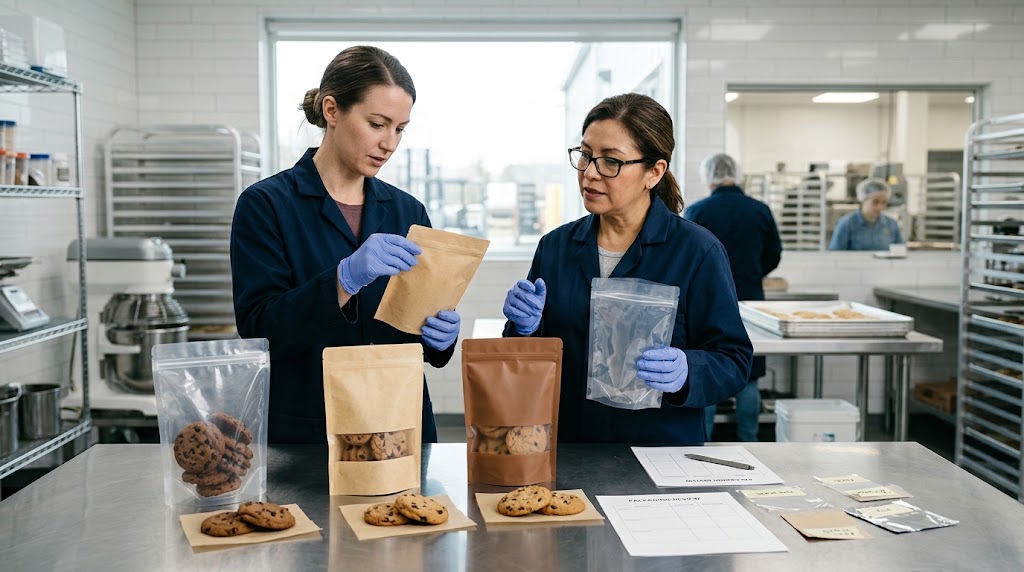
A bag can look environmentally thoughtful and still be hard to recover. Brown paper may hide a plastic or metallized lining. A pouch made mostly from one polymer may have a different zipper, label or barrier coating. A certified compostable film may end up in a location where the organics processor does not accept packaging. Meanwhile, a poorly protected cookie can go stale before anyone has a chance to eat it.
The short answer: choose the least complex bag that protects the actual cookie through the proposed selling period, then verify its complete material construction against a realistic collection or composting route. Say precisely what has been demonstrated. “Mono-material,” “paper,” “plant-based,” “biodegradable,” “recyclable” and “compostable” do not mean the same thing. None of those words alone proves a finished bag's food-contact suitability, cookie shelf life or accepted disposal route.
This guide is about flexible bags for cookies people eat: individually wrapped cookies, bakery multipacks and retail pouches. It is written for bakeries, food brands, co-packers and packaging teams. It does not cover pet treats, cookie dough or choosing a rigid box as the primary package.
Start With the Cookie, Then Define the Environmental Goal
“Sustainable” is a direction for a project, not a laboratory result. Write down the improvement you want before changing the package: less material by weight, a structure compatible with a specified recycling stream, verified compostability where collection is available, documented recycled content, or fewer cookies rejected because they lose quality. These goals can conflict. A thinner web may use less material but fail during filling; an opaque barrier may protect an oil-rich cookie while changing the recycling assessment. A comparison is useful only when the cookie, pack size, selling route and quality period are kept in view.
Make a brief for one SKU rather than “all cookies.” A crisp butter biscuit may be judged by snap and oxidative off-notes. A soft cookie may need to hold its intended chew. A decorated cookie needs clearance so icing does not rub against the bag. A nut-containing cookie may have a different odor endpoint from a plain sugar cookie. The food producer sets its own product safety, quality and date-marking plan. Packaging selection is one input to that plan.
| Question before material selection | Record for the trial | Why it matters |
|---|---|---|
| Which finished cookie is being packed? | Recipe revision, batch, fat-rich inclusions, icing/filling, initial condition | Different products can fail by different mechanisms. |
| What does acceptable quality mean? | Texture, aroma, appearance, breakage and a written rejection rule | “Fresh” cannot be evaluated from a bag specification alone. |
| How is it sold? | Single wrap or multipack, fill count, pack dimensions, expected handling | The bag needs compatible seals and physical support. |
| Where and for how long is it held? | Proposed storage climate, distribution route and unopened checkpoint schedule | Humidity, temperature and light change the challenge. |
| Which environmental outcome is sought? | Specific material-reduction, collection, certification or recovery objective | A vague green label cannot be checked. |
| Where will it be sold and discarded? | Markets, local collection instructions and processor acceptance | A theoretically recyclable material may lack an accessible route. |
There is no honest default answer that “compostable beats recyclable” or the reverse. A package with the smallest apparent material footprint may also have the wrong barrier for the cookie. The practical task is to compare candidates under the same product and route conditions, then state what each one actually achieves.
Four separate checks
Treat these as separate gates: food-contact evidence, cookie and pack performance, end-of-life evidence, and consumer-facing wording. A pass at one gate does not pass the others. A resin or film may be acceptable for a stated food-contact use while the entire printed pouch needs more documentation. A bag may preserve quality but have no established recycling route. A compostability certificate for a substrate does not automatically cover the zipper, ink, adhesive and finished article.
The FDA's explanation of food-contact materials illustrates a component-and-intended-use approach in the United States. It is useful as a method for asking a supplier exactly which substances and conditions its declaration covers. The applicable rules in the actual sales market still need to be checked by the food business; “FDA certified” is not a substitute for construction-specific records.
A Real Cookie Pouch as the Baseline
Mylarbag's published 3.5 oz bakery-bites cookie pouch case lists a digitally printed stand-up format, PET/VMPET/PE construction, zipper and nominal 12 × 18.5 + 3 cm dimensions. It gives a real reference for the functions a proposed replacement must retain: product fit, appearance, closure and protection. The public case does not publish a verified recycling outcome, compostability certificate, measured transmission rates or a validated cookie quality period. Its broad marketing language should not be converted into test data for another SKU.

Suppose a bakery wants to replace that structure with a PE-family pouch. A meaningful brief would ask whether the same number of cookies fits without excess empty space; whether the candidate's web, zipper and top seal run on the same equipment; whether crispness and aroma meet the existing quality limit; and whether the whole final package qualifies for the desired local collection route. If the answer to any one question is unknown, the proposal remains a candidate, not an approved sustainable conversion.
This case also prevents an easy but misleading narrative. “Organic cookies” describes a product positioning in the published example; it does not make the bag organic or environmentally superior. A silver-looking layer is not proof that a bag is aluminum foil, and “paper look” is not proof of paper recycling. Material declarations and testing records must carry those conclusions.
Compare the Main Flexible-Bag Routes
The most useful comparison names a structure and an intended disposal stream. “Eco friendly cookie packaging” is too broad to specify a heat seal or write an end-of-life instruction. The routes below are design families; individual constructions vary.
| Candidate route | What may make it attractive | Important qualification | What to request before choosing |
|---|---|---|---|
| PE-family flexible pouch, such as compatible PE layers | Potential fit with a PE film recovery stream; can be made as a sealable flexible pack | A compatible main film does not qualify every barrier, ink, zipper, label or food-residue condition | Full layer map, component list, design-for-recycling assessment for the target stream, actual collection route and filled-pack trial |
| PP-family flexible pouch | Can offer different stiffness, heat behavior or clarity in a similarly focused polymer family | PP flexible collection and sorting are market-specific; do not apply a PE film drop-off label to PP | Structure, target-market recycling guidance, closure compatibility and machine trial |
| Paper-based pouch with a functional lining | Printed paper appearance and possible paper recovery if the exact article is accepted and repulpable | Paper plus PE, PLA, metallization or grease barrier is not automatically a paper-recyclable bag; the coating can change both sorting and processing | Cross-section and coating/adhesive details, repulpability evidence where relevant, collection acceptance and barrier trial |
| Certified compostable flexible construction | A defined route may be possible for the complete item in a suitable organics system | Commercial compostability does not mean home compostability; certification and collection acceptance are distinct | Certificate or registry entry for exact finished SKU, component coverage, permitted claim, processor acceptance and cookie-pack performance |
| Current mixed-material barrier pouch | Known geometry and potentially useful protective functions | Do not call it recyclable or compostable merely because some constituent layers have those properties | Construction, present performance baseline and a truthful disposal instruction |
No row is a universal recommendation. For a crisp, longer-route cookie, a candidate must hold the required texture and aroma under the intended conditions. For a short-turnover single cookie sold on the day it is packed, a simpler construction might meet a different objective. The result is determined in the filled-package trial, not by the color of the pouch.
PE and PP: design for a stream, then verify access
A focused polymer family is a design strategy, not an automatic consumer claim. RecyClass packaging guidance evaluates specific features such as labels and adhesives against individual PE and PP flexible streams. A film containing a barrier layer or tie layer needs a stream-specific review of its actual composition and amounts. A zipper, spout, label or ink system can affect the outcome. Ask which edition of a design guideline was applied and what was evaluated.
Collection is another gate. How2Recycle's U.S. Store Drop-off explanation says not every flexible package in an otherwise eligible product category qualifies. It asks for the appropriate label and for food-contact packages to be clean and dry where residue is possible. That is a U.S. program example, not a global instruction to put every PE cookie pouch in a curbside bin. Verify the actual package and local program in each market.
It is reasonable to ask a supplier for a PE-family candidate with a compatible PE zipper and an assessment of the complete printed pouch. It is not reasonable to print “100% recyclable everywhere” based only on a material abbreviation. Nor should PP be routed into a PE collection stream merely because both are plastics. Where facilities or access are uncertain, qualify the claim or omit it until evidence is available.
Paper and grease barriers
Kraft color and a paper fiber layer answer an appearance question. They do not settle water-vapor resistance, oxygen transmission, grease holdout or disposal. A paper bag intended for butter-rich cookies may have a coating or laminated inner seal layer. That layer can be necessary for function while also changing repulpability, compostability or sorting. Request the exact basis weight and fiber treatment, coating type and amount, adhesive, window and seal layer. Then ask the appropriate paper-recycling or composting assessor to evaluate the complete article.
Avoid treating “plastic-free” as a synonym for paper-looking. A transparent window, polymer dispersion coating or heat-seal lining must be included in the claim's scope. If a design relies on a removable inner sleeve, check whether typical consumers can and will separate it without contaminating either stream. Instructions that depend on complex disassembly deserve extra scrutiny.
Certified compostable is a specific route
Compostability is about the tested article under stated conditions, not a promise that a bag disappears outdoors. BPI's commercial compostability program evaluates eligible items against its certification scheme. Its product catalog lets a reader check a licensed item and distinguishes commercial certification from products additionally certified for home compostability. This is one established program; other markets may use different schemes.
Confirm that the exact converted cookie bag—including its closure, print, adhesive, window and any label—is within the documentation. A supplier's certificate for a base film or an unrelated coffee pouch is a useful lead, not authorization to print the mark on a new cookie SKU. Ask whether the intended local composting facility accepts certified packaging at all. A valid certificate and a facility that declines the item can coexist.
“Biodegradable cookie packaging” needs special care. Biodegradation describes a process under conditions and time; it does not identify a disposal route or independently prove compostability. BPI recommends clear “compostable” terminology for its certified items. The FTC Green Guides summary calls for evidence supporting the entire package and qualified claims where appropriate. Rather than a broad “biodegradable” badge, state the exact certification, industrial or home conditions and accepted collection route where substantiated.
Map the Whole Bag Before Writing a Disposal Instruction
Make a bill of materials for the finished selling unit, not only the largest visible panel. A single cookie may sit in a printed flow-wrap bag; a multipack may have a zipper and back label. Each component has a material, a weight and a function.
| Component to record | Example questions | Possible effect on the claim |
|---|---|---|
| Main web and inner sealant | Which polymers, paper, coatings and tie layers? What are the weights and percentages? | Determines the candidate recycling or composting stream and package protection. |
| Barrier layer and clear window | Are they the same construction as the opaque body? What is their coverage? | May change sorting, transmission and whole-pack assessment. |
| Zipper, slider or tear strip | What resin? Does it detach during ordinary use? | Can change stream compatibility; reseal convenience does not prove recyclability. |
| Label, adhesive and ink | Are labels removable? Which substrate and adhesive? What is the print coverage? | Can affect sorting, washing, repulping or compostability. |
| Decorative finish | Is there a metallic film, foil stamping or coating? | Appearance and small parts can complicate assessment; verify with the actual evaluator. |
| Cookie crumbs and oil residue | Can the emptied bag be reasonably cleaned and dried? | Food residue may restrict a collection route even if the clean structure could qualify. |
| Outer display or shipping components | What is a separate carton, insert or transport bag? | These may need separate instructions; do not apply one symbol to every component. |
The bill of materials should include supplier part numbers and revisions. If a zipper supplier changes resin or an ink system changes after certification, the original assessment may no longer describe the sold article. Put change control in the specification: who must be informed, which evidence must be refreshed, and whether a new package trial is required.

A decision path readers can use without the picture
| If the verified final construction is... | Then check... | Consumer instruction may be written only when... |
|---|---|---|
| PE-focused or PP-focused flexible material | Compatibility of all components with that exact stream | The package-level assessment and local collection channel support the stated route. |
| Paper with coating or lining | Repulpability and local paper-sorting acceptance, or another supported route | Evidence describes the finished printed and sealed construction. |
| Certified compostable construction | Exact licensed article and commercial versus home scope | The certification, license to use the mark and local organics acceptance align. |
| Mixed or unverified construction | Whether any separate part can be responsibly directed elsewhere | The instruction does not imply the entire bag is recyclable or compostable without evidence. |
This table is a screening tool, not a universal municipal disposal guide. The final label belongs to the brand's approved market-by-market artwork. If consumers must remove a label or clean oily crumbs, test whether the action is practical and legible on the small bag. Never put a recycling arrow on an unassessed pack simply because a resin identification code appears on one component.
Claims: Translate a Word Into a Testable Sentence
Environmental language should answer four questions: which part, which property, under what conditions, and with what evidence. The FTC Green Guides are a U.S. example of this discipline. They distinguish broad environmental benefit claims, compostable, degradable, recyclable, recycled content and source reduction. For an unqualified U.S. recyclable claim, the FTC guidance uses availability to at least 60 percent of consumers or communities where sold as a criterion; that is not an international threshold. The article's broader rule is to check the destination market and qualify what cannot be shown.
| Draft phrase | What a reviewer should ask | More precise direction when supported |
|---|---|---|
| “Eco friendly cookie bag” | Which measured benefit and compared with what? | Name the verified feature, such as a documented material reduction against a stated prior bag, with comparison method. |
| “100% recyclable” | Does this include every layer, zipper, label and ink? Is the stream available? | State the applicable program and conditions only after a package-level assessment and market check. |
| “Compostable” | Commercial or home? Is the finished SKU certified? Will local programs accept it? | Identify the certified article and appropriate composting route with necessary qualifications. |
| “Biodegradable” | In what environment, over what period and for the entire article? | Use a specific, substantiated compostability statement where that is the actual verified property. |
| “Made from recycled material” | Pre-consumer or post-consumer? What fraction of which component? | State the documented percentage, component and accounting basis; check food-contact suitability separately. |
| “Paper bag” | Does it contain a plastic or biopolymer lining? | Describe the real structure; make a paper-recycling claim only with finished-article evidence. |
| “Uses less plastic” | Less than which previous design and at which pack size? | State a like-for-like mass comparison and the exact reduction, if measured. |
A certification logo is not a free-standing substitute for a claim review. Match the certificate holder, product identifier, edition, relevant components and permission to use the mark. The food business should keep its approved artwork and evidence together. If a consumer sees an unqualified “recyclable” badge on the front and a hidden “where facilities exist” line on the back, the overall impression may still be misleading.
Recycled content has a second, food-contact question
A percentage of post-consumer recycled content describes feedstock, not the package's end-of-life. If recycled plastic is proposed for a food-contact cookie bag, request the process and intended-use evidence for the actual construction. The FDA's recycled-plastics guidance page identifies contamination, source material and additives as concerns and describes case-by-case evaluation for U.S. food-contact uses. Do not assume an ordinary recycled resin, or a certificate for non-food packaging, is approved for direct cookie contact. The applicable market and use conditions govern.

Check Protection on Filled Cookies, Not Material Names
Changing to a preferred recovery route still leaves the original job of packaging: the cookie must arrive with its intended texture, aroma, appearance and safety controls. WVTR measures water-vapor transmission through a tested material under stated conditions; OTR measures oxygen transmission through a tested material under its stated method and conditions. ASTM F1249-25 and ASTM D3985-24 describe film test methods. Their values can screen material candidates, but a flat-film number is not a quality-period guarantee for a converted, filled and sealed cookie pouch.
Ask for measured values with units, test method, specimen thickness, temperature, humidity or pressure conditions, and the exact construction tested. A clear window may differ from the printed panel. A fold, gusset, pinhole, seal channel or zipper changes whole-pack behavior. “High barrier PE” is a design description until the data and filled-bag result support it. Resist comparing two reports taken at different conditions as if their numbers were directly interchangeable.
Build a practical trial with a current pack as control and at least one candidate. Keep recipe, batch, cooling, fill weight, piece count and top-seal settings recorded. Use independently sealed packs for each unopened checkpoint. Define failure before seeing the data: for example, the sensory score for crispness, an unacceptable oil mark, off-odor or a specified breakage rate. Follow the food producer's safety plan, especially for moist, filled or otherwise perishable cookies. A taste panel cannot establish safety by itself.
| Trial stage | What to measure or observe | Decision it supports |
|---|---|---|
| Incoming material | Layer specification, barrier reports, sealant and print revision | Whether the samples match the proposed production bag. |
| Day-zero cookies | Starting texture, water activity where useful, aroma and appearance | Whether later change exceeds normal batch variation. |
| Machine or manual pack trial | Fill fit, seal-window cleanliness, wrinkles, cut quality and reject rate | Whether the candidate can be packed reliably. |
| Whole-pack checks | Seal strength and an appropriate integrity investigation for suspected channels or pinholes | Whether failure bypasses the nominal web barrier. |
| Storage checkpoints | Texture, aroma, appearance, product condition, pack mass where informative and comparison to control | Whether quality meets the prewritten endpoint over the proposed route. |
| Consumer emptying | Remaining crumbs or grease; ease of separating any detachable parts | Whether the intended disposal instructions are realistic. |
| Evidence review | Complete-pack recycling or certification result, local acceptance, food-contact records | Whether the planned claim and instructions can be published. |
Do not borrow a “90 days” result from a different recipe, climate or pouch. Accelerated storage can help screen choices, but it needs a suitable real-time arm and a product-specific interpretation. If both candidate bags meet the product endpoint, a simpler construction or clearer collection route may decide the choice. If a candidate fails early, first determine whether the loss came from the web, seal, filling process or cookie formulation.

A Supplier Brief That Produces Comparable Samples
The query “where to buy eco friendly cookie packaging” is best answered with a specification before a supplier list. Ask candidate manufacturers for the same pack format, cookie loading conditions and target route. Custom cookie bags can be specified for the product geometry; the eco-friendly packaging options and plastic films pages are starting points for requesting actual structures and samples. Website category language is not certification for a particular future cookie bag.
Send one request that includes:
- The exact edible-cookie SKU, ingredients relevant to oil or moisture, fill weight, number of pieces and dimensions.
- The proposed unopened quality period and distribution conditions, with a statement that the period must be validated by the food producer.
- The required bag style, seal width, zipper or tear opening, print area, window and packing equipment.
- The target selling markets and desired specific claim: PE-film collection compatibility, verified commercial compostability, documented recycled content or measured source reduction.
- A request for the complete layer-by-layer construction, component and weight breakdown, food-contact documentation and applicable material test reports.
- A request for the exact certification or recyclability assessment, item or license number, permitted wording, scope and any facility or collection limitations.
- Enough identical samples for packing setup, distribution handling, independent unopened storage checkpoints and consumer emptying checks.
- A change-control rule for zipper, film grade, coating, print and label substitutions.
Compare the total outcome, not just the empty-pouch quote. The useful cost record includes material price, setup, scrap at filling, breakage, product rejected before sale, sample testing, certification or label approval, freight, and the handling required by the intended recovery route. A higher unit price may be justified if it avoids loss and has a verified collection pathway; a cheap “green” pouch can be costly if the cookies fail their quality endpoint or the claim must be withdrawn. Report assumptions rather than asserting a universal lifecycle winner from this one comparison.
What to approve before printing
Have one owner sign off the bag revision, food-contact record, performance protocol, end-of-life assessment and proposed wording. A separate artwork proof should show the claim at its real printed size, including qualifications. Keep supplier declarations and independent assessments in a revision-controlled folder. Recheck them if a component changes. If the pack is sold in more than one market, local acceptance and claims may require separate artwork or no disposal badge at all.
Frequently Asked Questions
Is sustainable cookie packaging always recyclable?
No. “Sustainable” has no single material definition. A project might reduce material mass, use a qualified recovery route or limit cookie waste. A recyclable claim needs evidence for the whole finished package and an appropriate collection route where it is sold. Do not infer the answer from the surface color or one polymer layer.
Can I put a mono-PE cookie bag in curbside recycling?
Do not assume so. The specific package needs an appropriate assessment, and the local program must accept that type of flexible film. In the U.S., some qualifying PE films use participating store drop-off channels rather than ordinary curbside bins. Food residue, inks, barrier materials and attached parts can affect eligibility; follow the exact approved local instruction.
Is a mono-PP bag recyclable wherever a mono-PE bag is accepted?
No. The two polymers can have different flexible-film sorting and collection routes. A structure designed around PP requires its own market-specific evaluation. Do not reuse a PE label or claim for a PP bag.
Are kraft paper cookie bags recyclable?
Not automatically. Check whether the actual finished bag contains a plastic lining, grease barrier, window, adhesive or metallized layer and whether it passes the relevant assessment for the local paper stream. A removable sleeve or separate outer box may need separate instructions.
Is compostable packaging the same as biodegradable packaging?
No. A credible compostability claim identifies a tested finished item and conditions such as commercial or home composting. “Biodegradable” by itself does not tell a cookie buyer how, where or how quickly the entire bag will break down. Use specific, substantiated wording and verify collection acceptance.
Does industrial compostable mean home compostable?
No. The environments and certifications differ. BPI's catalog, for example, identifies commercial-certified products and separately flags items with home certification. The exact pack and local organics program still need checking.
Can a compostable cookie bag go in a food-waste bin?
Only if that bin's collector and processor explicitly accept the specific type of certified packaging. Many facilities limit what packaging they take. Certification supports a defined technical claim; it does not force every local program to accept the item.
Does PLA on the supplier sheet prove the bag is compostable?
No. PLA is a material designation. The converted bag may also have paper, coatings, inks, adhesive, a zipper and a window. Request evidence covering the exact final article and the claimed commercial or home route.
Can recycled plastic touch cookies?
It depends on the source, recycling process, finished construction, intended conditions of use and applicable food-contact requirements. Ask for documentation specific to the proposed contact layer and selling market. Recycled-content evidence alone does not answer food-contact suitability.
Will a recyclable or compostable bag keep cookies fresh as long as a conventional barrier bag?
That cannot be answered from the claim. Measure candidate material properties under comparable conditions, verify seals, then compare actual filled and unopened cookie packs against the approved quality endpoint. The outcome can differ by recipe, window, closure and distribution route.
Does a zipper improve environmental performance?
It may make a multipack more usable after opening, but it adds another component. Its material and attachment matter to the whole-pack assessment. A zipper cannot replace the original heat seal for unopened distribution unless the package has been engineered and validated for that use.
Where can I buy eco friendly cookie packaging for a bakery?
Start with a supplier that will identify the exact construction, supply matching samples and document food-contact suitability, pack performance and the proposed claim. Request a complete-component assessment and verify local collection or composting before using an end-of-life label. Price the tested bag and the resulting cookie loss or waste together.
The Practical Decision
The best next step is a controlled comparison, not a green badge selected from a catalog. Establish a cookie-specific quality baseline, shortlist two or three complete bag constructions, test filled packs and check each proposed disposal path. Request proof for the finished SKU, then write the narrowest claim the evidence actually supports.
For a bakery seeking custom cookie bags, a useful inquiry names the recipe format, required bite, portion, closure, route, quality target and proposed end-of-life statement. That gives the supplier a concrete specification to answer. The food producer remains responsible for its safety, quality period and consumer-facing claims.