

Mylar® is a brand of polyester (PET) film. A finished food pouch sold as a “Mylar bag” can contain several materials. In a structure written PET/VMPET/PE, the middle entry identifies metallized polyester film. A supplier that specifies aluminum foil is describing a different construction. To find out what your bag is made of, ask for its material specification in order from the outside to the food-contact side.
Consider the phrase “silver Mylar food pouch.” A designer could use it to find a reference photo. A buyer sending the same words to two suppliers could receive very different samples. One supplier might match the silver finish. The other might quote a foil laminate because the buyer mentioned protecting the product from light. A useful brief makes clear which feature the buyer wants to reproduce. Here is how to read the reply, using three food pouches with published material specifications.
What does “Mylar” tell you about a food pouch?
PET stands for polyethylene terephthalate, a member of the polyester family. Mylar Specialty Films identifies Mylar® PET film as one of its branded products. If a quotation simply says PET, you know the polymer name. If the film brand matters to your order, ask for the manufacturer and grade on the technical sheet for that film. Use the name on that sheet when preparing your own purchase order. Mylar Specialty Films trademark guide
You may also see BOPET. The “BO” refers to biaxial orientation. During manufacture, the film is stretched in two directions, along and across the web. The name adds information about how the PET film was made. You could specify a BOPET film without having chosen a brand. Equally, a pouch specification that says only PET leaves the orientation and grade open. These distinctions matter when someone proposes a replacement film and says it is “the same polyester.” Ask which part of the original specification the replacement matches. How biaxially oriented PET film is made
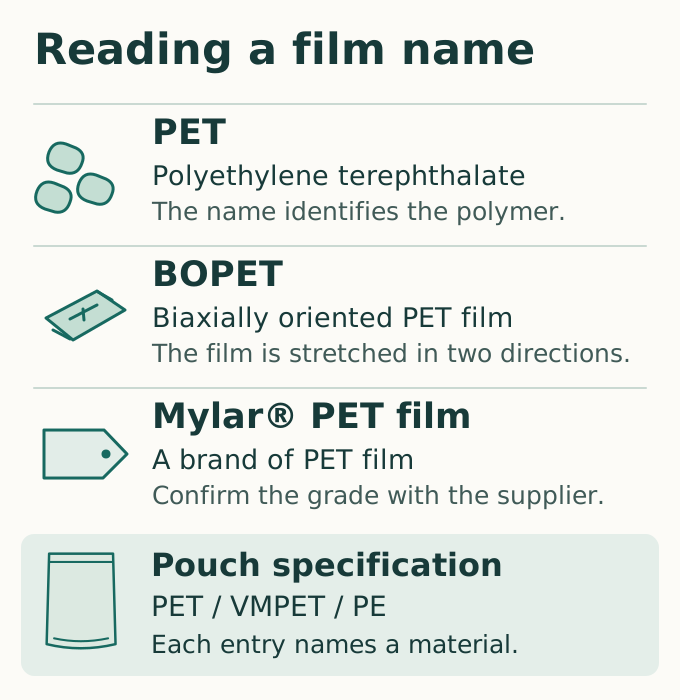
A film grade can answer a question that the brand name leaves open. For example, the maker's sheet for Mylar® OL2 identifies a PET film stretched in two directions with a heat-sealable polyester surface on one side. A buyer reviewing that grade can ask for the sealing face to be identified on a drawing. The sheet describes a specific lidding film. To establish the construction of a coffee or powder pouch, ask for the grade actually used in its wall. Manufacturer’s OL2 product sheet, page 1
How to read PET/VMPET/PE from the outside in
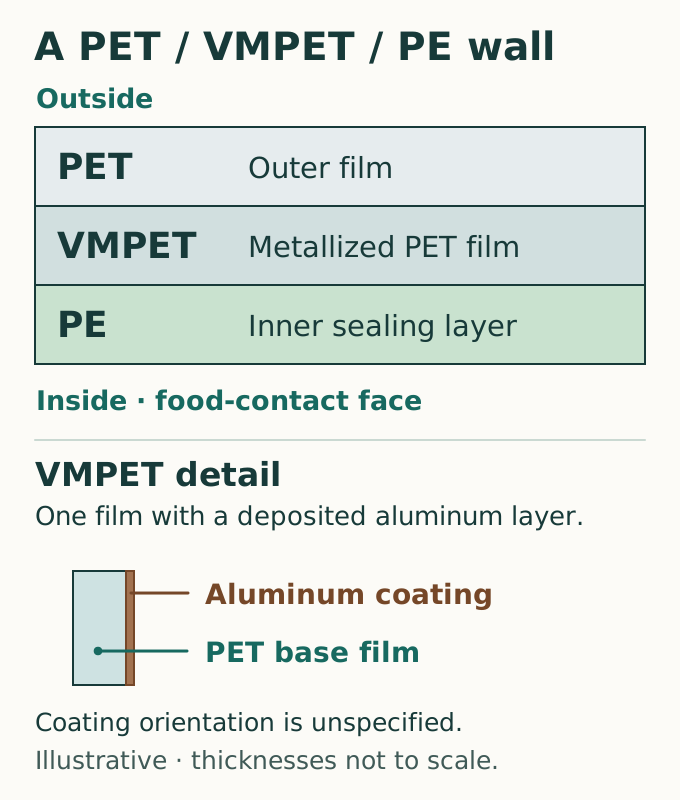
Start by asking the supplier which end of the line faces the food. Read PET/VMPET/PE as an outside-to-inside example once that direction has been confirmed. Picture one wall of the bag in your hand. You could touch the printed face with one finger and put another finger inside against the food side. The material line takes you from one finger to the other across that single wall.
The outer PET film. PET identifies the first film in this example. Artwork visible through an outer film can be printed on its reverse side and enclosed during lamination. Surface printing is also possible. If your decision concerns abrasion of printed text, a writable patch or a matte finish, ask which surface carries the ink or finish. The letters PET alone tell the printer very little about what will be exposed to handling. Flexographic Technical Association on reverse-printed laminates
The VMPET film in the middle. Read this as one specified film made with a PET base and deposited metal. The PET in this abbreviation belongs to the metallized film. It is separate from the PET named at the beginning of the material line. This accounts for something that puzzles buyers looking at a section drawing for the first time. Three entries can describe a construction with more than three physical constituents. Ask for the coated face if that detail matters to a change you are evaluating. The material shorthand does not say which way the metallized face points. How vacuum metallizing deposits metal on a film
The PE sealant on the inside. PE stands for polyethylene. In this example the PE surface of one pouch wall meets the PE surface of the opposite wall at the top seal. That is the surface your filling team needs to identify. The team can then ask the supplier for the sealing guidance for that grade and trial the sample on its own equipment. The abbreviation supplies neither a machine setting nor a description of every constituent in the sealant film.
| Entry | What the letters describe | Where it appears in an example | What to ask for |
|---|---|---|---|
| PET | Polyethylene terephthalate, a polyester | Outer film in PET/VMPET/PE | Manufacturer and grade if a specific film is required |
| BOPET | Biaxially oriented PET film | A more specific description of a PET film | Which film in the quoted construction has this designation? |
| VMPET | Vacuum-metallized PET film | Middle film in PET/VMPET/PE | Deposited material, film grade and coated face if relevant |
| AL | Aluminum foil where the supplier identifies it as foil | Middle entry in the fruit powder example below | Written confirmation of foil and its nominal thickness |
| PE | Polyethylene | Inside sealant in this outside-to-inside example | Food-contact face, sealant specification and intended filling conditions |
A layer list may leave out the ink, bonding adhesive or a surface coating. If one of those details affects the pack you intend to buy, ask the converter to annotate the drawing at the relevant interface. A cross-section that looks complete can still omit the very surface you need to identify.
Keep the supplier's original line in the order file even after you expand the abbreviations. A convenient internal description like “three-layer silver film” loses both the polymer names and their order. If purchasing uses that description on a repeat order, a different combination could meet every word of it. Copy the original wording in one field and put your interpretation in the next. If the supplier uses a plus sign or a trade code, ask what it means in that company's system before converting it into your own notation.
Where is the aluminum?
Aluminum can be deposited onto a film, or a pouch maker can laminate a separate sheet of aluminum foil between other materials. With metallized PET, the PET film carries the deposited metal. With a foil laminate, foil appears as its own component. Both may put a metallic surface somewhere in the construction. The distinction a buyer needs is whether the supplier is quoting a metal coating on a carrier film or an actual foil ply. A request to “keep the aluminum” leaves both possibilities open.
Ask the supplier to name the middle component of the proposed pouch wall in full. If the answer is aluminum foil, ask for the foil thickness and units. If the answer is a metallized film, ask for the carrier polymer and the film grade or specification number. The resulting records describe different things. A figure for the total thickness of a metallized film, for instance, includes the carrier. Entering it as a foil thickness on a buying sheet changes the meaning of the figure.
A window gives you a different clue. It shows where you can see through the finished pouch. You can outline the transparent area on a photograph and check whether the product will be visible behind the artwork. To identify the materials there, ask for a drawing that labels the clear area and the surrounding body. A transparent film can carry opaque print outside the window. Other constructions can produce visible and opaque regions by different means. Repeating the body's material description in the window field without checking can carry that mistake into a test request or the next artwork revision.
Read the material lines on three actual food pouches
These three projects use stand-up pouches. One specifies metallized PET, one identifies aluminum foil and one lists PET and PE. The table preserves the spelling on each project page so that you can find the original material field and see which questions it answers.
| Pouch | Published material field | What the project identifies | What to ask for next |
|---|---|---|---|
| 16 oz coffee pouch with valve | pet/vmpet/pe | Metallized PET in the middle of the pouch wall | A wall specification in outside-to-inside order and a separate reference for the fitted valve |
| Baobab fruit pulp powder pouch | matopp/al/pe | Matte oriented polypropylene, aluminum foil and polyethylene | Foil thickness on the proposed construction |
| Dried sea moss pouch with windows | PET/PE | A PET and PE laminate, with a printed center and clear sides | A drawing that identifies the window area and its construction |
The metallized film in a coffee pouch with a valve
The coffee project lists PET twice in different forms. Read the first entry as PET film. Read the whole middle entry, VMPET, as another PET film that has been metallized. If you shorten both entries to “polyester” on a purchase order, the supplier loses the detail that distinguishes those two films. If you write “aluminum foil” instead, you request a different construction. The project page names the metallized core in its description of this 16 oz coffee pouch. 16 oz coffee pouch project

Imagine a roaster ordering the same pouch for a second label design. The artwork proof is a good place to approve the new lettering. The material approval should point to the agreed wall specification. Record the valve model and its location on the pouch drawing as well. If a supplier later sends a sample of the printed film for color approval, you can approve the color on that sample and leave the valve position open until you see a converted pouch. If the artwork changes again next season, the production team can see which material and valve details were already agreed for that pack.
The foil behind the white face of a baobab powder pouch
The baobab fruit pulp powder pouch has a white printed face. The decisive detail is in the middle of its material field, where al appears on its own. The project description spells that entry out as aluminum foil. The first entry, MATOPP, identifies matte oriented polypropylene. A buyer can therefore specify both a matte exterior and a foil layer, even though the finished face reveals little about the material beneath the print. Baobab powder pouch project
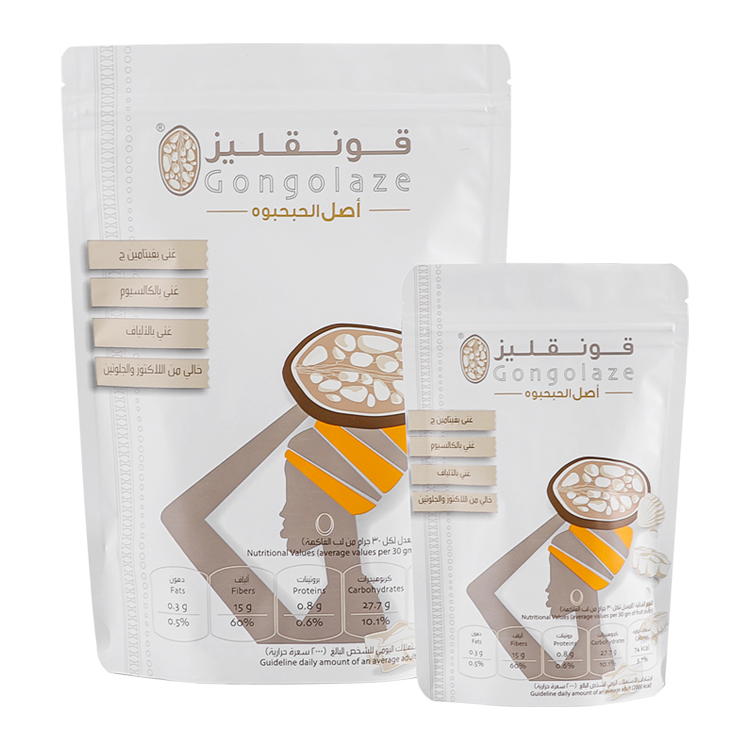
This distinction matters when requesting a second quote. “Match the white matte sample” gives the printer a visual target. If the foil is a requirement, put “aluminum foil” on the material line and ask both suppliers to state the proposed foil thickness. One supplier may give a thickness for the finished laminate while the other quotes a foil gauge. Enter each figure beside the object it measures. Ask for the missing value before comparing the quotes, and keep the approved appearance sample alongside the written construction.
The clear areas on a dried sea moss pouch
The sea moss project lists PET/PE and describes a printed center panel with clear areas at the sides. Its description identifies PET on the outside and PE on the inside. The published material field lists only those two polymers. Someone working from the silvery appearance alone could easily add an extra material to the brief. The useful detail to carry forward is where a shopper should be able to see the product. Dried sea moss pouch project

Mark one clear area and one printed area on a copy of the artwork. Ask the supplier to describe the films at both marks and show where the print ends. This gives the designer a boundary to work with and gives the packaging buyer two identifiable locations for follow-up questions. If a report later arrives labeled only “PET/PE,” send the marked drawing back with it and ask where the specimen came from. The answer determines which part of the proposed pouch the report can help you assess.
What can a barrier report tell you about the bag in your hand?
Imagine that the sea moss pouch has prompted a new design with a larger window. A supplier emails a data sheet headed “high-barrier film.” The sheet gives a number to two decimal places. Your immediate question is where the specimen came from. It could be a piece of the middle film before it was laminated, a sample cut from the finished pouch wall, or material from another job. The precision of the number settles none of those questions.
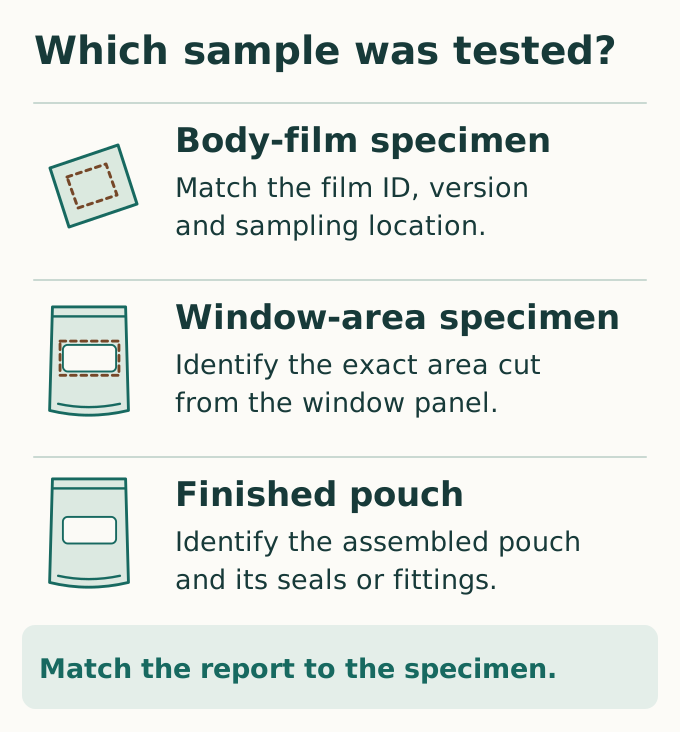
Start with the sample description on the report. Find the supplier's reference, the material revision, the thickness and the part that was tested. Ask the supplier to mark the position on the same drawing used for the quote. If the specimen was a flat piece cut from the opaque body, file the result against that body material. A piece from the window answers a question about the window. A measurement of a complete pouch requires a package test and a description of how the pouch was prepared and closed. A buyer investigating a fitted valve would also want to know whether the tested package included it.
Then read what was measured. Oxygen transmission rate (OTR) describes the rate at which oxygen passes through the specimen under stated conditions. Water vapor transmission rate (WVTR) concerns water vapor. A film report may express OTR in cubic centimeters per square meter per day and WVTR in grams per square meter per day. Copy the full units as reported, including any pressure terms. A test on a whole pack may give a result per package per day. A spreadsheet column headed simply “barrier” discards the distinction between the two substances and between a square meter of film and a single pack.
Keep the method, temperature and humidity beside the result. ASTM F1927 is one example of a method for oxygen transmission through barrier material at controlled relative humidity. ASTM F1249 addresses water vapor transmission through film and sheeting. If two suppliers cite the same method, look at the actual test conditions on both reports before comparing their figures. And if the result is shown with a less-than sign, retain that sign when you copy it. Replacing it with zero or an exact value changes what the laboratory reported. ASTM F1927 · ASTM F1249
What should purchasing do with the hypothetical data sheet? If the supplier can link it to the quoted body material and identify the test conditions, record that limited result. Keep the larger window as an open item until its construction and the evidence relevant to it are clear. If your aim is to establish how long the packed food will keep, hand the product, intended storage conditions and final pack to the team responsible for shelf-life evaluation. A film transmission result cannot supply that date. For the fields to compare when two suppliers send different reports, see how to compare barrier data under matching conditions.
Turn “silver Mylar food pouch” into a purchase specification
Start with the food and what happens to it. “Dry ground coffee, filled at room temperature, sold in the United States” gives the supplier a different task from “liquid product filled hot.” Include the relevant filling temperature and intended storage if you know them. Mark an undecided process as open. The supplier can then flag a proposed construction that depends on a particular use. For a U.S. food-contact review, the FDA's reference tables distinguish food types and conditions of use. Those fields are worth including when you request documentation for the finished construction. FDA food types and conditions of use
Copy this material sign-off sheet into the quote request. Fill the first two rows yourself and ask the supplier to complete the technical entries. In the last column, put a drawing number, specification revision or sample ID that someone else can retrieve. Give open questions to a named person on your buying or packaging team before placing the order.
| Field | Supplier wording or buyer input | Buyer's reading or question | Evidence, revision or open item |
|---|---|---|---|
| Product and use | Food ___ / fill process ___ / sales market ___ | Expected packing and storage conditions ___ | Product brief ___ |
| Appearance | “Silver Mylar food pouch” or marked photo ___ | Silver needed on front, interior or both? ___ | Artwork or appearance sample ___ |
| Pouch body | Exact outside-to-inside sequence ___ | Name the metal-containing layer, if present ___ | Supplier material specification ___ |
| Thickness | Per-ply and total thickness, units and tolerances ___ | For one pouch wall? Nominal or measured? ___ | Drawing or measurement record ___ |
| Contact and seal | Food-contact surface ___ / sealant grade ___ | Which grade and use conditions are covered? ___ | Supplier supporting document ___ |
| Window and fittings | Clear area ___ / fittings ___ / none | Does each part have a separate specification? ___ | Marked drawing and part numbers ___ |
| Barrier evidence | Sample ID ___ / test and result ___ | Material, sampled area or complete pouch? ___ | Method, units, conditions, report ID ___ |
| Sample and release | Sample code ___ / quote revision ___ | Agreed items ___ / outstanding items ___ | Approval owner and date ___ |
If you only have a photo, send it with a short request.
We want to match the visible finish of the attached pouch for [food and filling process]. Please list the body materials from the outside to the food-contact side and identify the sealant. If the structure contains metal, tell us whether it is foil or a deposit on a film. If the design has a window, please mark its construction on the drawing. Please identify the specimen covered by any barrier figures you quote.
When the sample arrives, put its reference on the sheet before passing it around. The designer can initial the appearance line against the printed sample. The person running the filling trial can record the material revision actually tried. If the supplier proposes a substitution after either review, request the changed line in writing and decide which check to repeat. A different outer finish might call for another appearance sample. A changed inner sealant gives the filling team a reason to revisit its seal trial even when the front still looks right.
For a roll of film to run on your own equipment, add the winding direction and which side faces the product as it runs through the machine. The plastic films and rollstock guide lists the roll details to discuss with a supplier. If you already have a sample or material line you want quoted, include its reference and your open questions in a packaging or sample inquiry.
Frequently asked questions
Is Mylar a type of plastic or a type of metal?
Mylar® PET film is a branded polyester film. PET is a plastic. A finished pouch can gain a metallic appearance from an additional component, such as metal deposited on a film. To answer a question about a particular silver bag, look up the laminate used to make its walls.
Is every PET film a Mylar® brand film?
PET identifies the polymer. Film suppliers sell PET under different names and in different grades. If your customer specifies Mylar® PET film, request the manufacturer's grade and its supporting document. A quotation listing PET alone leaves that purchasing requirement unresolved.
Does every food pouch sold as a Mylar bag contain aluminum foil?
No. Look for an explicit foil entry on the material specification. In the coffee example, VMPET identifies metallized PET. The baobab powder project identifies a separate aluminum foil ply. The sea moss project lists PET/PE. All three records are more informative than the color of the sample.
Which layer of a PET/VMPET/PE pouch touches the food?
If the supplier confirms this is the body-wall sequence from outside to inside and identifies PE as the inner sealant, the PE face is on the food side. For a pouch with a valve or other fitting exposed to the contents, ask for the contact materials of that component separately.
How can a pouch have a clear window and a metallic-looking body?
One design can use transparent film with print covering selected areas. Another can incorporate a different construction in the window. To reproduce a sample, mark the area that must remain clear and request a description of both regions. Use the supplier’s annotated drawing to identify the sequence at the window.
Can two pouches of the same thickness use different materials?
Yes. A total thickness figure for one pouch wall describes the combined construction. One supplier might change the sealant thickness or the middle material while keeping a similar total. Compare the ordered material names and individual thicknesses, then match each quote to its own sample. That gives you a written basis for deciding what to approve.