
Candy bags can look puffy because of their original fill and headspace, changes in temperature or outside air pressure, or gas produced after packing. A photograph cannot identify the cause or establish food safety. If a bag becomes unusually swollen, leaks, or differs unexpectedly from its normal appearance, do not taste the candy to investigate. Contact the brand with the product details, lot code, photographs, and storage or travel history.
This guide separates basic packaging explanations from decisions that require product records or testing. It is written for consumers reporting an unusual pack and candy businesses investigating complaints. The food-safety references are primarily U.S. sources, checked in September 2026; they do not provide a diagnosis for a particular candy or batch.
First establish whether the package actually changed
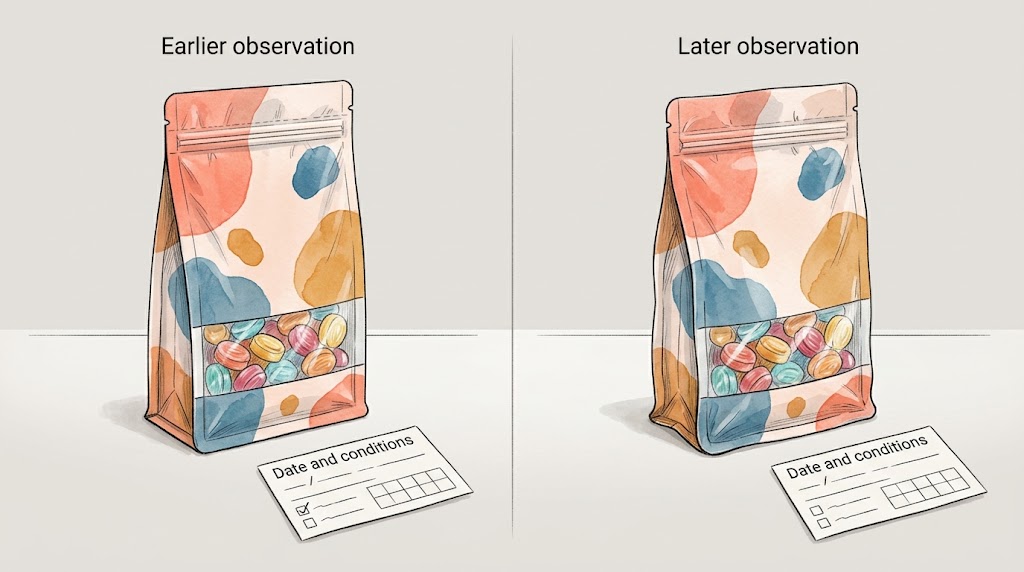
“Puffy” can describe a normal pouch with room around the candy, a bag whose folded base has opened, or a package that has become noticeably more distended. Those observations should not share one automatic explanation. Start by describing what you can see and when you first saw it.
An unopened bag photographed on a table may look different when held upright. Loose pieces can settle, and a folded bottom can spread. A change in silhouette is not itself a measurement of internal pressure. Record the package in a consistent position, without squeezing it, so the brand can compare like with like.
The strongest comparison is with the same product, pack size, and packaging version under known conditions. A small hard-candy packet is not a useful reference for a larger pouch of soft sweets. Even two bags with similar artwork may have different fills or constructions. Include identifying details with each photograph rather than assuming the reviewer will recognize the version.
If you did not see the package before delivery, say so. “It arrived looking like this” is a reliable observation; “it inflated during the flight” is a conclusion that needs additional evidence. Separating those statements prevents the investigation from starting with an assumed cause.
For a brand, an approved reference image can establish intended presentation, but it cannot replace a record of the actual production lot. Keep the reference alongside the filling specification, finished-package checks, and sample identity. That combination is more useful than an isolated marketing photograph.
What to do with an unexpectedly swollen candy bag
Avoid opening a suspect pack merely to release pressure, smell it closely, or taste a piece. If it is already open, do not use an acceptable smell or appearance to decide that the rest is safe. The FDA's food-storage guidance explains that food can cause illness without looking, smelling, or tasting spoiled, and advises discarding food that looks or smells suspicious.
Keep a suspect package separate from food ready to serve while seeking the manufacturer's handling or disposal instructions. Photograph the intact exterior and readable codes if that can be done without manipulating it. Do not keep a leaking or clearly deteriorating product solely to preserve a sample; ask for instructions and prioritize safe handling.
At a shop, bring an unusual package to the retailer's attention rather than buying it for comparison. FDA packaging guidance advises consumers to avoid damaged or unusual-looking products and to examine packaging. This does not mean that every rounded pouch has been tampered with. It means the normal condition of the exact pack matters, and an unexplained departure deserves attention.
Send the brand facts it can act on: the full product name, size, lot code, printed date, purchase location, and whether the bag was opened. A refund request and a quality investigation may follow different procedures, so ask what information is needed for each. Serious product concerns can also be raised through the FDA's reporting information in the United States.
Gas already in the bag is different from gas added later
The space around the candy contains gas unless the packaging process has deliberately removed it. That gas may simply be air remaining when the pack was closed. A brand may instead use a specified atmosphere during filling, but the bag's shape does not identify which process was used.
Modified atmosphere packaging replaces the original atmosphere with a selected gas composition. Equipment manufacturer WITT describes gas mixing and analysis for this purpose. That establishes MAP as a packaging process, not a finding that every candy bag contains nitrogen or that a particular brand uses it.
If a supplier or customer says, “It is just nitrogen,” ask for the product's filling specification and relevant production record. An empty-pouch manufacturer may know the film and bag dimensions without knowing what the candy packer introduced during filling. Keep those responsibilities distinct when requesting an explanation.
A larger-looking bag also does not necessarily contain more gas than it did earlier. Existing gas can occupy a different volume when conditions change. Conversely, an increase in gas quantity requires an explanation separate from temperature or outside pressure. This distinction helps a technical reviewer choose useful measurements instead of treating all expansion as one problem.
For a new project, discuss the desired filled appearance and filling method when reviewing custom candy pouch specifications. Do not choose the empty bag solely from an inflated shelf image and assume the same appearance will follow with another candy or packing line.
How pressure and temperature can affect a sealed pouch
Lower surrounding pressure can allow expansion
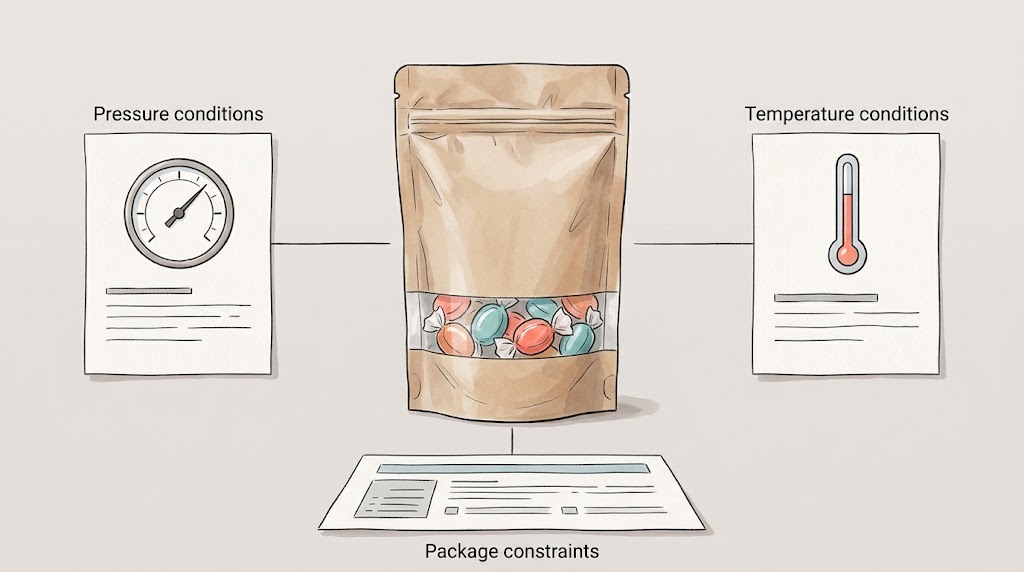
Gas presses against the surfaces containing it. If the surrounding pressure falls, a flexible pouch may expand until the forces balance or the package limits further movement. This is an application of gas-pressure principles; NASA's explanation of pressure provides the underlying relationship between gas and its container walls.
A route involving changes in elevation or a reduced-pressure transport environment is therefore worth recording. It is not enough to know that a parcel traveled by air: the conditions experienced by the package must be established. Do not substitute a flight's cruising altitude for a measured or documented cargo environment.
For an investigation, ask where the bag was packed, where the change was first observed, and what is known about the journey. If those records are unavailable, label the pressure explanation as a possibility. A technically plausible story is not the same as a demonstrated cause for the complaint.
Warming can change the gas state
For a fixed quantity of ideal gas, pressure, volume, and absolute temperature are related. Warming can increase volume when pressure is held constant, or pressure when volume is constrained. A flexible pouch may show a combination of changes. The NASA equation-of-state explanation also makes clear that temperature in these calculations must be absolute temperature, such as kelvin.
As a simplified model, for a fixed amount of gas:
V₂ / V₁ = (P₁ / P₂) × (T₂ / T₁)
Use absolute gas pressures, not gauge readings, and kelvin temperatures. The examples below are calculations for an idealized gas space, not measurements of candy packages or recommended storage conditions.
The pressure-only example also follows Boyle's law. In an actual pouch, gas volume is only part of the internal volume: candy occupies space too. Film tension, available folds, restraint from a carton, and changing conditions prevent a simple volume ratio from predicting the visible bag dimensions.
Do not turn these examples into an at-home heating, chilling, or pressure test. A bag becoming less distended after conditions change would still not establish whether its contents are safe. Controlled reproduction belongs in a planned packaging investigation, with the product kept out of normal distribution until the responsible team has made its decision.
Product-related gas needs a separate investigation
Some microbial fermentation pathways produce gas. OpenStax's microbiology text describes gas production in fermentation, including carbon dioxide from yeast metabolism. That general mechanism is a reason to consider product condition when swelling is unexplained. It is not evidence that fermentation occurred in a specific candy bag.
Candy is not one uniform food. A dry hard sweet, a soft filled piece, and a confection containing several ingredients may require different assessments. The recipe name or sweetness does not provide measured water activity, processing history, or microbiological results. Avoid using a generic claim that sugar “preserves everything” to dismiss a complaint.
The FDA's technical discussion of water activity distinguishes available water from total moisture and explains its relevance to microbial growth. For a candy investigation, use product-specific measurements and qualified interpretation. A threshold copied from a different food or regulatory category cannot clear the finished batch.
If swelling developed during storage without an established physical explanation, the product owner should involve its quality or food-safety team. The useful question is what happened to this formulation under these conditions, not which organism an online photograph resembles. Testing must be selected for the product and the investigation; naming a microorganism without evidence adds certainty the record does not support.
Record the sequence before changing the package
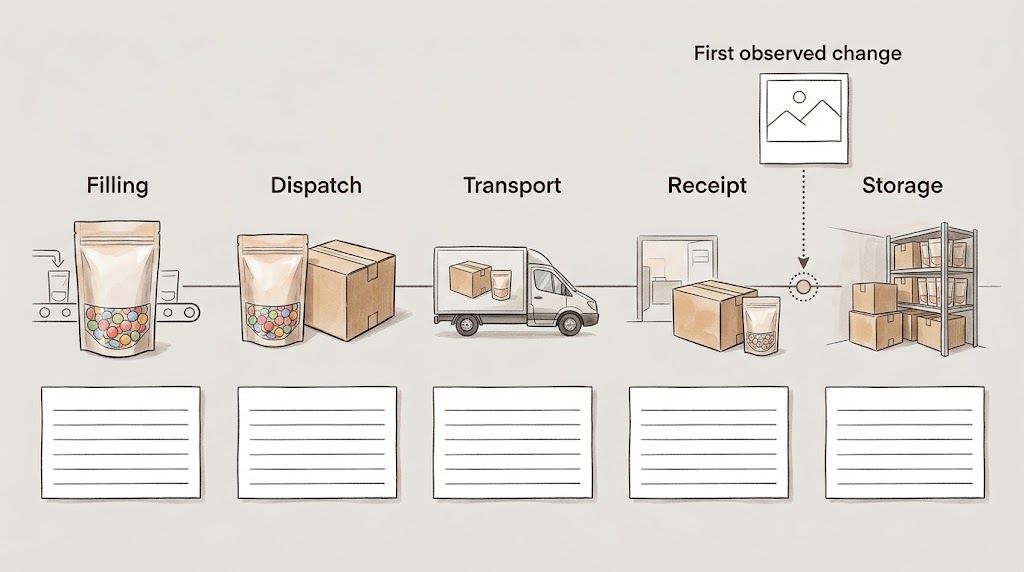
A short timeline often exposes what information is missing. Start with the earliest documented state, then add filling, dispatch, receipt, storage, and the first observation of change. Keep exact observations separate from recollections. A recorded warehouse temperature is different from someone remembering that the day felt warm.
For each stage, note who supplied the information and which units it concerns. A temperature logger in one carton does not automatically describe every parcel in a shipment. A photograph of a retained sample does not describe a customer's bag that traveled elsewhere. Both may be useful when their limits are clear.
Report counts with a denominator whenever possible. “Three unusual bags among twenty checked” says more than “several bags.” Identify whether the twenty were selected because they looked abnormal or sampled according to a plan. A complaint count alone cannot establish a lot-wide defect rate.
Use neutral wording in the first record. “Front panel became more rounded between the receipt photograph and the later photograph” leaves room for investigation. “Bad gas seal” assigns a cause before the seal or gas has been examined. Clear wording helps the candy maker, packer, bag supplier, and carrier work from the same evidence.
Compare samples without losing their identity
For a business, each sample should have an identifier tied to its product lot, pouch version, and handling history. Distinguish customer-returned units from retained production samples. A returned package may have been opened, squeezed, exposed to different storage, or placed in new outer packaging; record what is known instead of silently treating it as untouched.
Choose comparisons that answer a question. A same-lot retained sample helps examine the production baseline. A unit from the same destination helps examine a route pattern. A different lot using the same pouch version may help identify what changed, but it introduces another product history. No single comparison isolates every variable.
Plan the order of observations and tests before consuming the available samples. Opening a package changes its atmosphere. A puncture used for gas sampling changes its integrity. An immersion test changes the sample's handling history. Record what has already been done so a later result is not interpreted as if it came from the original unopened pack.
Consumers should not be asked to recreate laboratory conditions. Clear exterior photographs and readable codes are an appropriate starting point. If a physical sample is needed, the brand should provide handling and return instructions suitable for the reported condition. Do not ask someone to squeeze, pierce, or reseal a questionable food package to make shipping easier.
For internal comparisons, agree on orientation, background, scale reference, and recording time. These choices improve repeatability without pretending a photograph measures gas pressure. Preserve the original images alongside any annotated copies, and keep the annotations descriptive rather than diagnostic.
A visible seal cannot answer every question
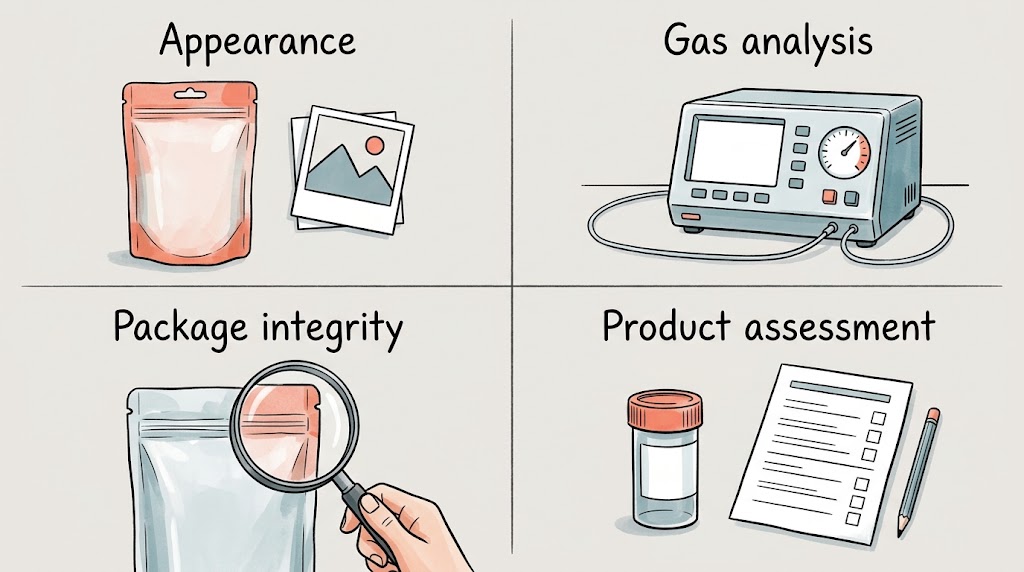
A seal that looks continuous provides a visible observation, not a full assessment of package integrity or food condition. A zipper that closes is another observation. Neither reveals the atmosphere originally introduced, what happened to the food, or how the bag behaved throughout distribution.
Start a packaging review by identifying which closure was intended to protect the unopened product and where the customer opening feature sits. Record visible folds, contamination in the sealing area, damage, or separation without assuming which feature caused swelling. A leak can alter package behavior, but finding one does not automatically explain when or why the bag became distended.
Different checks answer different questions. WITT's headspace analyzer description describes measuring selected gases in food packs. Its bubble leak-testing equipment addresses finding leaks under controlled conditions. These are distinct measurements. Neither equipment description establishes a result for the candy being investigated.
The laboratory or qualified reviewer should choose methods, sample handling, and acceptance criteria for the actual question. A favorable result needs its sample identity, conditions, and limitations attached. Avoid a report that reduces several different checks to a single unexplained “passed.”
Give the quality team a report it can use
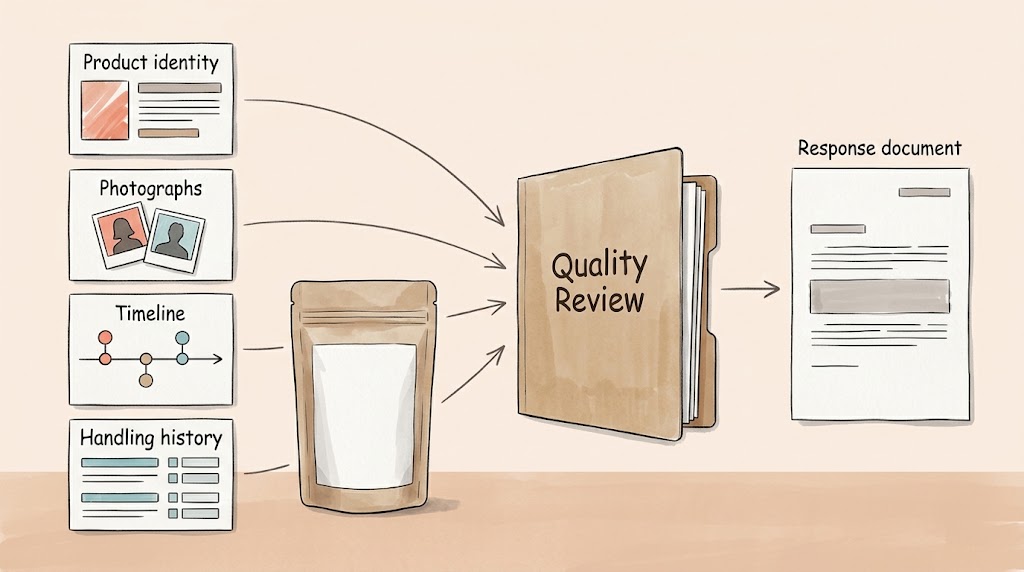
A helpful complaint report can fit on one page. Identify the product and package, describe the observed change, list when and where it was seen, and attach the relevant images. Include whether any units were opened or consumed, without asking the customer to taste more or perform a test.
For a business, add the affected inventory locations and known distribution records. The responsible quality team should determine the scope of any hold, investigation, or further action. This article cannot set a release rule from a bag photograph or prescribe a recall decision without the product facts and applicable obligations.
Give each proposed explanation an evidence status. Pressure exposure may be documented, suspected, or unknown. The filling atmosphere may be specified but not yet checked for the lot. A seal concern may be visible but untested. Recording those distinctions prevents the first plausible explanation from becoming a customer-facing assurance.
When results arrive, connect them to the original question. If a gas measurement differs from a process target, investigate that difference rather than assuming the instrument has identified its cause. If the tested package shows a leak, retain the question of product condition and timing. The final response should explain what was found, what remains uncertain, and what action the product owner has authorized.
Keep the packaging supplier's role practical: provide the pouch specification, relevant manufacturing traceability, and support for package evaluation. The candy producer retains the product formulation and process knowledge needed for food assessment. A coordinated report is more useful than asking either party to answer every question from the same photograph.
Related project: a side profile is a format reference
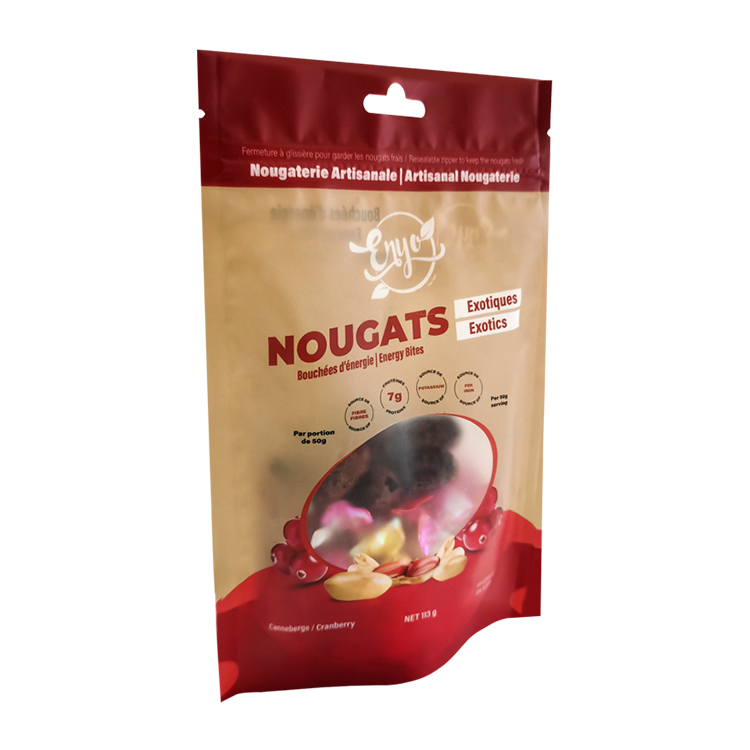
A published Mylarbag project for nougat and energy-bite pouches provides a useful reference for discussing package geometry. The record identifies a Canadian project using digital printing and MATOPP/PET/PE, with dimensions listed as 14 × 21 + 4 cm.
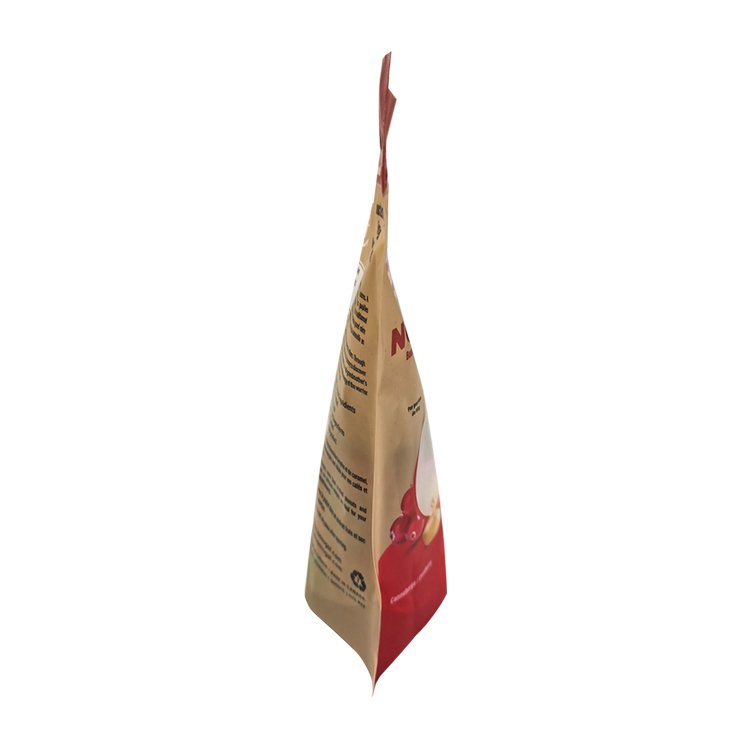
The picture shows why a front view alone is incomplete when discussing pouch shape. It provides no measured headspace, internal pressure, filling atmosphere, or before-and-after history. No swelling complaint or related test result is established by the project record, and none should be attributed to this customer.
A buyer can use the format to explain a desired standing presentation, then supply their own candy sample and filling requirements. The new project's filled appearance must be evaluated separately. A dimension on an empty-pouch drawing does not specify how rounded the finished pack should look or establish an acceptable pressure.
Recommended packaging configuration: define the filled pack
For a new candy line, begin with a pouch format appropriate to the product and display, then define the intended filling and closing process. A stand-up format may be considered where shelf presentation matters. The proposed material, size, opening features, and usable sealing area need evaluation with the actual product and equipment.
Add a filled-package reference to the development brief. Specify how the reference sample was prepared, which product it contains, and the conditions under which its appearance was recorded. If an atmosphere is intentionally introduced, keep the relevant process specification and verification plan with that reference rather than using “puffy” as the target.
Describe the distribution conditions the project must address and decide what qualification work is needed. Include carton restraint and handling alongside the retail pouch. Evaluate one defined change at a time where practical, so a different result can be connected to the changed feature rather than to several simultaneous substitutions.
Do not select a thicker film, add a vent, or squeeze out headspace as a universal solution to an unexplained complaint. A redesign needs a reason supported by the investigation and a review of its effect on the complete package. Making the symptom less visible is not evidence that the underlying issue has been resolved.
Use candy packaging options for your filling process to organize a sample discussion. Ask what the proposed bag specification covers, what the packer must establish, and which finished-product decisions remain with the quality team. That gives the next order a clearer basis than a promise that a particular pouch will never swell.
Frequently asked questions
Does a puffy candy bag always mean the candy has spoiled?
No. Original headspace and changing physical conditions can affect appearance, while an unexplained change can also require product investigation. The shape alone cannot distinguish those situations. If the bag is unusually swollen or damaged, do not taste the contents to decide. Record the details and ask the brand for handling instructions; a general explanation online cannot clear that package for eating.
Can altitude make a candy bag expand?
Lower surrounding pressure can allow gas in a flexible package to expand. Whether it explains a particular bag depends on the actual route, conditions, and package behavior. A mountain journey or air shipment is relevant information, not proof of the cause. Keep any available before-and-after photographs and route records, and avoid treating a plausible pressure explanation as a food-safety determination.
Is every inflated candy bag filled with nitrogen?
No. The gas may include air remaining at closure, or the product may use a specified packaging atmosphere. The bag's appearance cannot identify the gas or confirm how it was filled. Ask the product manufacturer about its process. A pouch supplier's material description does not show what atmosphere a separate candy packer used for that batch.
What if the printed date has not passed?
A printed date does not explain unusual swelling or override evidence of damaged or suspicious packaging. Share the date together with the lot code because they help identify the product. Do not rely on the date alone to decide whether to eat it. Follow the manufacturer's instructions for the specific concern and the food-safety guidance appropriate to the product.
Should I puncture or reseal the bag to remove the gas?
Do not puncture or reseal a suspect retail pack as a remedy. That changes its original condition, releases evidence a reviewer may need, and does not establish that the candy is safe. Keep exterior photographs and codes, then obtain handling or disposal instructions. Professional sampling, where needed, should follow an agreed procedure rather than a consumer attempt to flatten the bag.
Will a stronger seal prevent candy bags from puffing up?
Seal performance is only one part of the package. It does not identify the gas already present, eliminate changes in surrounding conditions, or resolve a product-related problem. Investigate the specific cause before changing sealing settings or materials. A revised seal should be evaluated with the actual pouch and filling process; stronger-looking closure is not a substitute for the product assessment.
Prepare a useful packaging brief
For a new specification or a packaging review, send Mylarbag the product and pouch details, target fill, filling method, destination, and available photographs or observations. State whether you are developing a new pack or investigating an existing issue. An identified sample, a clear timeline, and the relevant process records make the packaging discussion more useful while the product owner handles food-quality and safety decisions.