
Short answer: Foil can give a cream-cheese block a light-blocking, shape-holding wrap with strong material-level protection against oxygen and moisture. It is also easy to fold around a rectangular portion. Those are useful properties, but a foil sheet does not make a finished pack sterile, leakproof, or safe by itself. Fold geometry, pinholes, a food-contact coating or liner, the outer carton, filling hygiene, cold-chain control, and the actual product all matter. Spreadable cream cheese is commonly better suited to a cup or tub with a validated peelable lid and, where needed, a separate reclosure. A flexible pouch may fit a different filling and use case. The right question is not simply “foil or plastic?” It is “which complete package protects this particular cream cheese through its stated life and is practical for the buyer to open and use?”
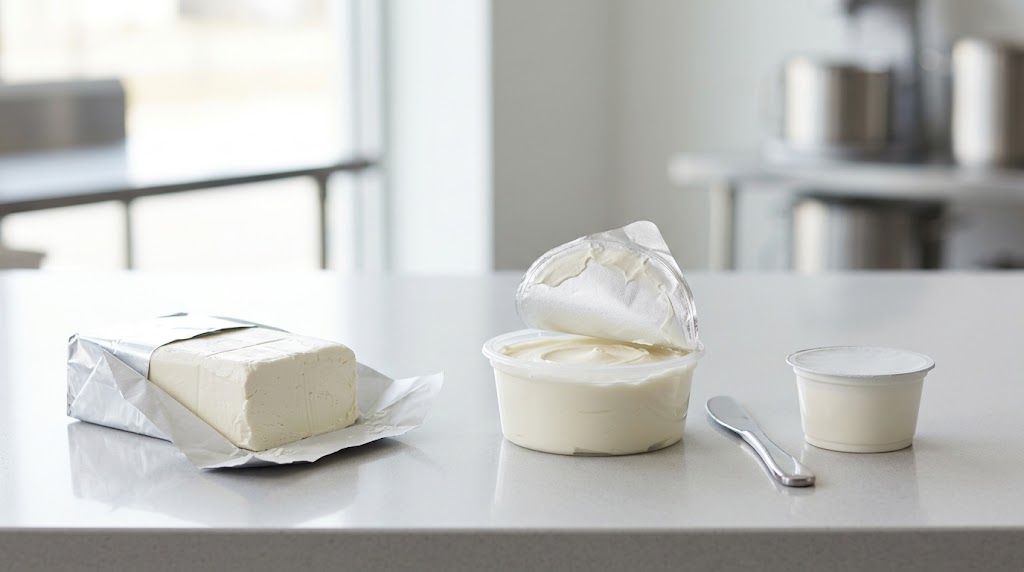
Conceptual hero image: distinct block, spread and portion formats on a clean product-planning surface; it does not claim that every cream cheese needs foil.
This guide is written for dairy brands, co-packers, packaging buyers, and converters specifying a refrigerated product. It separates the function of a foil layer from the performance of the formed and filled retail pack. The general cheese-format guide, shredded-cheese process, swollen-pack investigation, condensation guide, sealing guide, and goat-cheese style guide in this content cluster address different questions.
What Does the Foil Actually Do?
Light protection is an immediate reason to consider an opaque wrap. A bright chilled cabinet can expose a clear pack for many hours each day. The amount of light reaching the product depends on the whole package, including a sleeve or carton, window size, and display orientation. A package designer should compare cream cheese under the proposed display conditions rather than assume every clear tub fails or every foil pack succeeds.
Barrier protection is another reason. The European Aluminium Foil Association describes aluminium foil as a barrier to light, gases, and moisture and notes its characteristic “dead fold”: once pressed around a shape, it tends to retain that fold. These are properties of foil material and its formability, not a certified shelf life for a cream-cheese SKU. A tiny defect, loose fold, damaged corner, or unsuitable closure can bypass an excellent barrier layer. See the association's foil facts and properties for the material-level explanation.
Portion geometry matters just as much. A firm chilled brick can be placed into a wrap and folded in a repeatable sequence. A fluid or very soft spread requires a contained cavity and a reliable seal at the rim or pouch mouth. Even two products sold under the name “cream cheese” may have different viscosity, inclusions, exudate, and handling behavior. In the United States, 21 CFR § 133.133 defines the standardized food called cream cheese; the packaging specification still has to describe the actual recipe and process.
Foil also gives the familiar brick a recognizable unwrapping experience. That commercial advantage may be real for a particular brand. It is not evidence that a foil wrap beats a tub on every shelf, or that familiar appearance should override a failed seal or poor consumer access. If an easy-open feature damages the fold or tears the food-contact surface, the user experience has to be redesigned along with the protection.
Four questions behind the familiar silver wrapper
- Is the product a form-stable block? A foldable wrap can suit a block that holds its shape in handling. A soft, wet spread needs a more supportive package.
- What protects the product from light? The foil, an opaque cup, a printed sleeve, or a combination may provide the needed cover.
- Where is the actual closure? Identify the heat-sealed seam, folded overlap, paperboard carton, lidding rim, or other closure. “Wrapped in foil” is too vague for an integrity specification.
- What happens after opening? A disposable brick wrap and a resealable tub serve different household routines. Neither should be described as automatically extending safe use after the original seal is broken.
Foil Wrap, Tub, Lidding Film, or Flexible Pack?
Start with the physical product and filling line. A material comparison detached from the filling operation hides the failures most likely to reach the retailer.
An aluminium lid on a plastic cup is not the same package as a foil-wrapped brick. The cup wall, flange geometry, lidding laminate, heat-seal coating, overcap, and tamper presentation all affect performance. A customer may see silver on both packs, yet the layer structure and failure modes can be completely different.
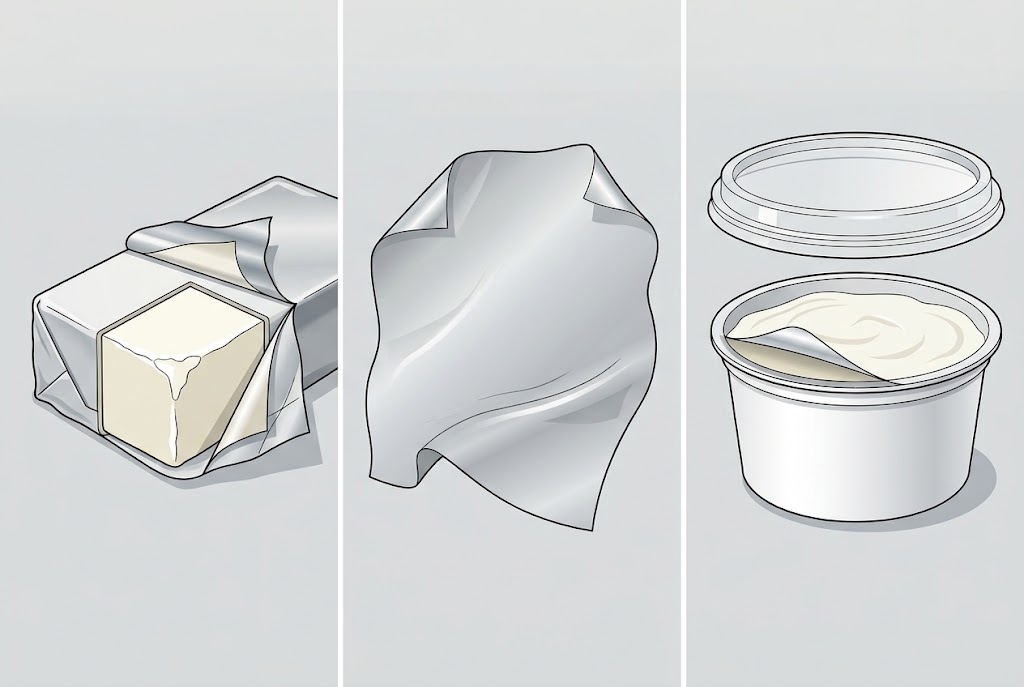
Conceptual format illustration: a wrapped block, a metallic-looking flexible film, and a tub with separate peelable membrane and overcap. Appearance alone cannot identify foil versus VMPET or establish a material's layer structure.
When a block favors a folded wrap
The block should be firm enough at the intended wrapping temperature to maintain a rectangular shape. Map the line from cutting and portioning to placement, folding, coding, cartoning, and case packing. Photograph trial packs at each handoff. A block that looks neat immediately after folding may smear the inner face or push against a corner when the case is compressed. If the product weeps, ask where that moisture will collect and whether it reaches a fold or printed surface.
An outer paperboard carton can protect the wrapper from rubbing and give the brand printable space. Specify its role honestly: a carton is a handling and display component, not necessarily the food-contact barrier. A layered wrap may contain foil, paper, polymer coating, or a heat-seal layer. Require the exact structure, not a shorthand material name. Where food touches the package, review the intended time and temperature and any relevant ingredients or flavors.
When a spread favors a tub
Spreadable cheese is often filled by volume or weight into a formed cup or tub. Here, seal-land cleanliness, lidding compatibility, flange flatness, peel force, and overcap fit are the first design questions. The cup can support the soft product and allow repeated utensil access. The overcap may improve convenience after opening, but the intact peelable membrane generally performs a different job before first use. State those roles separately on the supplier drawing.
A transparent tub is attractive on a shelf, but light exposure must be assessed for the actual product. An opaque or pigmented cup, an opaque lidding film, a sleeve, or a secondary carton can alter that exposure. Do not assume a switch to foil lidding alone shields the sidewalls. Compare the same recipe in the candidate packs under realistic case, display, and household-light conditions.
When a portion pack changes the calculation
Small cups and sachets shift the specification toward dose accuracy, opening force, tear quality, component count, and line output. A single-serve foil lid should peel without delaminating, tearing erratically, or lifting cheese over the rim. A sachet must open where intended without a burst of product. Trial participants should include people opening the pack after cold storage, not just a packaging engineer testing empty samples at room temperature.
Aluminium Foil Is Not Metallized Plastic Film
Two silver-looking materials can lead to very different briefs. Rolled aluminium foil is a thin metal sheet. Metallized PET, often written VMPET or MetPET, is a polymer film carrying a very thin deposited metal layer. A silver appearance, “Mylar” colloquialism, or decorative foil-stamped graphic does not identify which one is in the barrier construction. A metallizer's technical explanation of metal deposition describes the coating on film; the European Aluminium Foil Association describes rolled foil production and properties. Ask the converter for the layer stack and the tested barrier data rather than judging from a photograph.
In a proposed laminate such as PET/AL/PE, the outer PET can provide a print surface, AL identifies an aluminium foil layer, and the PE may serve as an inner heat-seal or food-contact layer if its exact grade and use are suitable. In a structure such as matte OPP/VMPET/PE, VMPET identifies metallized polyester. These are examples of how to read a specification, not universal cream-cheese recipes. Nominal film thickness, foil gauge, sealing layer, adhesive, and the quality of conversion all need to be documented. “Foil” may also refer casually to the metallic-looking top of a cup, even when the supplied lid has several layers and coatings.
When comparing materials, request oxygen transmission rate (OTR) and water-vapor transmission rate (WVTR) for the relevant structure, with units, temperature, humidity, specimen condition, and test method. ASTM D3985 describes OTR testing for film and laminates and explicitly notes that OTR is not the only determinant of packaged-product protection. ASTM F1249 addresses WVTR. A laboratory sheet value does not include a folded corner, a scratched web, a weak lidding flange, or oxygen already present at filling. Do not compare two supplier numbers measured under different conditions as if they are a head-to-head result.
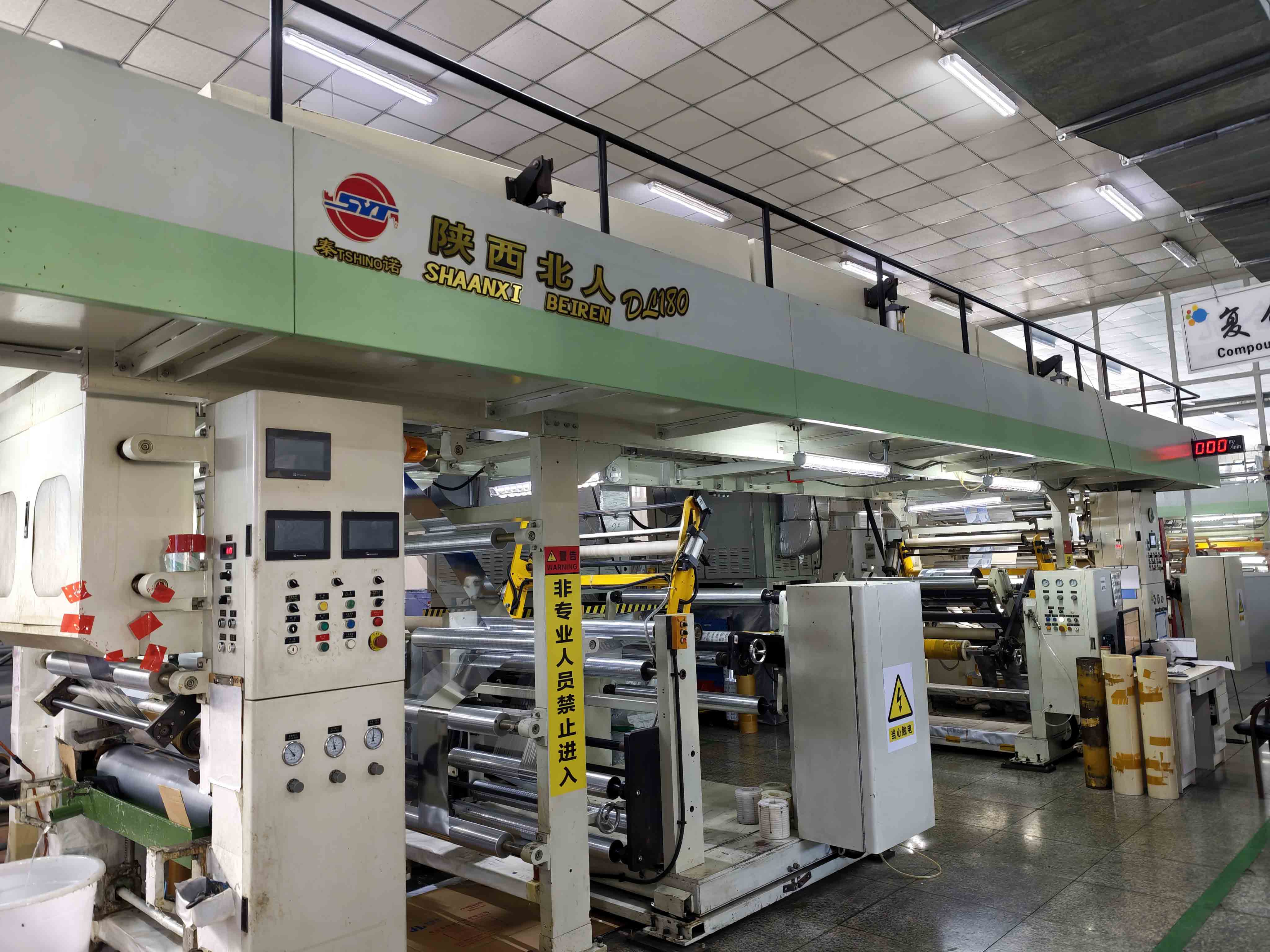
Real factory image: dry lamination capability. The equipment photograph does not establish a cream-cheese pack's OTR, WVTR, food-contact approval, or shelf life.
A real food-pouch case shows why names matter
Mylarbag's 8 oz Mexican mole-paste pouch project lists Mexico, a matte OPP/VMPET/liquid-PE construction, gravure printing, and a stand-up pouch. It is a useful non-dairy example of a metallized structure selected for a moist, oily food presentation. It is not an aluminium-foil cream-cheese wrapper, not a cream-cheese food-contact authorization, and not a measured performance result for dairy.
The transferable procurement lesson is to spell out the layers and use case. For a cream-cheese project, the buyer would still have to test the cheese's acidity, fat, moisture, inclusions, filling temperature, product contact, seal contamination, light exposure, and refrigerated distribution with candidate packs. The adjacent case proves that a named VMPET food-pouch construction exists in the supplier's portfolio. It does not prove that simply moving that pouch to a different food will work.
Beware of “foil stamping” in a sales presentation
Foil stamping is a decorative print finish. It may make a logo shine on a carton or pouch, but it is not evidence that the food package contains a continuous aluminium foil barrier layer. Put decorative treatments in the artwork specification and barrier layers in the material specification. If the sales brief uses “silver foil” for both, ask for a cross-section or layer declaration before approving a trial.
Cream Cheese Quality Is a Whole-Pack Question
A research example helps keep the material discussion grounded. In a cream-cheese thermoformed-tray study reported by Nofima, researchers compared A-PET/PE, PS/EVOH/PE, and PP/PE trays of different colors and drawing depths. The study measured sensory and volatile-compound changes under dark and illuminated storage. It found a pronounced effect of package color on photo-oxidative changes and did not find a significant drawing-depth effect under its tested conditions. Differences in oxygen transmission rates between two structures did not translate into equally large differences in all observed outcomes. This is evidence for testing the filled product under its own display conditions, not a ranking of all future foils and tubs.
That study is not a safety clearance or a guaranteed shelf-life figure. It concerns the specific cream cheese, trays, storage, and measurements studied. If a brand changes recipe, light exposure, retailer, or seal design, it needs its own evidence. Sensory quality, chemical oxidation, microbiological safety, and package integrity are related but distinct endpoints. A pack that looks clean can still have a poor seal, and a film with an excellent data-sheet OTR can still be filled with contaminated product.
Refrigeration remains a separate control. The FDA explains that Listeria can grow at refrigeration temperatures. A barrier package cannot correct contamination introduced before or during filling; neither foil nor a gas mixture makes unsafe cheese safe. The producer should own the food-safety plan and shelf-life study for its actual product and market. Packaging suppliers can provide construction and testing evidence, but should not promise a universal use-by date.
Use these four endpoints in a trial:
- Product quality: flavor, color, visible whey, spreadability, and texture at opening.
- Package integrity: fold condition, punctures, seal continuity, peel force, leaks, and damage after transport.
- Process control: fill mass, headspace, rim or seal contamination, cooling, code legibility, and line rejects.
- Food safety: producer-controlled sanitation, microbiological program, time-temperature history, and label review.
Light, oxygen, and moisture are not interchangeable
An opaque foil or printed wrap blocks a light pathway, but it does not remove oxygen already incorporated during mixing or trapped in headspace. An oxygen-barrier film can slow ingress through intact material, but a pinhole or channel leak creates a different route. Moisture transport through the wall is separate from whey release inside the pack or condensation on the exterior after a cold package meets warm humid air. Record which failure the team is trying to solve before adding a layer, changing a lid, or increasing gauge.
For a block, examine where the product touches folds and corners. For a tub, inspect the lidding flange and sidewall. For a sachet, inspect longitudinal and transverse seals and the tear zone. If the target problem is photo-oxidation, test in the intended illuminated display. If the problem is whey on the lid, a more opaque barrier may not address it. If the problem is weak seals, a material-only OTR comparison is the wrong first test.
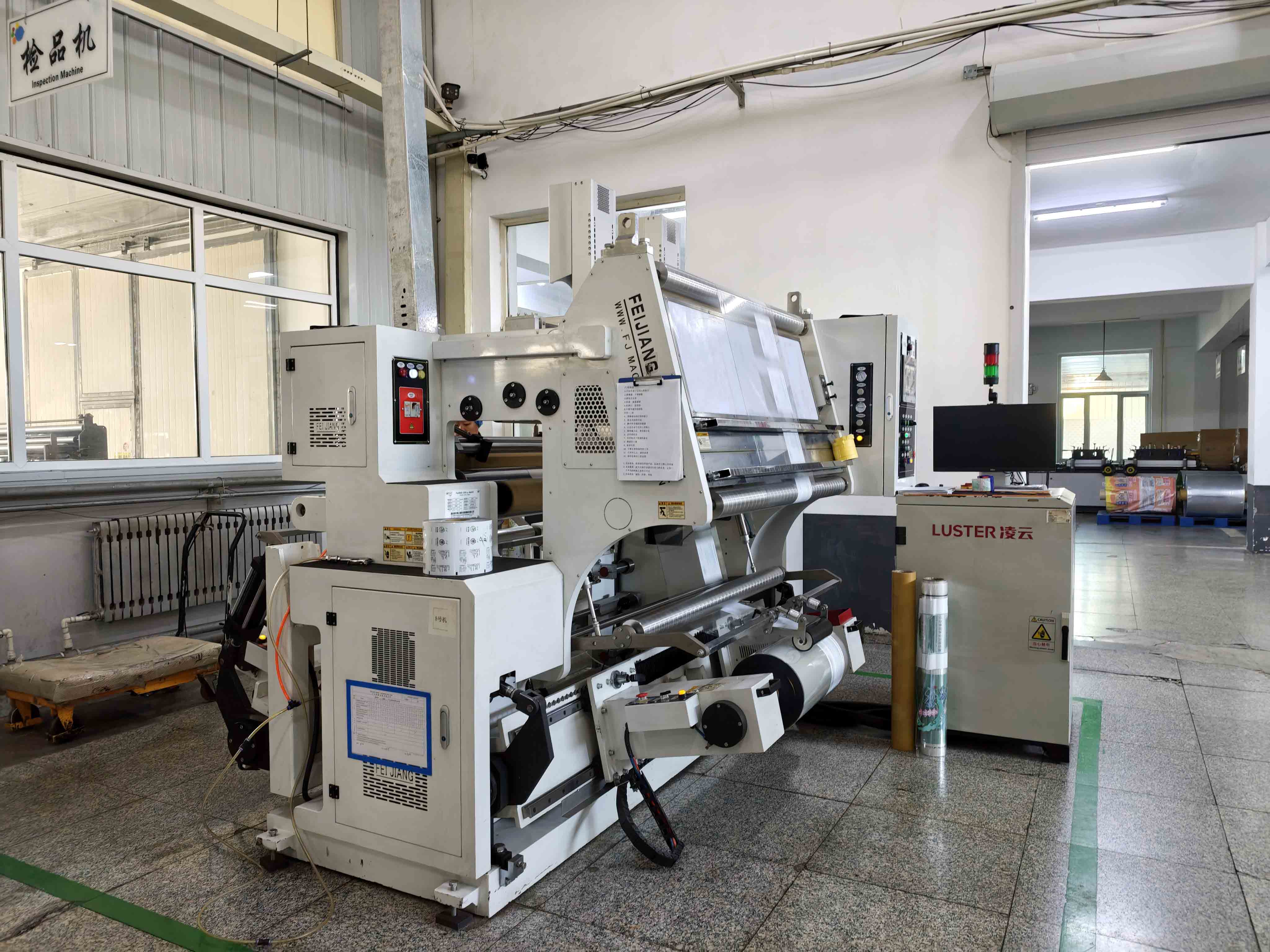
Real factory image: converter-side web inspection. Finished filled-pack defects and shelf-life performance require separate product-specific checks.
Test the Fold, Flange, and Seal
Write the closure map before ordering printed stock. On a wrapped brick, draw the end folds and any seam that provides the claimed closure. On a tub, identify the entire flange circumference and the intended peel tab. On a pouch, identify every heat-seal band, corner, fitment, and tear initiation point. Then sample the highest-risk locations at normal and challenged line conditions.
Pinholes and flex damage. Look at incoming foil or laminated web, then at packs after folding, cartoning, and transport. A bright-light inspection or suitable package-integrity method can help locate defects, but choose the procedure for the actual opaque or multilayer construction. Never infer that a visual “no pinholes seen” check proves a microbiological barrier. Compare samples from line start, steady state, roll change, and after case compression.
Seal contamination. Cheese, whey, fat, or inclusions in a heat-seal area can alter seal formation. Run a clean-seal baseline and realistic contaminated-seal challenge using the filling equipment. Record sealing temperature, dwell, pressure, jaw condition, fill speed, and reject rate. A broad “high barrier” claim does not address an intermittent product smear on the flange.
Seal strength and leak location. ASTM F88/F88M provides a method for seal-strength measurement; it is useful for process control and opening-force decisions. It does not alone prove that the whole retail package is leak-free. ASTM F3039 describes dye-penetration methods for locating leaks in nonporous packaging or flexible barrier materials. Its test is destructive and qualitative, so set the sampling plan and acceptance criteria for the project. Choose additional integrity methods with the dairy's quality team as appropriate.
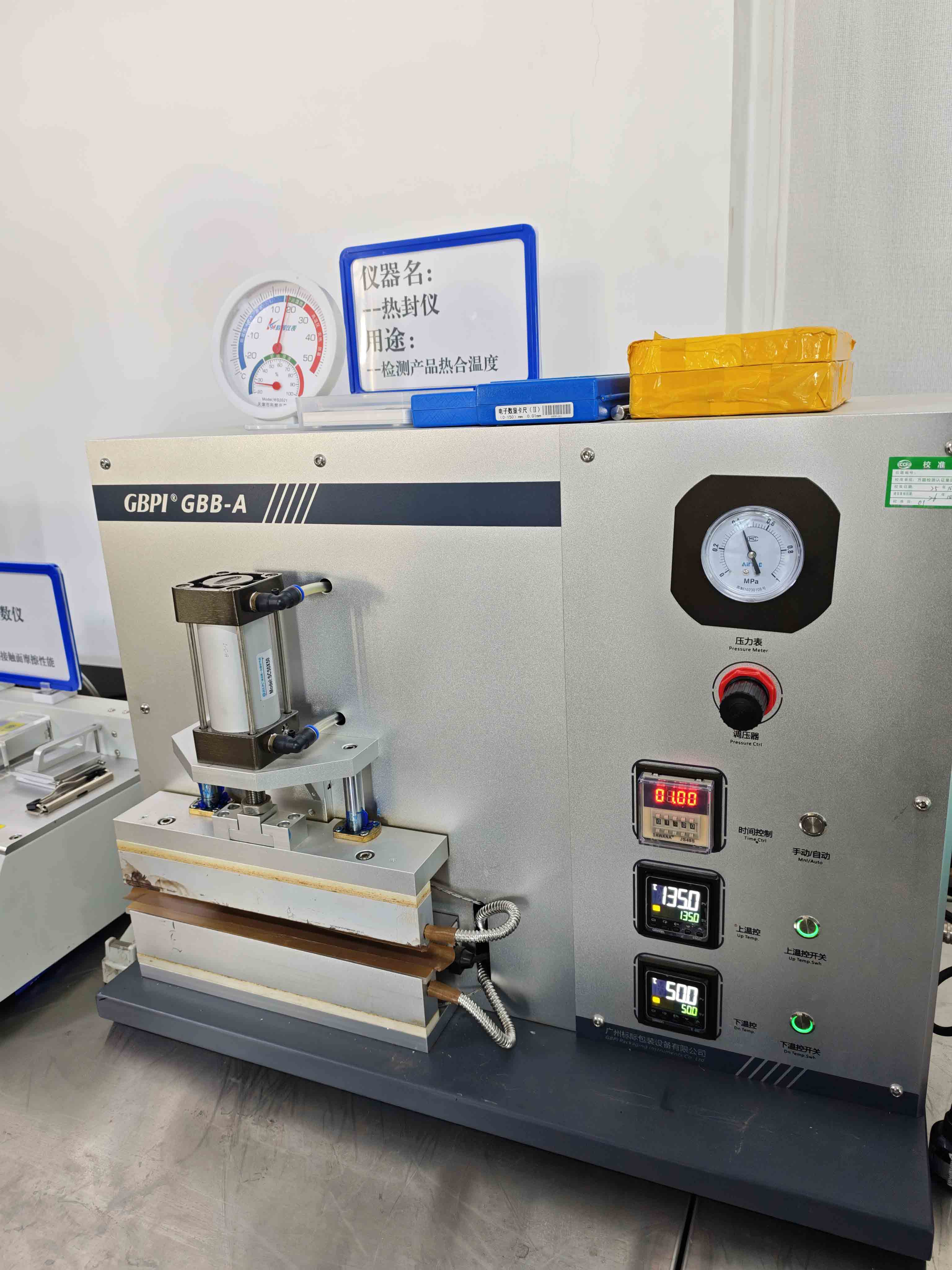
Real factory image: seal-test equipment. The photograph does not report a result for a cream-cheese pack.
Do not skip the cold opening test
Peel a lidded tub or unwrap a brick at the temperature at which a buyer will use it. Does the lid peel in one piece? Does the foil tear at the intended tab? Does product adhere to the wrapper and create waste? Does the fold allow a partially used block to sit in its carton without spreading cheese onto the print? These are measurable design observations. Record user actions and complaints, then change the geometry or laminate rather than assuming a stronger seal is always better.
For a sealed tub, seek an opening-force window that balances integrity with access. For a folded wrap, repeat the folding pattern consistently and document whether the outer carton contributes to handling. For a sachet, test the tear path across production tolerances and any printed mark. If the package cannot be opened neatly, there is little comfort in an impressive flat-film barrier number.
Food-Contact, Print, and Label Questions
Specify which surface touches the cream cheese. Aluminium foil may be lacquered, laminated, or combined with paper and plastic; a tub lid may have inks, adhesive, primer, foil or metallized film, and seal coating. The food producer needs documentation for the entire proposed use, not a generic “food grade” phrase. The FDA's component-status guidance explains that the status of a food-contact material depends on its component substances and conditions of use. Obtain the applicable market-specific assessment for the actual contact conditions.
An acidic or flavored spread, oily inclusion, or warm filling operation can change the relevant contact question. Keep the recipe and temperature window in the brief. Do not borrow a claim from a coffee pouch or sauce pouch and relabel it as dairy compliance. If the product is sold outside the United States, review the destination-market rules and exact structure; an FDA-oriented document is not a worldwide certificate.
Print and coding have their own failure paths. Put the date code where a fold, rub point, condensation, or consumer peel will not erase it. If a carton carries the main branding, confirm that the primary pack and multipack still carry the information required for the intended sales channel. Proof the barcode on the curved tub or folded brick as sold, not on a flattened dieline. On a foil-based wrap, check how ink, coating, and fold sequence interact under cold handling.
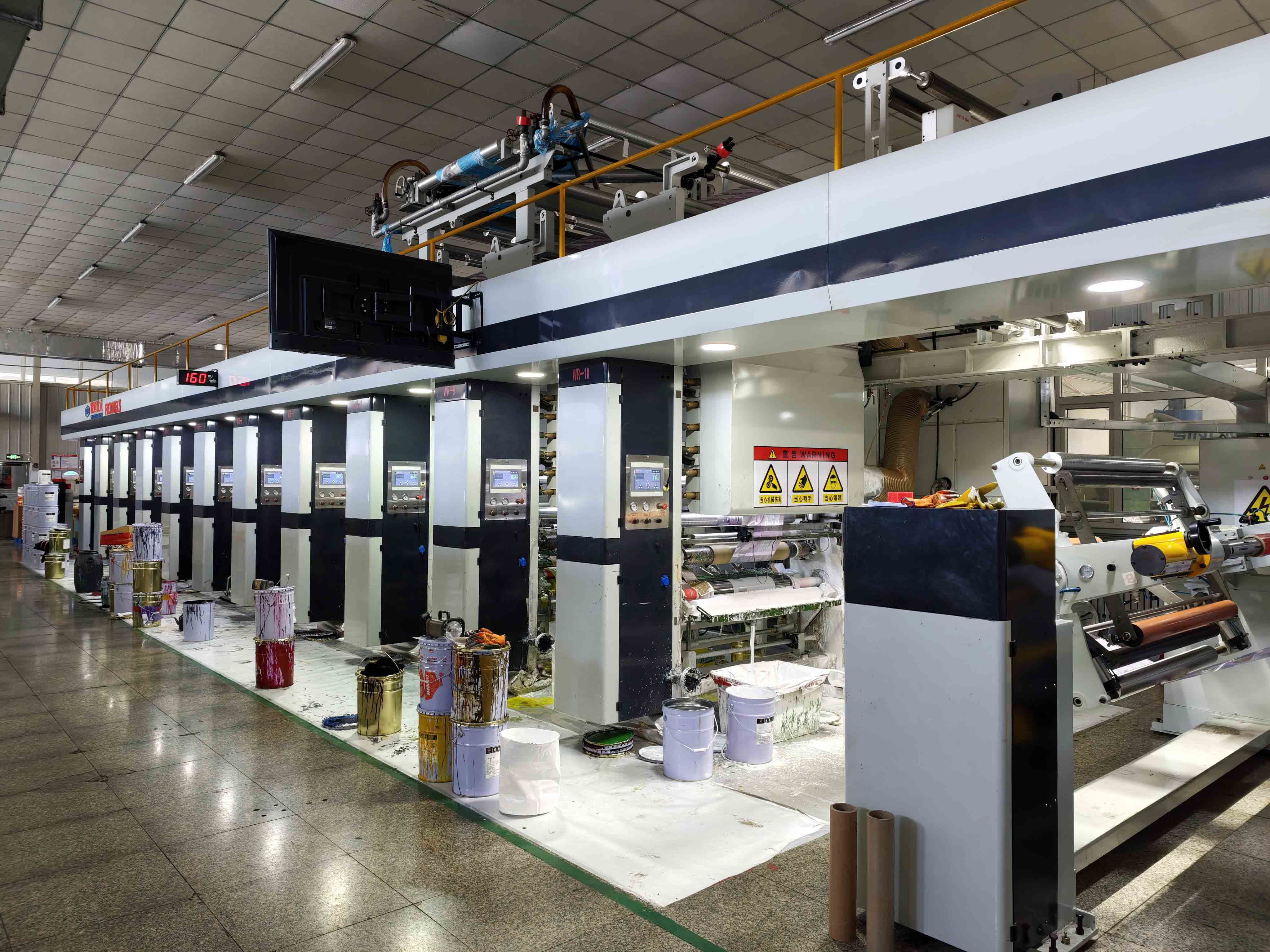
Real factory image: printing capability. Final cream-cheese artwork, food-contact suitability, rub resistance, and coding still need project-specific approval.
Is Cream-Cheese Foil Recyclable?
The word foil alone cannot answer the disposal question. A clean, separable aluminium foil item, a foil-and-paper wrap, a multilayer plastic/foil laminate, and a peelable foil lid attached to a plastic tub may be handled differently by a collection system. Food residue, small-item sorting, detachable components, and local infrastructure matter. The European Aluminium Foil Association's design-for-recyclability guidance explicitly covers cheese foils and aluminium lids on plastic cups while noting that not every aluminium-containing format achieves good recyclability.
Write a component-by-component disposal brief. Can the consumer separate the lid from the tub? Is the wrapper predominantly foil, or is it bonded to plastic and paper? Will food residue be practical to remove? What does the local program accept in each target market? A “100% recyclable” statement needs evidence tied to the finished package and collection reality, not the theoretical recyclability of aluminium as a metal. Do not transfer instructions for clean household foil to a complex cream-cheese laminate.
Environmental decisions also require context. A heavier barrier structure might reduce product waste for one distribution route; a lighter tub might meet the same validated product life elsewhere. Compare packaging mass, rejected packs, product losses, transport, and collection pathways with real data. Neither a shiny foil appearance nor a mono-material label is a substitute for a verified product and market assessment.
Build a Supplier Brief That Can Be Tested
The first useful supplier email is more specific than “Please quote foil packaging for cream cheese.” Share enough data for a converter to propose a structure and for the dairy to run a meaningful trial. The supplier should return a sample plan with material and process assumptions, rather than a one-line price per thousand.
Use a staged sequence. First compare a small set of technically plausible formats with the actual product. Next, run the selected candidates on the real filling line and record rejects. Then pack and ship cases through a representative refrigerated route, inspect arrival damage, and hold matched controls through the intended life. Finally, review sensory, appearance, integrity, microbiology under the dairy's plan, opening behavior, label durability, and cost per acceptable unit. A pouch with a lower quoted price can cost more if fill waste and rejects rise; a premium foil laminate may be wasteful if a validated tub already meets the brief.
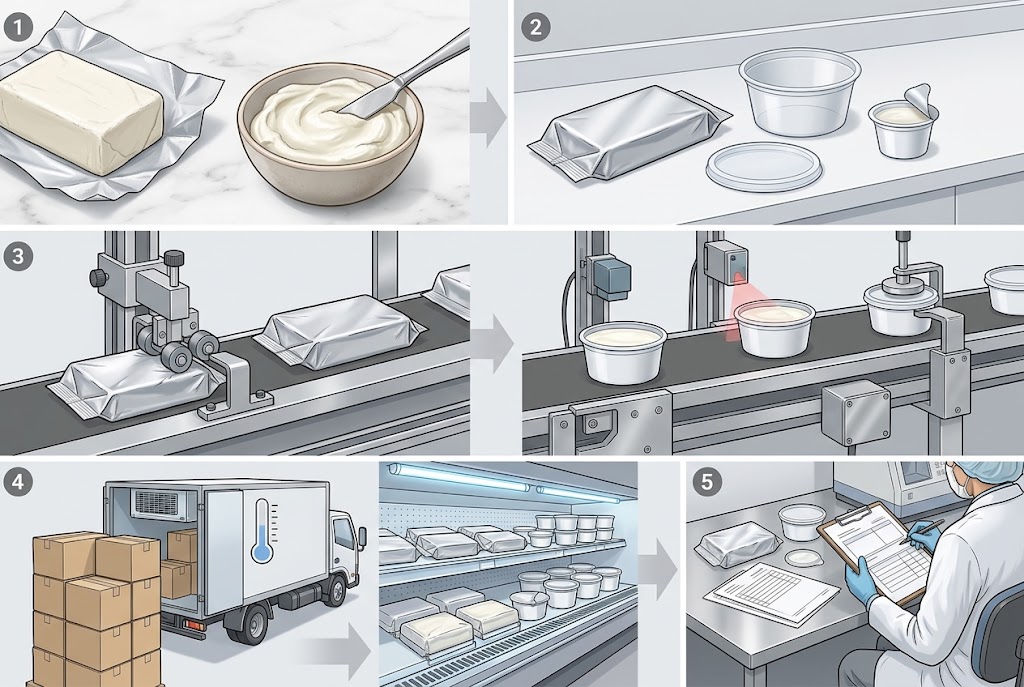
Conceptual validation illustration: product profile, candidate structures, filled-line checks, refrigerated transport/display, and final product-and-label review. It is a test sequence, not evidence of a passed test.
A conditional shortlist for a first trial
- Firm block with strong light-protection needs: trial an appropriately constructed foil-based wrap with a protective carton. Challenge folds and corners after shipment and verify the contact surface.
- Soft spread used over several occasions: trial a tub or cup with a validated peelable primary lid and a separate convenient reclosure. Check sidewall light exposure and rim contamination.
- Small portion or food-service application: trial a cup-lid system or suitable sachet only after fill accuracy, opening, product recovery, and cold handling are tested.
- Existing flexible-pack line: ask about appropriate cheese packaging, barrier layer, and plastic film options, then evaluate them with the actual cheese. Do not assume a familiar VMPET pouch is a drop-in replacement for a foil brick.
When asking Mylarbag for a quote, send the product form, pack dimensions, expected run size, fill method, destination market, and a description of the failure you are trying to prevent. Request candidate structures, sample quantities, documented food-contact scope, and the proposed checks. The best answer may be a foil-containing laminate, a non-foil lidding system, or a different format once the filled-product trial is complete.
FAQ: Why Is Cream Cheese Sold in Foil Packages?
1. Why is cream cheese packaged in foil instead of a plastic tub?
Some form-stable blocks use foil-based wraps for light protection, barrier properties, and a fold that conforms to the block. Spreadable products may be easier to fill, seal, open, and reuse from a tub. Product form, line design, distribution, and consumer use decide which format to trial.
2. Does foil keep cream cheese fresh longer?
It can be part of a protective package, but no material alone establishes a shelf life. The recipe, sanitation, seal or fold integrity, headspace, light exposure, refrigeration, and actual filled-pack study set the evidence for a dated-life claim.
3. Is the silver wrapper always aluminium foil?
No. It may be rolled aluminium foil, a foil-based laminate, a metallized polymer film, or simply a metallic-looking print. Ask for the exact layer construction, food-contact surface, and supplier specification.
4. Is VMPET the same as aluminium foil?
No. VMPET is PET film with a deposited metal coating; aluminium foil is rolled metal sheet. Their appearance can be similar, while construction and tested barrier performance differ. Compare the actual finished structures under stated methods and conditions.
5. Does foil touch the cream cheese directly?
That depends on the wrapper or lidding design. A coating or polymer layer may be the contact surface. The supplier must identify the surface and provide documentation for the intended food and use conditions.
6. Why does cream cheese also come in a tub with a foil lid?
A tub supports a soft spread and gives users a container after opening. The peelable lid can serve as the primary closure before first use; an overcap may help with reclosure afterward. The whole system needs a seal and shelf-life trial.
7. Is a snap-on plastic overcap enough without a sealed membrane?
Do not assume so. The required closure depends on the product, process, distribution, and validated design. The manufacturer must determine and document what provides the pre-opening barrier and tamper presentation.
8. Can a foil wrap prevent mold or Listeria?
No packaging material can replace safe production, sanitation, and temperature control. Barrier and seal integrity may help prevent ingress in an otherwise suitable process, but a package cannot make contaminated cheese safe.
9. What causes leaks around a cream-cheese tub lid?
Possible causes include product on the rim, uneven or damaged flanges, incompatible lidding sealant, line-setting variation, and handling damage. Inspect failed packs and run a structured seal and leak investigation before changing the barrier layer.
10. Why would a foil wrapper tear at the corners?
Folding geometry, foil or laminate gauge, sharp block edges, temperature, and transport compression may contribute. Inspect samples after the full folding and case-shipping sequence, not just flat incoming web.
11. Can an opaque tub replace a foil wrap?
It may meet the product's needs, but the brand has to validate quality, integrity, food contact, filling, and use. A tub changes material distribution, closure geometry, shelf presentation, and opening experience.
12. Does an excellent OTR guarantee cream-cheese quality?
No. OTR describes oxygen passage through a tested material under specified conditions. Light, oxygen already in the pack, seal defects, whey, temperature history, and the cheese itself also influence outcomes.
13. Is the foil from a cream-cheese brick recyclable?
It depends on whether the finished wrapper is separable foil or a bonded multilayer, how clean it is, and what local collection accepts. Check the exact component and destination before making a claim.
14. What should a small dairy request before ordering printed foil?
Request the full layer stack, food-contact documentation for the intended use, samples for the actual filling process, barrier results with test conditions, seal or fold specifications, artwork proof, and a filled-pack validation plan. Approve print after the basic package works.
15. Can Mylarbag copy the mole-paste VMPET pouch for cream cheese?
The published project demonstrates a non-dairy VMPET food-pouch construction, not a cream-cheese qualification. It can start a technical conversation, but cream cheese needs its own contact review, filling and sealing trials, and producer-led shelf-life and food-safety validation.