
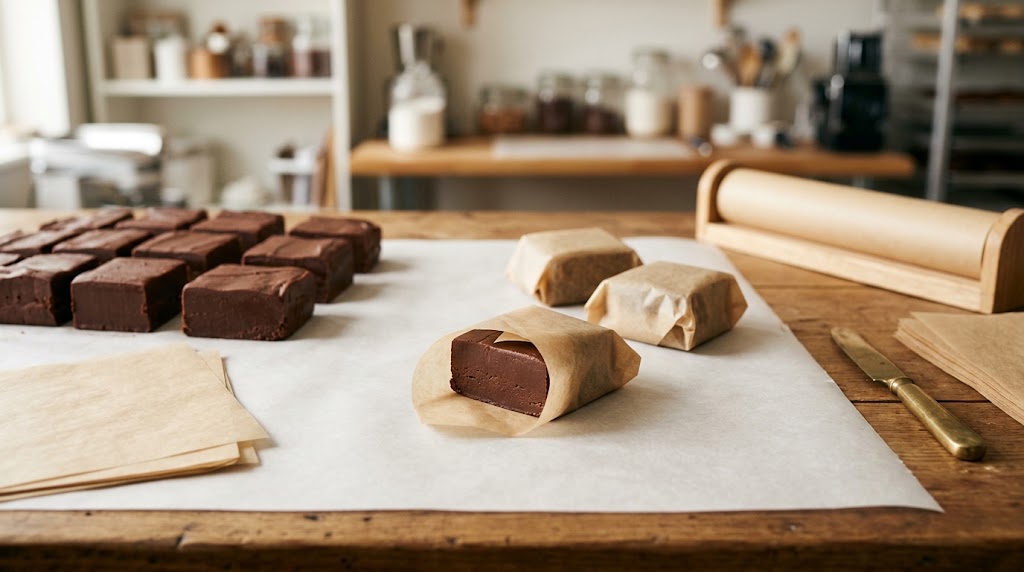
If you need to know how to wrap fudge for commercial sale, begin with a finished portion at the point it would normally be packed. Decide whether neighboring pieces need individual wraps or only separation. Obtain a contact material documented for the actual food, temperature and holding conditions. Make trial wraps using the production fold or closure. Open samples immediately and again after the intended holding period, recording sticking, product transfer, oil marks and shape damage. Measure the wrapped portion before choosing its outer retail pouch.
That answer deliberately has no universal paper name, fold size or number of storage days. A soft, tacky cut face behaves differently from a firmer piece with a dry surface. A chocolate-coated portion can leave a different mark from a plain square. Two recipes that both say “fudge” may need different controls. This guide is for fudge eaten by people, made and packed as a food product. It addresses the contact wrap and its handoff to a flexible retail bag; it is not a hot fudge sauce recipe, a gift-wrapping craft guide or a claim that a packaging supplier can approve a finished food.
Start With the Fudge at Its Real Packing State
The first mistake in wrapper selection is to test a piece that does not represent the production item. A freshly cut sample may still be changing at the surface. A sample taken after a different cooling or handling step may release differently. The food producer should establish the product's approved packing state and storage route, then use that state in a packaging trial. Do not use this article to decide whether a recipe is safe to cool, hold or sell at room temperature.
Write a short brief for each recipe and portion format. For a mixed assortment, treat each flavor as a separate test item before assuming that one contact layer suits the set.
| Record before trial | Why the wrapper team needs it | What to compare on real samples |
|---|---|---|
| Recipe version and inclusions | Fat, syrup, dairy ingredients, nuts or a coating may affect the contact surface and label review | Plain and inclusion-heavy versions, if both will be sold |
| Finished portion and variation | Corners, cut faces, thickness and weight change contact area and folding room | The largest, smallest and most awkward pieces from normal production |
| Surface at packing | Tack, visible oil, loose particles and decoration affect release and cleanliness | Samples from the intended packing step, not a convenient demonstration batch |
| Planned conditions | Contact temperature, intended storage route and duration affect documentation and later observations | Retained samples held under the actual proposed conditions |
| Opening behavior | A customer must lift the piece without scraping away an unacceptable amount of food | Normal operator wrap and normal consumer-style unwrapping |
| Retail configuration | A single portion, assortment or slab creates different pressure and fit | Fully wrapped units in a filled prototype outer pack |
The FDA's water-activity technical guide explains why water activity matters to food stability. That does not classify every fudge as shelf stable, or tell you whether its wrapper will release. The food team must establish appropriate controls for its own formulation. The wrap trial then evaluates a narrower question: how this finished product interacts with this actual material through the planned use.
Decide Which Pieces Need Their Own Wrap
An individual wrapper can separate cut faces, give a person a clean way to lift a piece, and reduce direct contact among flavors. It also adds contact area, folds and handling. A separate wrap is a design choice to test, not an automatic improvement. A rigid divider can prevent contact between pieces without enclosing every surface. A single stable piece might go directly into a suitable pouch if its contact with that pouch has been reviewed and its release and presentation pass the intended trials.
| Product format | First arrangement to compare | Main question at opening | Likely reason to change it |
|---|---|---|---|
| One relatively stable square | Direct pouch contact versus one approved contact wrap | Does either surface lift away without marking the cut face? | Sticking, oil transfer, corner pressure or awkward handling |
| Several tacky squares | Individual wraps versus approved separators inside the retail pack | Can one piece be removed without lifting the next? | Pieces fuse, separators curl, wraps grab the surface |
| Mixed flavors | Appropriate wrap or partition for each flavor, then a shared pack only if suitable | Do appearance and correct flavor identity survive packing? | Cross-contact concerns, aroma transfer, decoration loss or copy-control errors |
| Thick piece or slab | Supported base plus an appropriate contact layer | Can it be lifted without bending or imprinting? | Unsupported weight, stretched wrap, compressed edges |
| Coated or decorated piece | Minimal pressure on the finished face, then qualified separation | Does the coating detach or pattern print onto the wrap? | Scuffed finish, flakes, transfer or smear |
The arrangement is not a food-safety decision by itself. A separate sheet between pieces is still a food-contact material if it touches the food. A decorative sleeve around a sealed inner unit may not be the contact layer. Draw the stack of components and identify every surface that can touch fudge, including corners and edges when the pack moves. That list is more useful than calling the whole assembly “food-grade wrapping.”
For an assortment, include a realistic worst case in the trial: the heaviest piece resting where it will actually sit, the stickiest recipe next to the proposed divider, and an operator removing one piece without carefully rearranging the others. The point is to reveal contact and pressure that a neat product photograph hides.
Choose a Specific Food-Contact Surface
“Wax paper,” “parchment,” “greaseproof paper,” “cellophane” and “plastic film” are useful shopping descriptions. They are not complete material specifications. Two sheets sold under the same everyday name may have different coatings, additives, thicknesses or recommended uses. A clear sheet is not automatically low-stick. A paper-like appearance does not establish oil resistance. The supplier should identify the actual product, its food-contact side and its documented intended conditions.
In the United States, the FDA's food types and conditions-of-use tables distinguish food categories involving free fat or oil and conditions such as room-temperature filling and storage, refrigeration and freezing. Its component-status explanation makes clear that the status of a contact material depends on its constituent substances and their intended use. These are tools for asking the right questions, not an approval of any specific sheet mentioned in this article. A different sales market needs the applicable local review.
| Candidate contact approach | Why a team might prototype it | Questions to ask before approval |
|---|---|---|
| Identified flexible contact film | Can wrap closely around a small square and may suit a repeatable fold or an appropriately designed seal | Exact food-contact side and construction; fat and temperature conditions; release and odor; print or coating position; whether it is actually sealable |
| Identified treated paper or paper/film construction | Can give a paper handling feel and a defined separation surface | Specific treatment, contact authorization for the use, grease staining, fibers on release, fold memory and whether any coating changes with storage |
| Flat separator or interleaf | May reduce piece-to-piece adhesion with less wrap labor | Whether side faces still touch, movement during distribution, removal sequence, and whether the separator is also food-contact suitable |
| Direct contact with the retail pouch | Removes an inner layer when a single or stable portion permits it | Food-facing sealant surface, compatibility, release after holding, appearance through any window and ease of removal |
| Supported slab with a contact liner | Can protect a broad base while the support carries weight | All food-contact faces, edges under load, liner slip, lift-out movement and the support's own documentation |
Ask for a written material description rather than guessing from an appearance sample. Request the food-contact documentation appropriate to the destination and intended use, including contact temperature and duration if relevant. Identify inks, coatings and adhesives relative to the contacting surface. Ask whether the material is supplied as a pre-cut sheet, a roll or a finished unit and whether that version differs from the sample. If a conversion, print or coating step changes, review it before continuing an old approval.
Paper feel and release are different claims
A sheet can be pleasant to handle and still stain or cling to fudge. A grease-resistant surface can reduce visible marks in one trial while leaving an unacceptable pull on a soft cut face. Conversely, a sheet that releases well from a firm piece at day zero may transfer odor or mark a different recipe later. Trial the actual sheet, including the side that will face the food. Where the supplier specifies only one approved contact side, do not reverse it to obtain a better appearance.
Do not heat-seal an unidentified paper, film or decorative wrap merely because a household demonstration showed it closing. A heat-sealable layer, compatible equipment, a controlled process and an appropriate contact review are separate requirements. A folded but unsealed piece wrap can be suitable for separation inside a properly designed outer pack, while it may be unsuitable as the only protective closure for a product needing an established unopened package.
Make a Wrap That Opens Cleanly
Choose the fold around the largest normal portion, not a nominal drawing. The purpose is to keep the chosen contact face against the product, control loose ends and allow a person to expose a grip point without dragging the wrap across a decorated face. Make several wraps with ordinary operators. If the operation is automated, use a representative line trial rather than a careful hand-folded showpiece.
For a simple folded sheet, set the piece on the approved contact side. Bring the sheet around it without stretching it tight across soft corners. Put the overlap where the customer can find it and where it will not press an imprint into a presentation face. Tuck or fold ends so they do not unfold and touch neighboring portions. Record the orientation; a fold that works on a square may spring open around a thick slab. These are trial actions, not universal dimensions. The exact sheet size and overlap come from sample handling.
If a piece-level sealed film is proposed, define which faces are sealed, where the food sits during closure and what temperatures and dwell conditions the material supplier and line can support. Protect the product from unintended heat exposure, keep product out of the seam, and review the peel or tear opening. A strong seam can still force a customer to squeeze a soft piece while opening it. An intentionally easy-open individual unit and a secure outer retail seal solve different problems; specify both separately.
For a slab, support the base before the edges. One wide sheet may cover the base and sides, but lifting by the sheet alone can bend or drop a heavy piece. A food-contact liner over an appropriately qualified support may give the operator a stable lift. Trial removal from the actual pouch or carton, then check the underside and edge impressions. Do not infer that a pouch's film thickness makes it a rigid structural support.
Three small actions catch many practical failures:
- Wrap a normal piece without repeatedly smoothing the fold for the camera. Watch where fingers touch the fudge and where the sheet rubs its cut face.
- Put the wrapped piece into the intended group orientation. Check whether an overlap, corner or coated face bears the weight of another portion.
- Open the assembly the way a customer would. If the only clean opening requires a precise laboratory grip, adjust the design.
Document which failures happen during wrapping and which appear only after holding. A warm or unusually tacky product should not be silently excluded from the sample set; it may reveal an upstream product-state problem that the food team must resolve before packaging approval.
Run a Two-Time-Point Release Trial
A good-looking sample at the end of the packing shift proves very little about later opening. Build a simple internal comparison using the same product version and packing state across candidate materials. This is a product-development protocol, not an ASTM method or an FDA pass/fail rule. The producer chooses the sample size, observations, acceptance criteria and any required food-safety work before the trial.
Prepare a baseline group with the existing approved arrangement, where there is one, and candidate groups that change only the contact approach or fold. Label samples with the fudge batch, flavor, material identity and lot, contact side, operator or machine setup, wrap geometry, outer pack, storage route and observation date. Photograph the product before wrapping, the completed unit and the opening. Keep the controls under the same conditions. If a recipe version changes midway, start a new comparison rather than combining data.
Use at least two observation points:
- At packing or the defined initial checkpoint: Does the material already pull at the cut face? Is there obvious oil on the wrap, loose fiber, odor, heat damage or a crushed corner?
- At the proposed end of the product's holding period: Does release, oil staining, surface appearance or opening effort change after the full proposed storage route? If the producer's study needs interim points, add them without substituting a shortcut for the target-period result.
An intact retained unit should be stored in the same outer pack configuration where that pack may influence the outcome. Opening a sample is destructive for this purpose; plan separate units for later checkpoints. Record actual temperature and handling history instead of writing “room temperature” without context. Do not ask an operator to taste a sample of uncertain condition to make the release decision.
| Observation on opening | Record in a consistent way | What it may suggest; confirm before changing design |
|---|---|---|
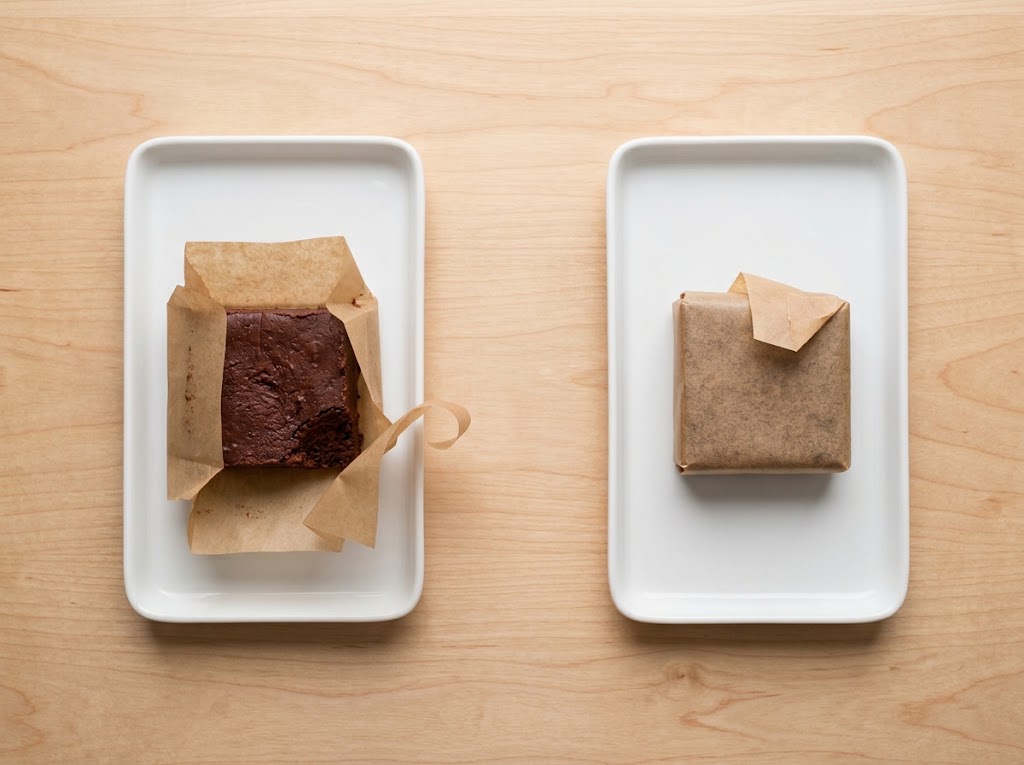
| Product stays on the sheet | Photograph location and whether it is a smear, layer or small spot | Surface state, contact chemistry, pressure or fold geometry |
| Oily halo or transparent spot | Which side, how far it extends, when first seen | Fat transfer, coating response or an unsuitable appearance target |
| Fibers or film residue | Whether material visibly remains on the food | Sheet quality, coating or an inappropriate contact surface |
| Imprint or flattened corner | Match mark to a fold, neighbor, divider or pouch seam | Compression, stacking and wrap tension |
| Crumbs or coating loss | Product and wrap surfaces before and after opening | Cut-face fragility, decoration or abrasive removal |
| Unusual smell | Sample identity and handling history; use the food team's method | Product change, material or print interaction, or unrelated storage issue |
| Easy initial release, poor later release | Note exact checkpoint and conditions | A time-dependent mismatch; do not approve from the day-zero photo |
Agree on what “pass” means before anyone sees the results. A visually clean premium piece may need stricter presentation criteria than a piece intended to be broken into a recipe, but neither label replaces the food producer's safety assessment. Score appearance, released product, opening effort and material integrity as separate outcomes. A candidate that reduces staining while tearing the fudge may not be a useful improvement.
When a trial fails, change one thing at a time
If all candidate sheets stick to one unusually soft batch, first investigate the actual packing state and recipe consistency with the food team. If one sheet sticks while a controlled alternative releases, compare the contact face and supplier documentation. If only lower layers are flattened, reduce load or change separation and support before condemning the material. If the outer pouch's inner face alone picks up fudge, check direct contact and movement after the individual wrap is opened or displaced.
Keep a short corrective-action record. State the defect, the unit and material lots, the likely mechanism, the one variable to change, the revised trial and the result at both observation points. Changes to coating, paper basis, film thickness, fold direction or packing temperature can affect more than one observation. A successful retest at day zero alone does not close a failure that appeared at the target period.
Measure the Wrapped Portion Before Choosing an Outer Pouch
The wrap changes the dimensions that matter. A flat square becomes thicker at folded corners. A slab on a support has a new base footprint. A group of loose interleaves may spread when the pouch is lifted. Measure the largest normal finished assembly in its normal loading orientation, including overlaps, support and realistic manufacturing variation. Then trial a few sample pouch sizes with actual wrapped pieces.
Use a packaging handoff table rather than a bare “fudge weight”:
| Handoff item | What the wrapping team provides | What to check on the filled outer bag |
|---|---|---|
| Wrapped geometry | Maximum length, width, thickness and bulky folds | No scraping during loading; no side seam pressing into corners |
| Pack count and order | Pieces per unit, flavor arrangement and support | No top-heavy or crushed lower layer; accessible first piece |
| Loose material | Interleaf edges, release tabs, liners and support corners | Nothing enters the top-seal area or catches a zipper |
| Contact and movement | Surfaces that may rub if the pack tips or settles | No new sticking or surface transfer after handling |
| Opening path | How the customer opens pouch and then wrap | Both closures accessible without squeezing the fudge |
| Information control | Flavor/ingredient version associated with the unit | Correct printed bag, label and variable code for that batch |
A flat pouch can be a sensible sample for one or a few slim wrapped pieces. A stand-up pouch can present several pieces upright when the gusset, count and fill actually work. Neither format is a recommendation based on net weight alone. Window film, gusset fold and printed panel each affect the usable interior and the way the pieces settle. The food-facing surface of the outer pouch also needs an appropriate review if any fudge can touch it.

Keep the first retail seal clear
The packer must be able to place the wrapped pieces below the planned initial heat-seal zone, consistently and without an interleaf flap, fold, crumb or oil trace crossing it. Trial loading at a normal pace. Photograph a few filled packs before sealing; inspect the finished top seam and deliberately examine rejects. If the bag has a zipper, specify it below a distinct initial seal for the unopened retail unit when that closure system is required. The zipper is for use after opening.
ASTM F88/F88M-23 describes a method for measuring seal strength of flexible barrier materials. A sampled strength result does not by itself establish that every filled bag is leak-free or that a fudge recipe has an approved quality period. A producer should set the relevant seal and finished-pack inspection plan, including contamination, wrinkles and handling, with its packaging team. This outer-bag check is separate from the fudge-to-wrap release trial above.
What a Real Adjacent Candy Pouch Can and Cannot Show
Mylarbag has a published stand-up pouch project for nougats and energy bites. Its page identifies a MATOPP/PET/PE construction, digital printing, a shaped window, a hang hole and a nominal 14 × 21 + 4 cm project size. Those are facts about that outer pouch for those products. The project is not a fudge customer case. It does not document whether each nougat was individually wrapped, a fudge-contact sheet, a release test or a fudge quality period.
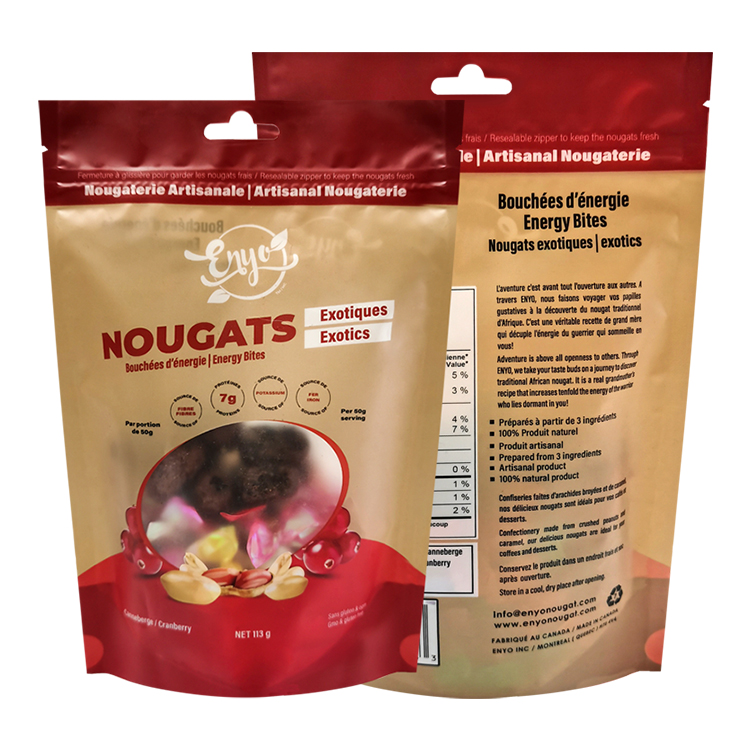
Why include it here? It gives a real physical example of the other layer in a commercial pack: a printable front and back, a window that needs deliberate product positioning, and top space for opening and closing. A fudge brand can use those visible design questions to make a sample brief. It cannot copy the size, laminate or any broad marketing claim and call the resulting pouch approved for its recipe. A windowed pack with wrapped pieces may show mostly folds rather than appetizing product. Check the actual presentation, not a mockup.
In a sample discussion, ask: will the approved contact wrap remain in the window's viewing area, will the pieces settle below it, is the top seal free, and does the back panel hold the correct information? If the answer is no, change the layout. The published case provides a useful starting conversation about the outer bag; the fudge trial supplies the evidence for the contact layer.
Control Material, Flavor and Label Changes on the Packing Floor
A production-ready wrap needs a repeatable specification. Record the contact material's identity, supplier and lot, which side touches food, cut dimensions, fold or seal drawing, the approved fudge versions, packing-state limits set by the producer and the inspection points. Keep a retained sample of the approved assembly and a controlled photograph of the intended opening. Train operators to recognize wrong-side contact, mixed material lots and off-position folds.
Mixed flavors make version control especially important. A common outer bag can carry different printed or applied labels only if the correct version is matched to the actual contents. Nuts, milk or other ingredients require a market-specific allergen review; production must also address cross-contact through its own food-safety controls. For U.S. labeling context, FDA's 2025 food-allergen labeling guidance is an authoritative starting point, not a ready-made label for every market. The food brand approves the finished information. A pouch converter can reserve the panel and supply print proofs but should not invent the ingredient declaration.
Make changes visible before the first saleable batch. A new fudge formulation, different flavor inclusions, another contact-sheet coating, revised fold, new outer pouch, different handling route or revised intended storage period can invalidate parts of the old release comparison. State which evidence needs repeating. The disciplined question is: which contacting surface, load or condition changed? That question is more effective than assuming a previously accepted “paper” or “bag” name still describes the same system.
If you need an outer retail bag after the wrap is specified, send the wrapped dimensions, piece count, intended storage route, material-documentation needs, fill method and artwork versions to a custom fudge packaging bag supplier. Ask for sample formats and construction details for your trial. Source the individual contact wrap from a supplier able to document that specific material if it is a separate product. The two suppliers' roles can meet at the filled, tested assembly without pretending that one factory produces every layer.
A Sample Approval Record You Can Actually Use
The following compact record is a template. It contains no predetermined acceptable material, pouch size or quality period. Fill the criteria before production trials, then attach the evidence rather than checking an empty “approved” box.
| Gate | Evidence to retain | Approval owner and unresolved question |
|---|---|---|
| Product state | Recipe and batch, size range, packing conditions, food team's storage plan | Food producer: is the test piece representative? |
| Contact material | Exact grade, supplier and lot, documented intended contact, correct side | Material/quality reviewers: is this use covered? |
| Immediate release | Photos and recorded unwrap observations for each candidate | Product/quality team: does the cut face remain acceptable? |
| Target-period release | Retained unit history and same opening assessment at planned checkpoint | Product/quality team: does the proposed pack still work? |
| Wrapped size | Maximum filled assembly and normal variation, fold and support drawing | Packaging engineer: does it load and display correctly? |
| Outer package | Material construction, seal-zone cleanliness, filled-pack inspection | Packer and pouch supplier: is the unopened seal reproducible? |
| Artwork and handoff | Exact flavor, ingredient, allergen and lot-code version | Food brand: does the finished saleable unit have approved information? |
An attractive photo completes none of these gates. Nor does a clean peel from one freshly made square prove that all flavor variants will open the same way. A practical approval identifies what was tested, under what conditions, for which product version, and when a change calls for a new trial. Keep the record short enough that people use it, and complete enough that a later complaint can be traced to a material, product and packing decision.
FAQ: Wrapping Fudge for Retail
Can I wrap fudge in ordinary baking parchment?
Possibly only after you identify the exact product and confirm its intended food-contact use for your fudge and conditions. “Parchment” alone does not tell you the coating, contact side or storage suitability. Trial release immediately and at the intended later point, and examine oil marks and fibers. If the piece needs protection beyond separation, evaluate the complete outer pack as well.
Is wax paper the best wrapper for fudge?
There is no universal best wrapper. A material sold as wax paper may vary by manufacturer and intended use. Ask for its specification and documentation; compare real fudge samples with other qualified candidates. A good day-zero peel is one observation, not approval for every recipe or storage period.
Will transparent film stick to soft fudge?
It might, depending on the specific film surface, the fudge at packing, pressure, handling and time. Transparency is not a release specification. Test the actual grade, including the correct contacting side, with retained pieces in the intended assembly. If it sticks, compare product state and candidate surface before changing the outer retail bag.
Does every fudge square need an individual wrap?
No. A stable single piece may work in a reviewed direct-contact pouch; a set of pieces may need only suitable separators. Individually wrap when trials show that separation, handling or presentation benefits justify the extra contact material and work. Check the result after holding and normal customer opening, not only when the neat pieces first leave the cutting table.
Should I wrap a whole slab differently from small cubes?
Usually the geometry asks different questions. The slab may need broad base support and a way to lift it without bending or sticking along a large face. Cubes emphasize cut-face contact, fold corners and piece-to-piece pressure. Trial each format with its actual support and final pack; do not scale a small-piece fold by eye.
Can I simply fold the sheet, or must I seal each piece?
A fold can separate a portion inside an appropriately designed outer package if it stays closed and passes handling and opening trials. It is not necessarily a protective sealed food pack. If an individually sealed unit is required, specify a suitable food-contact sealing material and a validated process. Do not assume ordinary paper or clear film can be heat-sealed.
Can I wrap warm fudge immediately after making it?
Use the packing state established by the food producer's process and safety plan. A material approved for one contact temperature may not be approved for another, and product state can change release. The FDA distinguishes intended food-contact conditions, including room-temperature and hot filling. Do not improvise a cooling or room-temperature holding rule from a packaging article.
What if the wrapper peels cleanly today but sticks later?
Keep the later failure. Check whether the product batch, storage history, contact material lot, pressure and fold position match the initial sample. Repeat the comparison with a control and change one variable at a time. Approving the first opening while ignoring the later one would miss the actual customer experience.
Does an individual wrap give fudge a longer shelf life?
No shelf-life extension can be inferred from the presence of a wrap. A contact sheet may help keep portions apart but might have little barrier function. The food producer must assess product formulation, process, packaging construction, seal integrity, storage route and appropriate safety and quality endpoints. The outer bag's film data alone are also insufficient to set a date.
Is a high-barrier outer bag enough without a good contact wrap?
Not if the product sticks to the food-facing surface, pieces fuse, or the wrap damages them on opening. Conversely, a well-releasing contact wrap does not prove that the outer pouch protects the product for a target period. Test contact behavior and complete-pack performance as separate questions.
Can I use the nougat case's 14 × 21 + 4 cm size for fudge?
That is the published nominal size for a different confectionery project, not a fudge specification. Measure your largest wrapped portion, support and count, trial multiple filled pouch samples, and keep adequate seal and label space. The case shows possible exterior presentation, not proof that its size or laminate fits your product.
What should I send when asking for a custom outer pouch?
Send the product and storage brief, photos of the wrapped pieces, maximum assembled dimensions, count, fill method, desired display, target market and artwork versions. Ask for sample pouch constructions, the food-facing layer and relevant documentation. Keep the contact-wrapper brief separate if it comes from another supplier. Review the complete filled pack and its initial seal before releasing print.
Wrap for the Real Opening, Then Approve the Whole Pack
The workable answer to how to wrap fudge is a recorded comparison, not a favorite paper. Start with the product as it will be packed. Verify the specific contact surface, make repeatable folds or closures, and open retained samples at the beginning and at the planned end of the holding period. Use the largest wrapped assembly to select and test the retail pouch. Once the contact layer, outer seal and food label each have an owner and a clear acceptance record, the pack is ready for the producer's full product-specific review.