
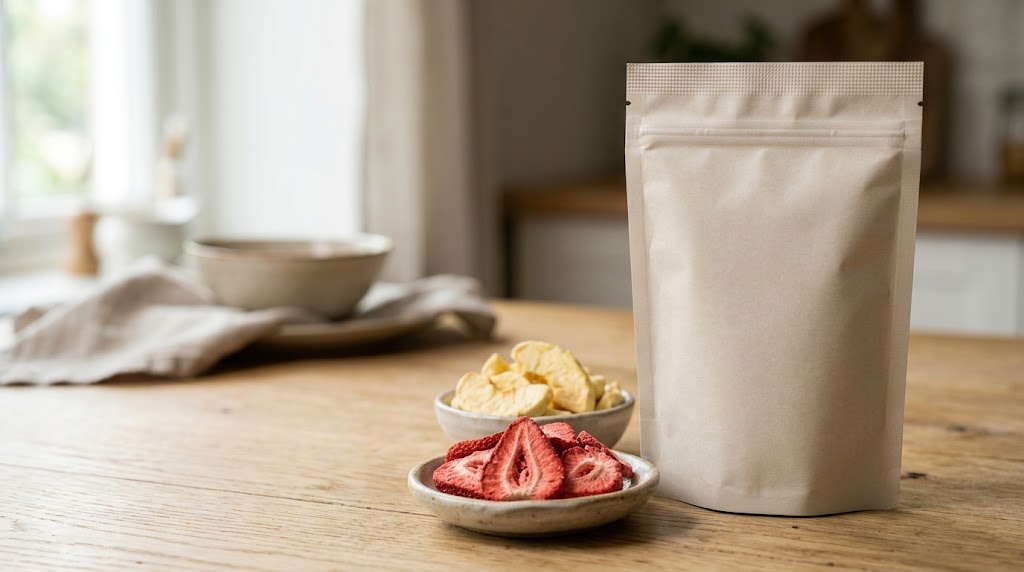
How long does freeze-dried fruit last? There is no reliable number that follows from the words freeze-dried, Mylar bag, or oxygen absorber. A brand can assign a selling period only after defining the finished fruit, packing it under controlled conditions, and checking representative sealed units through that period. The first unacceptable change might be loss of crispness, flavor or color, excessive crumbs, a package defect, or a food-safety issue. The first one to fail matters. Opening the pouch changes the question again.
This guide is about freeze-dried fruit intended for people to eat, such as strawberry pieces, apple slices and other fruit snacks. It does not give a home freeze-dryer recipe or a storage date for meat, vegetables, candy, powders or every food described as freeze-dried. The goal is a practical brief for a fruit brand, its food-quality team and its pouch supplier.
The University of Minnesota Extension explains that freeze-dried foods readily absorb moisture and should be packaged promptly. Its guidance also makes a crucial safety point: freeze-drying is not a microbial kill step. Home-preservation guidance is useful background, but its long-storage examples cannot establish the date on a particular commercial fruit snack. The fruit producer must qualify the product and its label for the intended market.
What “last” means for a freeze-dried fruit snack
A single expiry question often hides four different decisions. Microbiological safety concerns the hazards of the fruit and process, the product's approved release criteria and the conditions that could allow a hazard to matter later. Eating quality concerns the intended crisp bite, flavor, color and aroma. Physical condition concerns whole pieces versus fines or crushed fruit. Package function concerns the initial seal, pouch seams and whether the customer can open and reclose the pack as intended. A fruit can fail a quality standard before a food-safety limit is reached; the reverse must never be inferred from a pleasing bite.
The FDA's water-activity technical guide explains that water activity, written a_w, describes water available for microbial and other interactions. It is different from total moisture content. A crisp bite or a surface that feels dry is not a water-activity measurement. Take representative samples by an appropriate method and interpret them within the approved hazard analysis for the actual product. No generic number in this article is a release specification for a strawberry, mango or mixed-fruit line.
For a retail product, write down what the customer bought. Were the berries intended to shatter lightly with a crisp bite? Were apple slices meant to stay mostly intact? How much loose dust is acceptable at the bottom? Record the initial distribution of whole pieces and fines. Otherwise, a later observation such as “some crumbs” cannot show whether packaging, filling or transit caused them.
| Question | Evidence to collect | Common mistaken shortcut |
|---|---|---|
| Is the finished fruit suitable for packing? | Approved process and release checks on representative lots | It sounds crisp, so the interior must be ready |
| Does the fruit retain its intended bite? | Baseline and retained samples examined against a defined texture criterion | The bag looks sealed, so the fruit must still be crisp |
| Do pieces reach customers intact? | Fines and whole-piece observations before filling and after the real shipping route | A strong film must prevent the fruit inside from breaking |
| What period can the brand label? | Same-product, same-pouch stability study under specified conditions | A supplier's bag name or another brand's date |
Why freeze-dried fruit needs its own storage plan
Conventional dried fruit may be deliberately chewy or pliable. Some fruit pieces may become hard or sticky as moisture moves. A freeze-dried snack is usually selected for a light structure and crisp bite. Moisture pickup can change that experience quickly. The University of Minnesota's advice to package promptly reflects the food's sensitivity to room air. The exact rate for a retail piece depends on its composition, process, geometry and the conditions to which it is exposed; it cannot be copied from a different food or an online shelf-life table.
Even one fruit type does not have one universal moisture response. In a published study of freeze-dried strawberries, processing temperature affected hygroscopicity, and packaging affected storage stability in the study's own conditions. That result is a reason to test the actual fruit and process. It is not a claim that all whole strawberries should be vacuum-packed or that the study's observation period is a valid date for a new product.
Porosity and low mass can also make a delicate piece vulnerable to crushing. A bag can be impermeable enough for a target storage period and still offer poor mechanical protection to a slice compressed inside a crowded shipping carton. Conversely, a rigid outer box can reduce breakage while an inadequate pouch permits moisture ingress. Evaluate these as separate failure paths. Do not transfer the chewy-fruit softness criteria from a conventional dried-fruit packaging discussion to a freeze-dried snack without defining what “good” means for the new product.
Three clocks begin at different moments
The product clock starts when a properly processed batch reaches its approved state. The exposure clock runs while finished pieces are in transfer, weighing and filling before the initial seal. The package clock begins after the complete retail pouch has been filled and sealed. These clocks overlap, but only the last one is represented by a test of an intact stored pouch. A low film WVTR cannot undo uncontrolled exposure before sealing, and careful handling cannot repair a leaking seam.
An opened pouch starts a fourth, consumer-use condition. Each opening admits room air, and the consumer may close the zipper with crumbs in its tracks. A “best before” period validated for an unopened heat-sealed pouch does not restart when the zipper is pressed shut. Make the label and any after-opening advice match what has actually been checked.
Map the moisture and damage routes before specifying a bag
Think about what can change between the freeze-dryer and the customer, then assign one observation to each possible route. Some problems are visible immediately; others appear only after storage. A simple route map is more useful than a long material wish list.
| Route | What to look for | First question for the team |
|---|---|---|
| Fruit not at the approved endpoint | Inconsistent pieces, a different interior, variable baseline readings | Were samples taken across the batch and released correctly? |
| Open-air handling before sealing | Changes between discharge, filling and closure | How long and under what conditions was the fruit exposed? |
| Film or window transmission | Gradual quality change despite intact-looking seals | Do candidate films have comparable WVTR data at relevant conditions? |
| Seal, gusset or window-joint defect | Local change, leaks, product in the seal or damaged edges | Did the finished pack pass the chosen integrity checks? |
| Consumer opening and reclosure | Faster softening after use | Is the zipper working cleanly, and was this use pattern tested? |
| Handling and transport | Crumbs, fractured pieces or crushed displays | Were the fill level, carton arrangement and route challenged? |
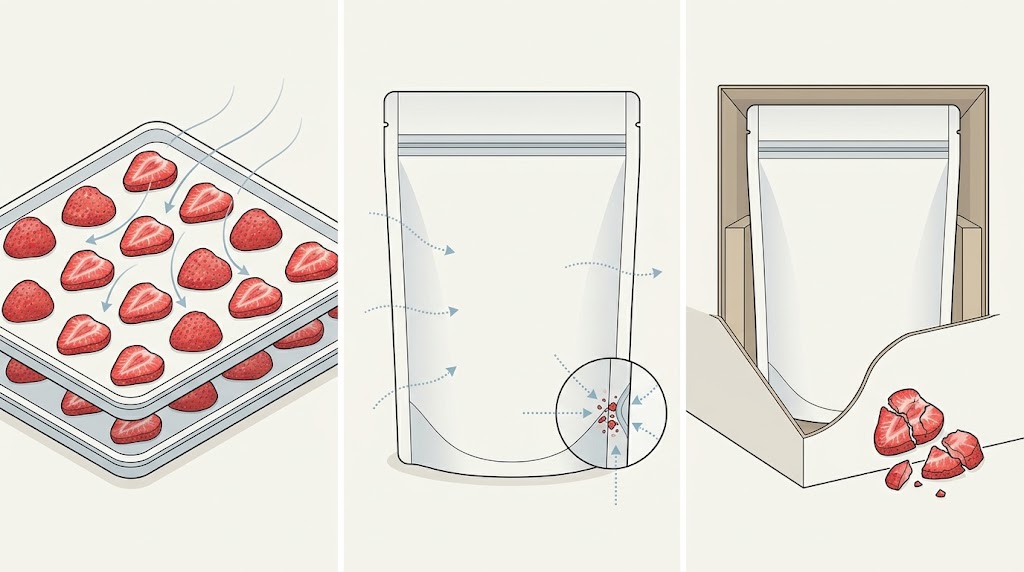
Run a short observation trial before expensive artwork or large printed orders. Set up the packing station, process a representative batch, and log the elapsed time from product release to sealed pack. Note room conditions, transfer containers, portion weight, filling tools and any hold step. Compare the fruit's condition at release and immediately after sealing. If the pieces already leave the line soft or broken, waiting months to inspect retained pouches will not identify the original cause clearly.
Keep fines out of the sealing zone
Freeze-dried fruit can shed crumbs during transfer. Small pieces and dust near the mouth of a pouch can prevent the inner surfaces from meeting consistently. Specify a fill limit that leaves clear space for the actual top seal. Inspect filled packs before they enter the sealer. Check the troublesome shapes and fragments generated during normal production, not only a carefully hand-picked sample. If dust is routine, change the filling method or cleaning control as part of the process trial.
Record the weight and piece range that the pouch holds without forcing the mouth flat. Overfill makes closure more difficult and can crush fruit; excessive empty space may let pieces move and abrade one another. Neither observation yields a universal headspace ratio. Fill trials with the actual fruit are the measurement that matters.
Choose a pouch by evidence, not by the word “Mylar”
For a moisture-sensitive snack, ask the supplier for the complete proposed construction. A printed exterior, a shiny inside and a total thickness are not enough. Identify the film layers, inner food-contact surface, any aluminum foil or metallized layer, window film, zipper, gussets and heat-sealing surface. Obtain the relevant food-contact documents for the intended food and market. For U.S. regulatory context, the FDA explains how the status of food-contact material components is determined. That page is a starting point for documentation review, not approval of an unnamed supplier's bag.
One candidate may be an opaque foil laminate when the target period and light exposure justify it. Another may use a metallized film or a transparent laminate with a different barrier profile. A clear window may help buyers see intact fruit, but the window is part of the actual pack to test, including its film and joining region. Kraft appearance does not establish the material underneath. Ask the supplier to quote the exact candidate that will be converted, printed and filled.
| Candidate configuration | Reason to investigate it | Evidence still needed |
|---|---|---|
| Transparent laminate | Product visibility for attractive whole fruit | Exact film data, light sensitivity, complete-window and seal performance |
| Metallized laminate | Opaque presentation with a specified barrier option | Actual layer stack, comparable test report, flex and finished-pouch trial |
| Foil-containing laminate | A candidate for demanding light and moisture objectives | Foil identification, conversion quality, folds, pinholes, seals and fruit breakage |
| Opaque pouch with a window | Mix of visible fruit and printed panels | Window's material, joining area and whole-pack behavior |
| Small single-serve pouch | Avoid prolonged consumer exposure after opening | Portion fit, clean sealing, retail handling and waste implications |
| Multi-serve pouch with zipper | Convenient access to several servings | Separate initial seal, opening sequence, clean reclosure and after-opening study |
The Mylarbag barrier-layer options are a place to discuss candidate structures. Treat any broad marketing claim as a request for an exact specification and evidence. There is no “zero transmission” guarantee for every converted bag, nor an automatic number of months attached to a foil appearance. The target is a measured performance under an agreed product and storage plan.
Read WVTR, OTR and conditions separately
WVTR describes water-vapor transmission through a specified film or sheet specimen under stated test conditions. For crisp fruit, it is a useful material-screening measure. Ask for its units, method, specimen identity, temperature, relative-humidity conditions and report date. ASTM F1249-25 is one standard test method for the WVTR of flexible materials. A comparison between two supplier numbers is meaningful only after checking that the conditions and units are comparable.
OTR concerns oxygen transmission and may matter for a fruit's color, flavor or other quality attributes. ASTM D3985-24 covers an oxygen-gas transmission method for film and sheet materials and explicitly says OTR alone does not establish packaged-product protection. Oxygen control does not substitute for moisture control. An oxygen absorber addresses oxygen inside a sealed package; it does not mend a water-vapor route through a poor seal. Likewise, a high-barrier film panel does not turn an unsealed zipper into a hermetic initial closure.
Request data for the exact proposal. If a quotation has a clear window, ask whether the figure is for the opaque panel, the window or both. If a structure changes thickness, sealant or supplier, do not assume a previous report still describes the new sample. An advertised figure without a method, units and conditions is not a usable engineering comparison. This does not mean every brand needs the same numerical target. The acceptable WVTR and OTR must come from the fruit's measured sensitivity, intended period, surface area, distribution conditions and complete-pack performance.
Design the initial seal for the actual filling line
The first retail closure and a consumer zipper do different jobs. For a heat-sealed pouch, establish a repeatable initial seal above the product and, where used, above the zipper. Locate the tear or cut line so the customer can access the zipper after opening. A zipper may be useful for a multi-serving snack, but it should not be described as restoring the unopened heat-sealed environment. Check the specific drawing rather than relying on a generic pouch illustration.
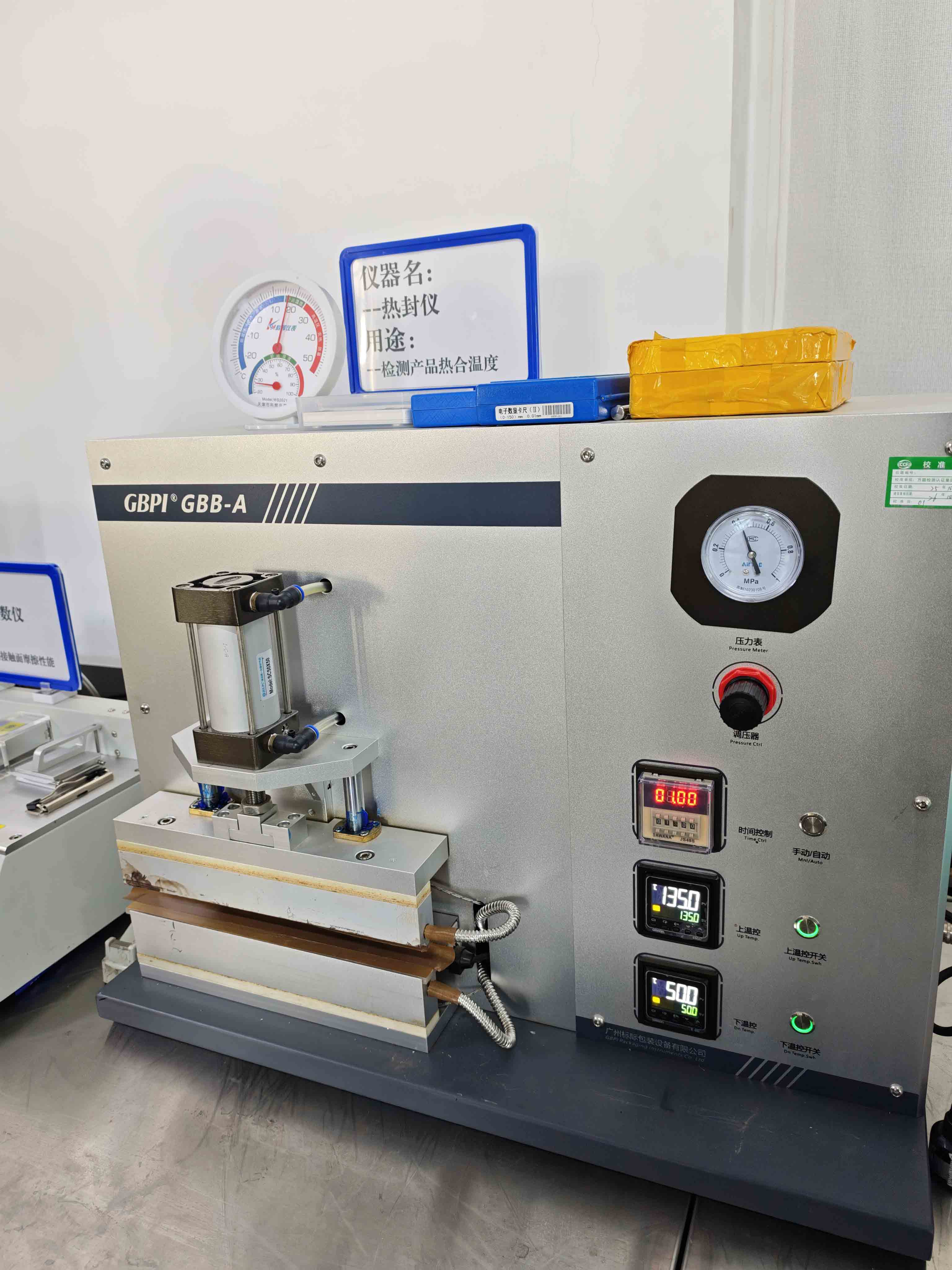
Start with the pouch supplier's proposed sealing range, then qualify settings on the packer's real equipment and production speed. Examine startup, steady-running and restart samples. Look for fruit fragments in the seal, wrinkles, scorching, incomplete bonding, misaligned jaws and unusual variation at side intersections or gussets. Keep records of the material lot, machine, settings, operator and checks. If a stored sample later loses crispness, those records make an investigation possible.
ASTM F88/F88M-23 describes seal-strength measurement on a sample strip. That can support process validation and control, but a sampled strength result alone cannot demonstrate that every finished package is leak-free. Choose a separate package-integrity method with a competent lab or quality team where appropriate. For example, ASTM D3078-02(2021)e1 addresses gross leaks in flexible packages with headspace gas; its public scope cautions that small leaks may go undetected. Match any method to the actual pouch and question being asked, and keep destructive test samples out of saleable stock.
A short line-start checklist
- Confirm the approved product and matching bag/label lot before filling.
- Check representative fruit, including large and fragile pieces, against its release criteria.
- Verify that the portion fits below a clear sealing band without compression.
- Confirm the zipper, tear feature and initial top-seal positions on the approved drawing.
- Check startup seals and the planned integrity or strength samples, with results recorded.
- Retain representative finished packs from the run for storage and distribution assessment.
These are project-planning checkpoints, not a substitute for a validated food-safety plan or machine-specific work instruction. If the fruit fails its release check, a better bag is not a corrective process step.
Do you need a desiccant, oxygen absorber or gas flush?
Decide what problem each option is meant to solve before adding it to a trial. A desiccant may be evaluated for moisture management in a suitable package. An oxygen absorber addresses oxygen under conditions for which its supplier has specified its use. A gas flush changes the initial headspace atmosphere if performed and verified properly. None compensates for unfinished drying, contaminated handling, poor material selection or a faulty initial seal. Packet performance also depends on its handling before sealing, capacity, compatibility, placement and the food's actual requirements.
Make the trial comparison fair. Use the same fruit lot and pouch construction when comparing an option with a control, and record the addition as a variable. Consider whether packets can migrate into the seal area, be mistaken for edible contents, interfere with the declared portion or create a consumer-use issue. The label and handling instructions need review for the markets where the product will be sold. Do not prescribe a universal packet size or call an absorber a safety certification.
Vacuum packing needs the same caution. The strawberry study cited earlier observed improved stability with vacuum packaging in its particular setup. Drawing a flexible film tightly onto delicate whole fruit may also increase breakage in another product. If vacuum is proposed, measure both retained texture and physical damage at the actual pressure and fill level. A pouch that looks tightly wrapped is not, by appearance alone, safer or better for a crisp snack.
Store unopened and opened packs as different products
For unopened retail packs, state the storage conditions your study covers: temperature, humidity, light exposure, normal handling and intended distribution. Retain separate sealed units for each time point. Opening the same sample repeatedly makes it an opened-pack trial, not an unopened-pack stability sample. Inspect the packaging as well as its contents, and compare with a baseline from the same lot.
For opened packs, simulate how customers will use the product. A multi-serve pouch may be opened several times in a kitchen with changing humidity, then partly emptied and reclosed. Define the test pattern before observing the results. Check whether crumbs prevent the zipper profiles from engaging and whether the opening is wide enough to remove pieces without grinding them. The after-opening statement should reflect the demonstrated use pattern. A short single-serve portion may be the simpler solution when the intended bite is very sensitive to room-air exposure.
Avoid treating “cool, dry and dark” as an entire shelf-life protocol. It is useful general handling advice, but the labeled period still requires the specific product, bag and actual conditions. If a store display includes strong light or a warehouse has seasonal temperature and humidity changes, include realistic conditions in the assessment. If a retailer wants a transparent panel, check the visual presentation and the product's actual sensitivity rather than rejecting or approving the feature by rule.
Protect the fruit in distribution, not just on the shelf
The retail pouch contains the fruit; an outer carton controls part of the handling environment. Neither one alone guarantees unbroken pieces. Map the route: palletized case to retailer, individual parcel to consumer, or both. Consider the number of retail pouches per carton, orientation, load above them, voids, dividers and the possibility that a person will squeeze a bag to make it fit. Record the amount of fines before packing and after the route. A baseline is essential: if the line creates most of the fragments, changing the carton cannot solve that earlier problem.
Begin with a realistic packout trial using the actual filled pouches. Photograph the inside of the closed carton, not just the attractive outside. Inspect the fruit and seals on arrival, then repeat with a meaningful number of representative samples. If using a formal procedure, choose it for the route. ISTA describes Procedure 3A for individual packaged products moving through parcel delivery systems; a shipper and qualified lab can determine whether it fits the project's route and acceptance criteria. An informal mailed sample is useful development evidence, but should not be presented as a passed ISTA test.
Transport can also expose a seal or crease weakness that was not obvious when packs left the line. Inspect both pouch condition and fruit condition after handling. If a bag remains closed while contents turn to crumbs, changing WVTR is unlikely to answer that failure. If pieces remain whole but soften, investigate the fruit baseline, exposure before sealing, film and finished-pack integrity. Keep mechanical and moisture results in separate columns so one success cannot conceal the other failure.
Build a defensible freeze-dried fruit shelf-life study
Write the study plan before looking at a preferred date. The food business should involve its qualified quality and regulatory personnel, and an appropriate laboratory when needed. Define the fruit variety and recipe, pretreatment, process and release specification, piece-size range, pack portion, film construction, features, filling line, seal settings and storage conditions. The study applies to that configuration. A major change in fruit, process, film, window, closure or route calls for a review of whether prior evidence still applies.
The central comparison is representative sealed packs from the same defined product and packaging configuration. A study can include more than one pouch candidate, but document differences rather than change several variables silently. Keep baseline fruit, immediately packed samples, and scheduled retained units. Include product from normal production variation, not only a hand-selected perfect batch. Use more than one lot or other appropriate design where the food team's risk assessment requires it. Never interpret one pouch opened repeatedly as independent time-point evidence.
| Stage | Sample or record | Decision it supports |
|---|---|---|
| Before packing | Approved batch identity, relevant process/release results, piece and fines baseline | Was the fruit suitable and consistent at the start? |
| At filling | Exposure time, room conditions, portion, observed breakage | Did handling change the product before closure? |
| At initial seal | Pouch lot and drawing, settings, visual and selected quantitative checks | Was the intended package made repeatably? |
| During real-time storage | Separate unopened units at planned intervals, conditions logged | Does quality and package function remain acceptable? |
| During opened-pack use | Defined opening/reclosure cycles and conditions | What statement is supported after opening? |
| After distribution | Identical packout, route or selected simulation, fines and integrity findings | Does delivery preserve product and pouch? |
| At decision | Signed quality review and reasons for any change or rejection | Which period and wording are justified for this product? |
At each planned storage point, inspect color, flavor, odor, visual moisture signs, crispness using an agreed sensory or instrumental approach, whole-piece proportion, fines, package seams and any other product-specific attribute. Measure water activity or moisture where the qualified plan calls for it, using an appropriate method and conditions. Consider relevant microbiological and chemical questions through the approved safety program. A low water-activity result does not retroactively prove an unsafe raw material or unhygienic process was made safe by freeze-drying.
Set acceptance criteria before results arrive. “Still okay” is too vague to use across panelists and lots. Define the product experience in observable terms; for example, a sensory panel reference for intended crispness or a documented acceptable range for crumbs, established by the brand and its quality team. Avoid inventing a numerical threshold from a competitor's pack. If a sample fails, investigate whether the fruit, exposure, pouch, seal, storage or route changed. The result may call for a shorter period, revised pack, revised process or an entirely different product format.
Real-time studies are the anchor for the label period. An accelerated condition can be useful for screening candidates, but temperature and humidity may change product behavior in ways that do not scale neatly to the real shelf. Do not convert an accelerated observation into a retail date with an unsupported multiplier. Retain the protocol, raw observations, rejected samples and decision trail. If the last observation occurs before the proposed label date, there is a gap to resolve, not a date to assume.
What a real pouch project can—and cannot—show
Mylarbag's published stand-up pouch project for baobab fruit pulp and superfood powders lists a Saudi Arabia destination, MATOPP/AL/PE structure, gravure printing and a 17 × 24 + 4 cm size notation. It is a concrete example of a printed foil-containing pouch configuration. Its published record concerns powder or pulp. It does not document a freeze-dried fruit fill trial, fruit-piece capacity, opening study, shipping breakage test, water-vapor report or shelf-life outcome. The size notation should not be converted into grams of whole fruit without a drawing and fill test.
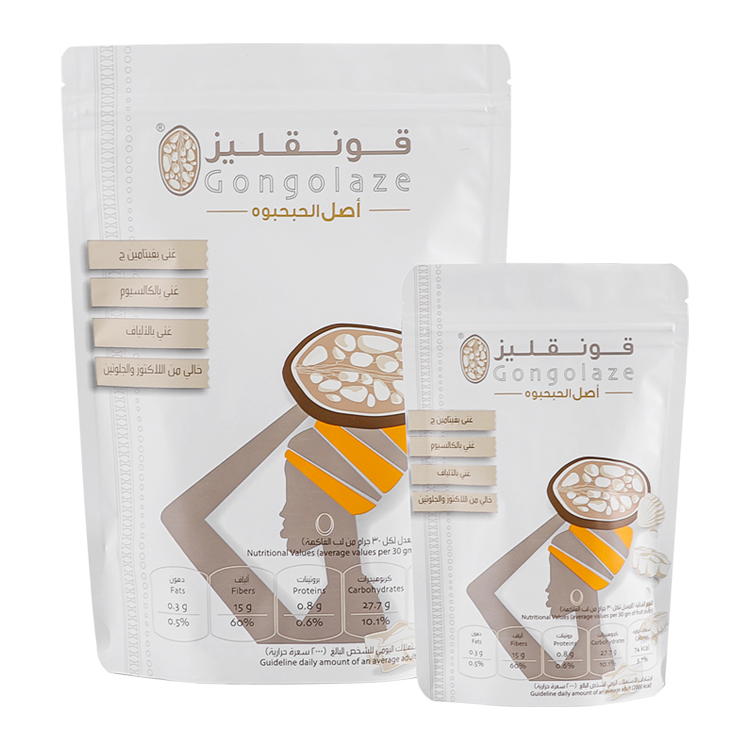
Use the project as a starting question, not an answer: would an opaque foil-containing structure, different sealant, smaller portion or another format suit your fruit, equipment and desired display? Ask for the exact current specification and test the proposed bag with real finished pieces. This is how a real manufacturing example becomes useful without turning a powder case into an invented fruit success story.
A brief worth sending to a pouch supplier
If you are choosing customized dried-fruit packaging, bring a representative finished fruit sample or clear product photos, not just a desired weight. Tell the supplier which fruits and piece sizes will be packed, whether the mix is intentionally crisp, the normal fines at filling, portion and channels, expected unopened period, proposed after-opening behavior, light exposure and shipping route. Include the filling and sealing equipment and whether a clear window or zipper is essential. Request sample bags and a drawing that leaves adequate fill and initial-seal space.
Ask for the complete construction, food-contact documentation appropriate to the destination market, WVTR and relevant OTR reports with methods and conditions, closure details, and suggested starting sealing conditions. Those materials support a shortlist. The fruit brand then approves the actual filled-pack, storage and distribution evidence. If a supplier proposes a different film to meet an appearance or budget target, ask which earlier tests still apply and which must be repeated.
The useful inquiry is specific: “We sell crisp freeze-dried strawberry slices in a multi-serving retail pouch. Here is the portion, filling method, expected store and parcel route, and our current texture and breakage criteria. Please suggest two construction samples and explain their film data, seal design and window trade-offs.” That conversation is more likely to produce a testable pouch than asking for a bag that “lasts 25 years.”
Frequently asked questions
How long does freeze-dried food last in a sealed bag?
For the freeze-dried fruit covered here, there is no universal duration. Define the particular fruit, process, initial condition, complete bag, seal, storage environment and acceptance criteria; then examine separate unopened samples over the proposed period. A published long-storage estimate for other freeze-dried foods is not a commercial shelf-life claim for your fruit. The date belongs to the qualified product-and-pack system.
Does freeze-dried fruit expire, or does it only lose crunch?
It can fail a quality specification, and a food-safety concern must also be assessed separately. A soft bite may be an early quality warning but cannot diagnose every safety issue. Damaged packaging, contamination or product that did not meet release criteria calls for the food business's investigation procedure. A “best before” statement and any safety-related date terminology must be reviewed for the destination market and the actual evidence.
How should freeze-dried fruit be stored before it is bagged?
Minimize unnecessary exposure after the product reaches its approved endpoint. Prepare approved pouches, containers and the sealing line in advance; record the transfer and hold conditions; and pack promptly under the product's controlled procedure. The University of Minnesota notes that freeze-dried foods absorb moisture readily, even from room air. Do not use a universal number of permissible minutes without testing the actual fruit and environment.
What storage conditions should appear on the finished pack?
Use wording supported by the brand's study and the market's labeling requirements. Cool, dry storage away from light may be sensible general advice, but it is not a substitute for evaluating the temperatures, humidity and display conditions the pack will actually encounter. If the package is multi-serve, assess and state the appropriate after-opening handling separately from the unopened date.
Is an aluminum-foil pouch required for every freeze-dried fruit?
No single laminate is automatically required by the product name. A foil-containing candidate may be useful where the protection objective, light exposure and measured results justify it. Compare the exact foil, metallized or transparent constructions and the complete converted packs. Poor seals or a weak window can defeat an otherwise promising film; mechanical damage to the fruit may require a different fill or outer carton instead.
Is a low WVTR enough to set the shelf life?
No. ASTM F1249 measures water-vapor transmission of a tested film or sheet under stated conditions. It does not measure fruit readiness, exposure at filling, zipper use, every seam, storage temperature or shipping damage. Film data screen candidates. Filled-pouch integrity and product stability studies provide the evidence needed for the intended label period.
Does an oxygen absorber keep freeze-dried fruit crisp?
An oxygen absorber has a defined oxygen-management role; it is not a moisture barrier. If crispness is failing, examine the fruit's baseline, ambient exposure, material WVTR, seals and consumer-use pattern. A desiccant may be a separate option to trial, with supplier instructions and food-contact/consumer considerations. Neither insert fixes an unsuitable product or leaking pack.
Can I use only a zipper instead of a heat seal?
For a pouch intended to be initially heat-sealed, no. Specify a clean, qualified first seal and place the zipper where the consumer can use it after opening. The zipper is for reclosure, and its performance can change when fruit dust gathers in the tracks. Test both the unopened pack and the opened-use scenario rather than applying the same date to both.
Is vacuum packing better for whole fruit pieces?
It may help one quality objective and hurt another. The published strawberry study observed a storage benefit under its tested conditions, but a vacuum process can press flexible film against a fragile whole piece. Evaluate the actual fruit under the proposed evacuation level and carton arrangement. Compare moisture-related changes and breakage separately before deciding.
Why did my freeze-dried fruit become soft in an unopened pouch?
There are several plausible causes: incomplete or inconsistent starting product, time exposed before sealing, film or window transmission, a poor seal, or storage outside the validated conditions. Isolate the lot, review its records, inspect retained packs and test according to the quality team's procedure. Appearance alone cannot locate a small leak or prove that the fruit was correctly processed.
Why are there so many crumbs although the bag is intact?
Count fines before filling, after the line and after shipping. If they appear before sealing, investigate transfer tools, drop heights, portioning and overfill. If they appear later, inspect the carton arrangement, compression, movement and handling route. A stronger bag film may prevent a puncture yet still transmit enough pressure to break the pieces within it.
Can one shelf-life study cover several fruits or bag sizes?
Only if the qualified study design and documented justification actually cover the differences. Different fruits, pretreatments, piece sizes, portions, bag areas, windows and headspaces can change moisture and damage behavior. A change-control review should decide which evidence transfers and which needs new sampling. Do not silently apply one strawberry result to apple slices or a larger zipper pouch.
How many samples and time points should a brand use?
There is no responsible universal count from a blog post. The qualified team should set time points through the proposed selling period, independent retained units, relevant lot variation, expected conditions and an analysis that can support the intended decision. Keep separate unopened, opened-use and distribution samples. Write pass/fail criteria before the results arrive, and extend or redesign the work if the evidence does not reach the proposed date.
Are freeze-dried fruit and freeze-dried candy packaging the same problem?
Both can be sensitive to moisture and breakage, but the product structures, ingredients, piece geometry and acceptability criteria differ. Mylarbag has a separate freeze-dried candy packaging guide for that product. Use the actual fruit's release, filling, storage and shipment evidence here, rather than importing a candy configuration or date.
Make the date a result of the evidence
A useful freeze-dried fruit pouch starts with correctly processed fruit, keeps the first seal clean, and matches the selling and shipping route. Material reports help narrow candidates; real filled packs reveal whether the whole system works. Check crispness, water-related measures where required, piece condition and package integrity at the planned intervals. Keep opened-use findings apart from unopened results. Then set the claim and period that the evidence supports. That is the answer to “how long” for the fruit your customers will actually buy.