
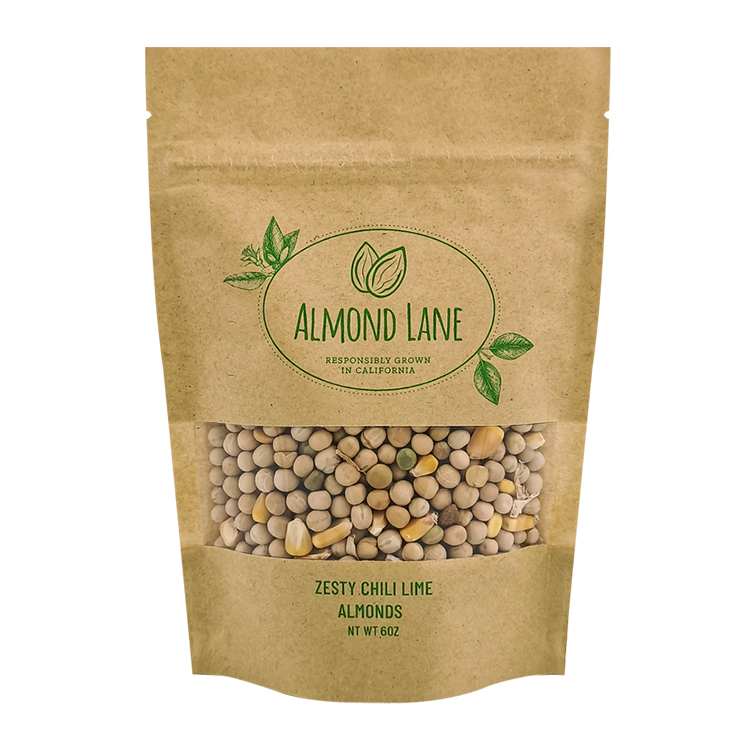
There is no single number of months that applies to every sealed bag of nuts. For an unopened commercial pack, start with its date and storage directions, provided the bag is intact and stored as specified. Once opened, the unopened date is no longer a promise for the contents: close the remaining nuts in a clean, dry, odor-tight package and use them while their flavor and texture remain acceptable. Product, processing, packaging and temperature all affect the answer.
This guide concerns dry retail nuts and dry nut snacks, including peanuts as a common packaged snack. It does not set a shelf life for fresh chestnuts, boiled peanuts or other high-moisture foods. It also separates a quality question—whether nuts still taste and smell fresh—from a food-safety question. Neither a printed date nor a normal smell can establish that a food is free of harmful microorganisms. The University of California's nut-handling publication explicitly warns that harmful bacteria cannot be identified by sight, smell, taste or texture.
The useful way to ask “how long do nuts last in a sealed bag?” is to name the nut product, the package and the storage history. A manufacturer's shelf-life decision applies to its own finished product in its own tested pack under stated conditions. A consumer's next decision is different: examine the intact bag, follow its label, and change the storage routine when the seal is first broken. The sections below turn those two decisions into practical checks.
Two clocks: unopened pack and opened contents
The unopened clock is the period the brand has assigned to a particular product and package when kept according to the label. The after-opening clock begins when air, room humidity, kitchen odors and repeated handling can reach the food through a newly opened mouth. A zipper can make repeated use more convenient, but the ability to reclose a bag does not recreate its factory seal or any original controlled atmosphere. A product may also be compromised before its printed date if the pouch is torn, wet, heat abused or otherwise mishandled.
The Philippines multi-SKU raw-nut pouch project illustrates why the name “nuts” is too broad for one number. It shows differently named nut products in a related stand-up pouch design. It does not provide a shelf-life test, a date setting or a claim that all those products age the same way. Roasting, seasoning, nut-piece size, incoming quality and the amount and condition of oil in the product need to be considered separately.
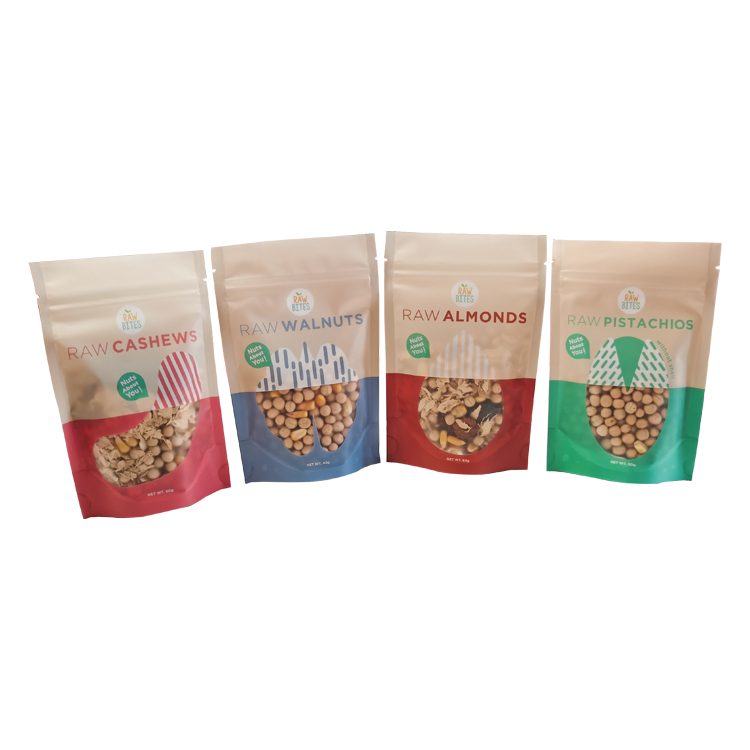
If you are buying one bag for home use, these distinctions help you avoid relying on an internet-wide “three months,” “one year” or “forever in Mylar” claim. If you are specifying commercial packaging, they tell you which exact filled sample must be evaluated. A product photo can show pouch format and artwork, but cannot establish moisture content, oxygen exposure, seal integrity or the way quality changes over time.
What does the date on an unopened nut bag mean?
Read the actual phrase on the pack: “Best if Used By,” “Best Before,” a use-by date or another market-specific wording may carry different requirements and meanings. In its food-waste and food-safety guidance, the U.S. FDA explains that “Best if Used By” identifies when a food is expected to be at its best quality; for most U.S. foods, date labeling is not a uniform federal food-safety deadline. That does not override applicable local rules, a specific product's directions or a recall. Do not take a general statement about one quality phrase and apply it automatically to every label or country.
Do nuts go bad in an unopened package? Yes, they can. An intact-looking pouch slows particular exposure routes to the extent its construction and seal have been validated; it does not stop the passage of time or reverse oxidation that began in the raw materials. A poor top seal, pinhole, long exposure to heat, moisture, a strong surrounding odor or a damaged carton may shorten the useful quality period. Conversely, the calendar passing a quality date does not by itself reveal the contents' actual condition. Follow the brand's directions and use reasonable judgment about the pack's condition, while keeping quality and microbial safety separate.
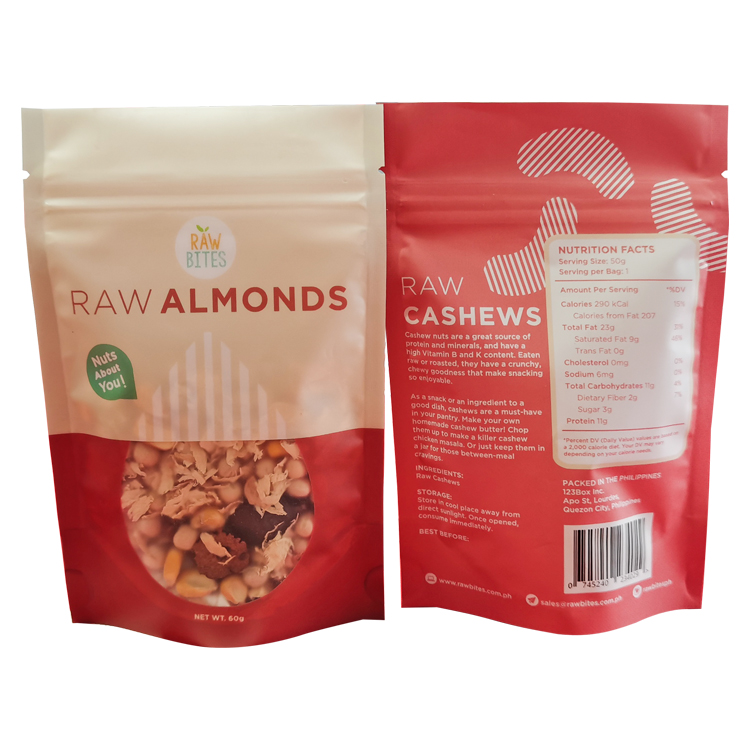
The photographed back panel on Mylarbag's Philippines raw-nut case includes a storage instruction and a “BEST BEFORE” area. This demonstrates where a brand can communicate the two decisions: handling the unopened pack and what to do after opening. The image is a packaging example, not evidence of a legible filled-in date, validated duration or a customer shelf-life study. For actual production, the brand should make the date, lot code, storage wording and market-specific legal text readable on the filled pack and approve the precise wording with its regulatory team.
When checking an unopened pack, first identify the product and lot, then the date wording, then the storage condition attached to that date. If the label says to refrigerate, a bag kept warm for an unknown period cannot simply borrow the printed date as if it had been continuously refrigerated. If the package has an “after opening” instruction, use that for the remaining portion. Photograph the lot and date if you need to ask the seller about an unusual smell, damaged seal or suspected quality issue; a lot-level trace is more useful than saying only “the nuts were old.”
Why sealed nuts can lose quality
Many nuts contain oils that are vulnerable to oxidation. The Almond Board of California's explanation of lipid oxidation describes how oxygen exposure can create off aromas and flavors in almonds, and how temperature, moisture, light and product processing affect the rate. Almonds are a useful studied example, but their published observations are not a tested shelf-life figure for peanuts, cashews or a particular customer's nut mix. Higher temperature generally makes a poor storage history harder to forgive; an outer carton or shaded shelf can reduce light exposure but cannot fix a leaky inner pouch.
Water is another part of the problem. Shelled nuts can absorb moisture and surrounding odors, which is why the UC guidance recommends clean, moisture-free, odor-tight containers. A bag lying against a wet pallet or a product handled with wet utensils after opening has a different history from a dry, properly stored sealed pack. Moisture movement can affect crunch and favor other deterioration. A reclose feature is only useful if the package itself remains clean and its opening is fully closed each time.
In a finished retail pouch, the food and the package form one system. Oxygen and moisture may reach the food by several routes: through the specified film over time, at the sealed edges, through a damaged window or pinhole, or through an opened/reclosed mouth. The least-protected route can dominate the consumer experience. A material name such as “Mylar,” “foil” or “kraft” is therefore not an expiry date; the actual layer specification, window, seal, filled product and storage plan matter. A photograph of a metallic-looking interior cannot tell you the measured oxygen or water-vapor transmission of a complete pouch.
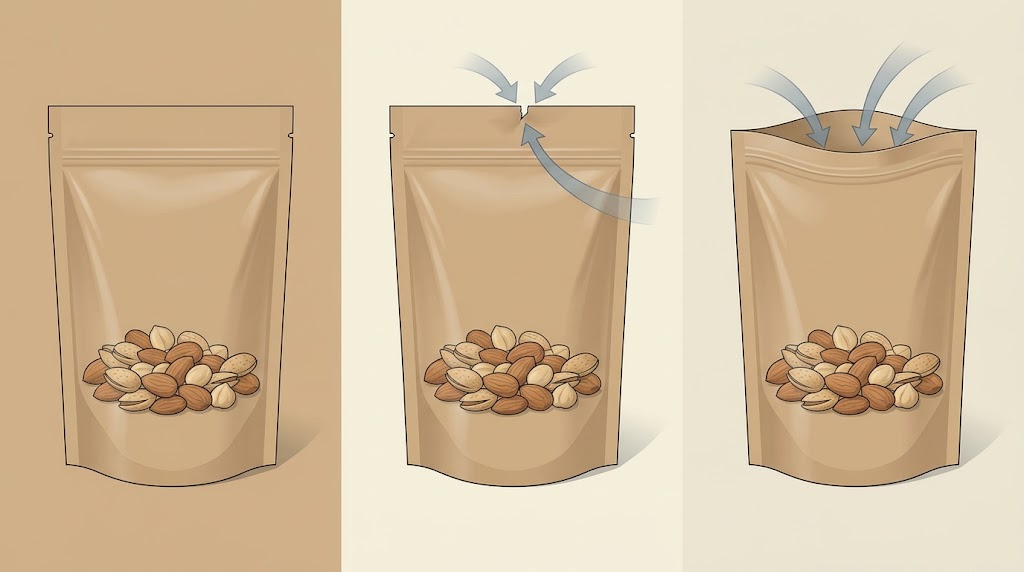
Four variables are especially worth recording in any shelf-life discussion: (1) whether the nuts are raw, roasted, chopped, coated or mixed; (2) how they were dried, processed and handled before packing; (3) the measured barrier and integrity of the finished bag, including its seal and any window; and (4) the real temperature, humidity, light and distribution history. The Almond Board's shelf-life and quality-preservation research presentation treats product, package and storage environment as interacting factors. That is a basis for a test plan, not a promise of a particular number of months for a customer's SKU.
An oxygen-management method is not a date by itself
Some brands use a suitable barrier pouch and a qualified nitrogen-flush or vacuum process. Those methods can be evaluated as part of controlling the product's oxygen exposure, but they cannot determine the product's finished shelf life without measurement and follow-up. A bag may be gas flushed yet have a contaminated top seal or later pinhole; a good initial gas reading does not cover all future handling. A consumer also cannot identify the original gas merely from a puffy or flat bag. The separate headspace article explains why apparent emptiness, fill mass and gas composition require different checks. Here, the practical point is narrower: no gas claim replaces a storage statement and a tested date.
How to store unopened nut bags
Keep commercial nuts under the conditions on their own label. For many shelf-stable dry-nut products this means a cool, dry area away from sunlight, steam, strong odors and heat sources; a pack with different directions takes priority. Avoid a damp floor, a hot car or a warehouse location with condensation. Keep the outer carton intact during distribution, and inspect inner pouches when a case has been crushed or wet. Do not assume that a carton protects an already punctured bag or that a decorative paper layer serves as a measured moisture barrier.
The University of California's consumer publication offers a general reference: nut quality can last up to a few months at room temperature, less in warmth; refrigeration at 40°F/4°C or below can support quality for a year or more, and freezer storage at 0°F/−18°C or below for up to two years in its general discussion. Its more detailed table varies by nut and in-shell/shelled form. These are consumer handling ranges, not dates to print on a new commercial pouch and not a guarantee for every recipe. The publication also treats fresh chestnuts separately because their storage behavior is different.
Refrigerating or freezing home-held nuts can slow quality deterioration when the packaging and handling are suitable. It does not make suspect food safe; UC specifically notes that cold does not destroy Salmonella. For a commercial product, the brand still needs to test its intended pack and temperature range. Whether an unopened original retail pouch can safely serve as a freezer package, how to handle condensation during warming, and what secondary container it needs are addressed in the planned freezing guide rather than answered from its material name alone.
Before buying or putting away an unopened bag, look for an unbroken top seal, no punctures or unexplained wetness, a readable date and storage direction, and a carton that has not visibly crushed sharp nuts through the film. If you find a defect, isolate the pack for the retailer or brand rather than opening it to see whether a bad seam “probably” kept most of the air out. A damaged package is an investigation, not a chance to extrapolate a shelf-life claim.
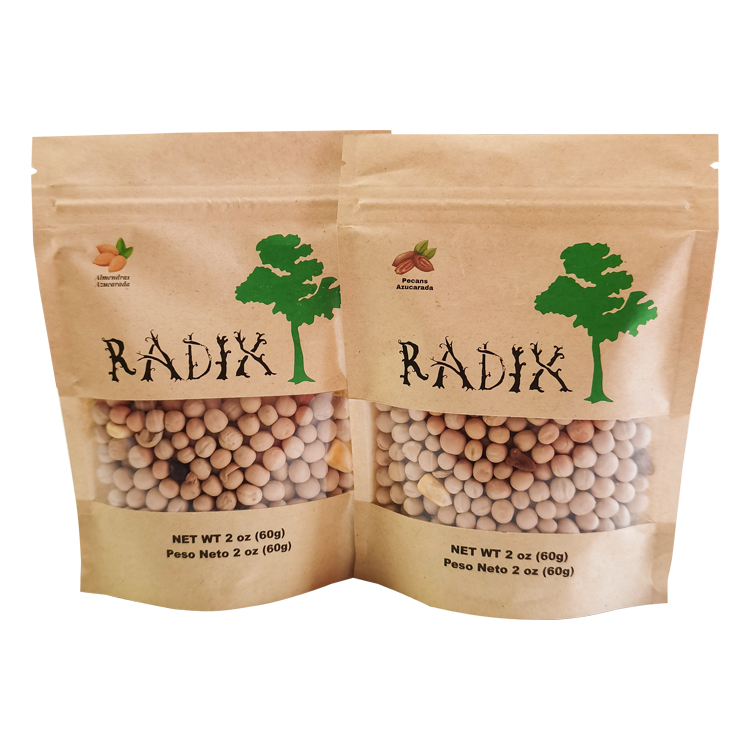
The Puerto Rico candied-nut stand-up pouch case shows a different snack product and a different public material listing (kraft paper/PET/CPP) from the raw-nut case. It is a reminder that candied, roasted, seasoned and plain nuts may require different product tests and consumer directions. The project page does not report a measured shelf life, water activity, oxygen level, storage trial or customer complaint rate; the photograph cannot supply those missing results.
How to store nuts after opening the package
Open the bag with clean, dry hands and utensils, take out what you plan to eat, and protect the rest immediately. If the manufacturer's label gives an after-opening instruction, follow it. Otherwise, use the ordinary quality-preserving principle behind the UC advice for shelled nuts: keep the remaining nuts in a clean, moisture-free, odor-tight container and choose a cool location. A working zipper can be convenient, but remove crumbs from the tracks, press it shut across its full width and check that it truly closes. A loose fold or clip on a torn pouch is unlikely to provide the same protection as an intact container.
For a bag you open repeatedly, consider transferring the remainder to a clean, dry, tightly closing container or placing the fully reclosed inner pouch inside one. Keep it away from onions, spices, detergents and other strong odors. A small portion for the counter and the rest in colder, suitable storage can reduce repeated temperature changes and openings of the main supply. Label the secondary container with the product, original lot/date and the day it was opened, so the second clock does not disappear when the printed pouch is discarded. If the product's label requires refrigeration after opening, follow that instruction rather than a generic room-temperature suggestion.
Do not pour uneaten nuts from a shared serving bowl back into the stored supply. Wet hands, a damp scoop or steam near a stove can add moisture that the factory package was never meant to handle after opening. If the nuts were part of a seasoned mix, expect the flavoring and exposed surface to influence how quickly the eating quality changes; a whole raw nut and a chopped, roasted, coated snack are not interchangeable. Make the initial portion size match likely consumption: a single large bag opened every day faces a different exposure pattern from several smaller portions opened once.
There is no responsible fixed “use within X days of opening” value for all dry nuts. The brand can provide one when it has tested the product and its likely consumer handling, and shoppers should use its label where present. Otherwise, close and store the remainder promptly, examine quality during use and avoid extending the brand's unopened claim to an opened pack. Colder storage often helps quality, but the original pouch, its closure and the handling process still have to keep out odors and moisture. Freezing a questionable product will not correct a previous safety or package problem.
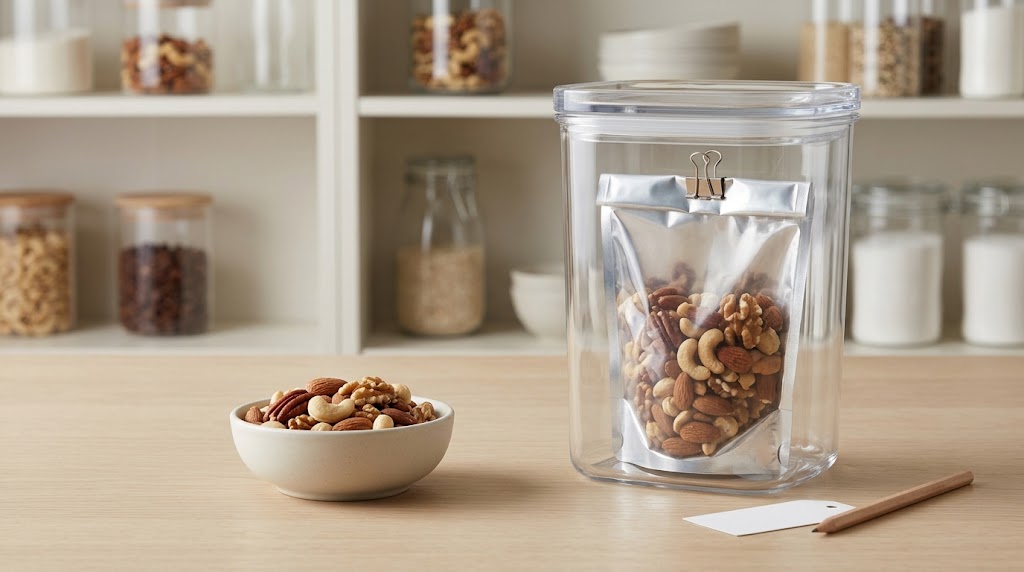
How to keep nuts fresh in a bag therefore has two meanings. Before opening, select and protect a sound package whose material and seal suit the product and its tested storage conditions. After opening, the immediate priorities are clean, dry handling and an effective closure or secondary container. A barrier film cannot compensate for leaving the mouth gaping on a humid kitchen shelf, and a zipper does not make the pack sterile or restore its initial headspace. Conversely, a sound after-opening routine cannot make stale or wet nuts fresh again.
When to keep, query or discard the product
Quality changes can include an old-oil or paintlike odor, an unpleasant bitter or stale flavor, a change in crunch or a flavor picked up from nearby storage. If the food clearly tastes or smells rancid, there is little reason to keep it for eating. Do not use tasting as a safety test. Visible mold, wet or slimy areas, insects, contamination, an obviously broken seal or a recall are different concerns and call for avoidance and appropriate disposal or follow-up. A normal-looking nut is not proof that pathogens are absent; this is especially relevant when investigating a suspect lot rather than deciding whether a slightly stale flavor is enjoyable.
If you have a consumer complaint, keep the outer bag, its lot and date, a description of where it was stored, and photographs showing any actual damage. The seller or brand can compare those details with production records and retained samples. Avoid promising that a replacement from a different lot will necessarily taste identical; incoming nuts, processing and age can vary. Likewise, do not diagnose “bad barrier film” from a rancid smell alone. The brand should examine the product's history and the finished package before assigning cause.
The storage advice above is about protecting quality in normal use, not determining the safety of a recalled product. Follow official recall instructions if a lot is affected. If the original seal appears opened, wet or tampered with at purchase, do not treat a future printed date as permission to sample it. The UC publication's microbiological warning is the reason a sensory check must stay in its lane: flavor can reveal a quality problem, but ordinary senses cannot establish the absence of harmful bacteria.
How a nut brand should set a defensible unopened date
For a brand owner, the appropriate answer to “how long?” is a documented specification and test, not a guess borrowed from a material supplier's brochure or another nut product. Start with the actual SKU: nut type and origin, whether kernels are raw or roasted, salt, oil or coating, piece size, acceptable incoming quality and the processing history. Decide what “acceptable at the end of life” means for flavor, aroma, texture and any relevant analytical and safety criteria. The food safety plan, legal label and quality plan must be set by the responsible food business; a bag supplier can provide package specifications and samples, not certify the food's shelf life from a photo.
Next, test filled and sealed production-representative pouches. Specify the complete material construction, window area if any, top seal, zipper position if present, carton and target storage conditions. Ask for the relevant gas- and moisture-barrier information for the actual construction and evaluate finished-pack integrity, including after normal filling and distribution handling. Define the process variables that matter if using nitrogen or vacuum and measure them with a suitable method. Package-level tests answer whether a protection route appears to work; they still must be connected with actual nut quality over time.
Then retain samples from more than one run or meaningful production condition as the quality team judges necessary. Compare baseline samples with intervals through the intended date, using planned sensory evaluation and suitable measurements such as moisture or water activity and indicators of lipid oxidation where appropriate. Record the temperature and humidity history; a warm warehouse or a simulated transport abuse condition may reveal a weakness that a stable laboratory shelf does not. Set acceptance criteria before reading the results, and decide what to do when the earliest relevant criterion fails. Neither an accelerated trial nor a single late photograph automatically substitutes for a real-time validation at the conditions claimed on the label.
The Almond Board's shelf-life research illustrates why sensory changes, product form and storage conditions must be assessed together. It provides a research framework, not a customer-specific pass result. In parallel, the FDA's date-label explanation is a reminder that a consumer-facing date phrase needs a clear meaning. If the intended consumer will store an opened pack in the pantry, do not silently validate only an unopened pack in refrigeration and then advertise a universal after-opening duration.
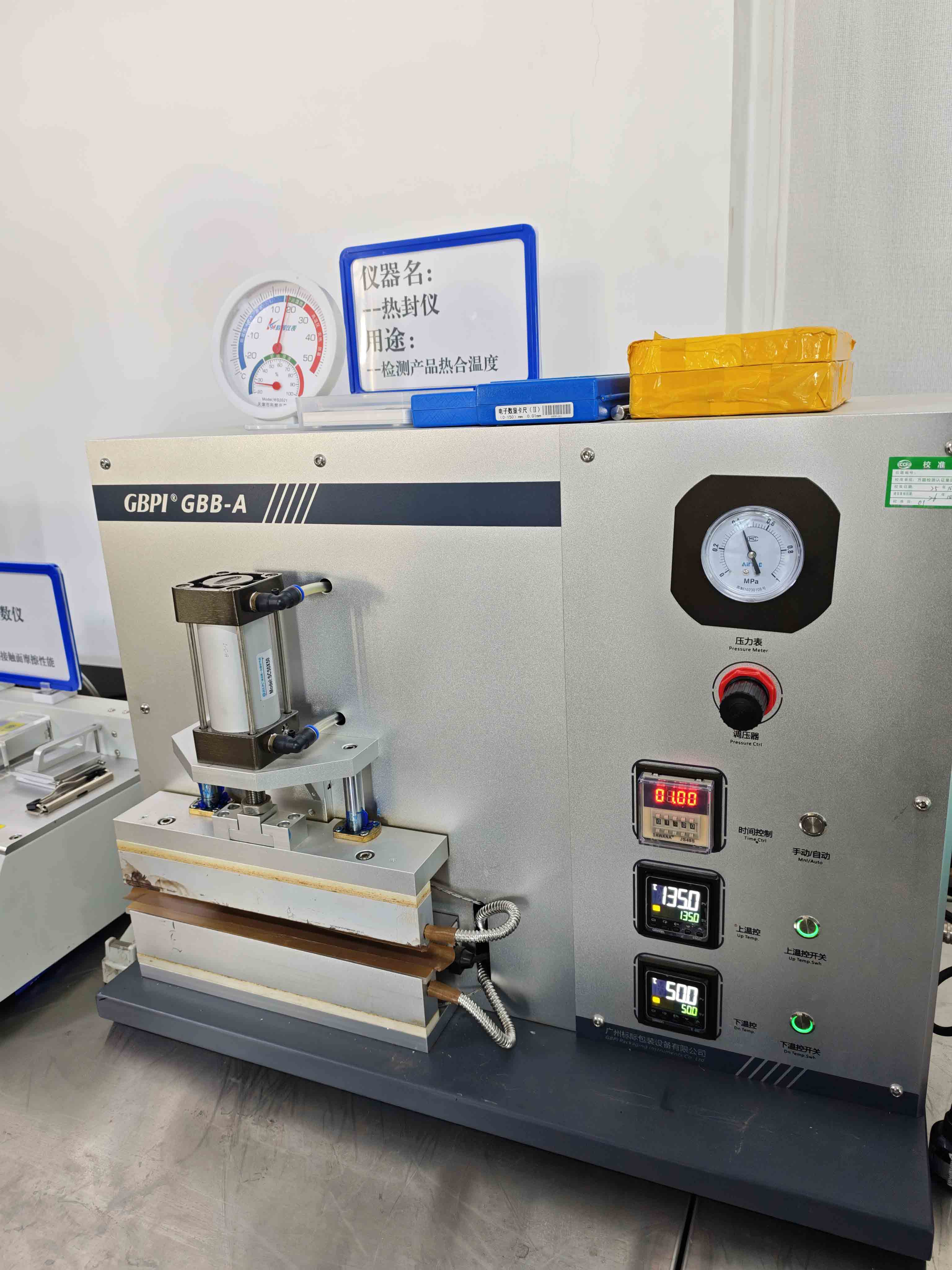
The photograph below is Mylarbag's factory heat-seal testing equipment, not a test report for any of the pictured nut products. It illustrates one part of package development: checking whether a candidate structure and closure process can make an appropriate seal under defined conditions. A food brand still needs its own filled-pack, storage and quality validation. It should not cite this photograph as proof that an almond, peanut or candied-nut bag has reached a particular number of months.
What if one batch loses quality earlier than planned?
Hold the affected lot and compare it with unaffected lots and control samples. Check incoming nuts and processing, date code and storage history, finished-package seal and damage, carton condition and any gas-management records. A cluster of corner punctures points the investigation in a different direction from an intact pack with a changed roast flavor. Review what consumers actually did after opening before attributing their experience to the unopened pouch. The corrective action may be a shorter date, cooler distribution, altered product, stronger carton, different window or better sealing control. Each change needs new evidence rather than a revised number printed by intuition.
Recommended packaging configuration for a dry nut SKU
For an initial brief to a packaging supplier, state the actual nuts and process, intended net weight, expected route and storage, whether the shopper needs to see the product, how often the bag will be opened, and the brand's proposed quality date. Request filled-size samples of two or three candidate formats. A stand-up pouch with a clean, qualified top seal can be a sensible starting point for many dry retail nuts; a zipper may help after opening if the consumer can close it fully. A window improves product visibility but changes the complete barrier construction and should be assessed as such. Some oxygen-sensitive roasted or chopped products may justify a different film, no window and a separately qualified atmosphere process. These are conditional design options, not a blanket recipe.
The nuts packaging collection shows available product formats and real examples; use it to shortlist a shape before requesting a precise structure, filled samples and relevant barrier and seal evidence. Ask Mylarbag's team for a sample brief that names the nut SKU, fill mass, format, closure, artwork/date area, storage market and planned validation. The brand's food-quality and regulatory teams should approve the date and after-opening instruction only after product-specific work. That division of responsibility keeps a useful bag recommendation from becoming an unsupported shelf-life claim.
Frequently asked questions
1. How long do nuts last in a sealed bag at room temperature?
Use the intact commercial pack's own date and storage directions under the conditions it specifies. For a general home-storage reference, UC says dry nut quality can last up to a few months at room temperature, less when warmer. That is not a transferable expiry date for a particular retail pouch. The nut, roast, initial condition, film, seal, light and real storage history can change the result. If the original pack is wet or torn, the printed date cannot settle the question.
2. Do nuts go bad in an unopened package before the best-before date?
They can. Heat, an inadequate seal, a pinhole, moisture or quality problems present before packing may change the food earlier. A “Best if Used By” date is generally a quality cue in the U.S. FDA's explanation, assuming the product has been handled as intended. Inspect the package and follow the brand's guidance. A normal aroma does not establish microbiological safety, and a visibly damaged bag should be raised with the retailer or brand rather than treated as fully protected.
3. Is a zipper enough to keep nuts fresh after opening?
A zipper helps only when its tracks are clean and completely closed. It does not recreate the original factory top seal, remove oxygen, prevent repeated handling or guarantee an odor-tight and moisture-tight pack in every setting. For a large bag used over time, put the fully reclosed pouch inside a clean, dry, tightly closing secondary container if needed. Follow any printed after-opening refrigeration or use instruction. Consider smaller pack sizes if the same bag will otherwise be opened many times.
4. Should I refrigerate or freeze an unopened bag of nuts?
Follow the product label first. Suitable cold storage can help preserve quality, and UC's consumer guidance gives longer general quality ranges under refrigeration and freezing than at room temperature. The container must still keep out moisture and surrounding odors, and cold does not destroy Salmonella. The suitability of the original commercial pouch for freezing and the warm-up procedure cannot be inferred from a “Mylar” name or an image; check the brand's directions and use suitable secondary protection where needed.
5. Can I eat nuts after a “Best if Used By” date?
The FDA describes that phrase as a quality recommendation for most U.S. foods, not a universal safety cutoff. That does not mean every post-date bag is good, or that a food is safe because it looks normal. Follow any more specific product instructions, recalls and applicable local rules. Do not use nuts with visible mold, contamination, wetness, damaged packaging or clearly unacceptable smell and flavor. If in doubt about an unopened branded product, give the seller its lot and date for a product-specific answer.
6. What should a nut brand test before printing a shelf-life date?
Test its own finished product in representative filled and sealed pouches under the intended storage and distribution conditions. Set quality and safety criteria with the responsible team, check sensory performance and relevant analytical measures, and verify finished-pack seal, barrier and handling integrity. Record the results over time and separately consider the likely after-opening routine. A material datasheet, a nitrogen setting, an image of a factory tester or another brand's published number cannot independently authorize the new date.
The practical answer
A sealed bag buys protection to the degree that its food, structure, seal and storage have been validated. For an unopened retail product, use the brand's stated date and conditions while checking that the pack is sound. After opening, treat the remainder as a newly exposed supply: keep it clean, dry, promptly closed and appropriately cool, and keep the lot information. For a new branded SKU, test the filled system and write separate unopened and after-opening guidance from the results. That is the honest answer to “how long” without inventing a single calendar number for every nut and every bag.