
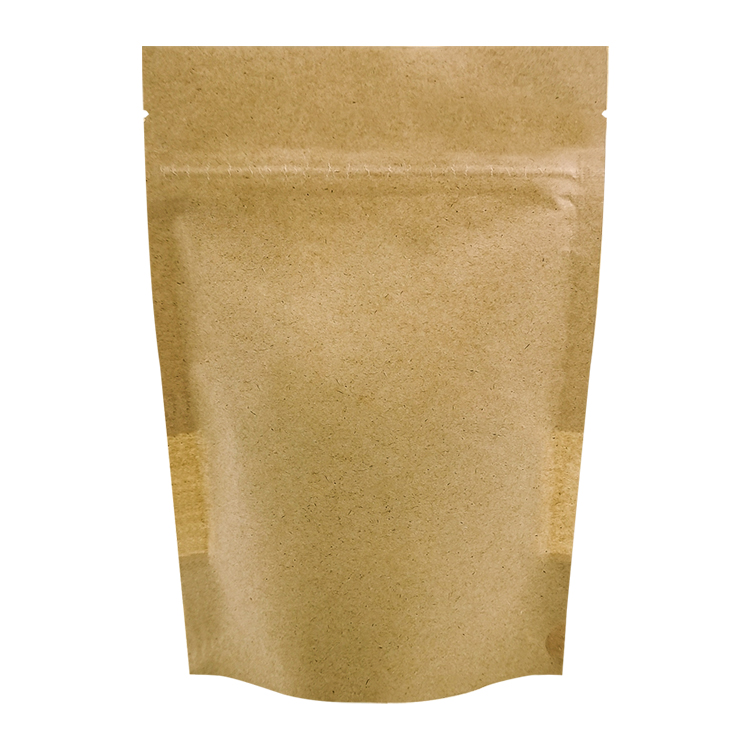
There is no reliable single bag dimension for 4 oz, 8 oz or 1 lb of nuts. Those numbers specify how much food you plan to sell by weight; the pouch must also hold the actual nuts after filling and settling, leave a clean area for the first seal, work on your equipment and still look right in its shipping carton. Start with samples in a few candidate widths, heights and gussets, then fill them with the real SKU before approving a custom size.
This guide covers dry retail peanuts, almonds, cashews, pecans, macadamias and dry mixed nuts. It is a pouch-sizing method, not a shelf-life, food-safety or label-approval calculation. A bag that holds one pound of whole almonds may be the wrong shape for one pound of cashew pieces or a coated mix. Wet boiled peanuts require a different product and processing brief. Sourcing the empty bag is a separate decision; this article stays with the size question.
You can ask for candidate samples from Mylarbag's nuts packaging team, but send a representative nut sample or measurements of an existing acceptable pack. A photograph and a supplier's “8 oz” SKU name are screening clues, not a filled-pack approval.
First separate net weight from physical pouch capacity
In this article oz means avoirdupois ounces of product mass, not US fluid ounces. One pound is 16 ounces. For planning, 4 oz is about 113 g, 8 oz about 227 g and 1 lb about 454 g; NIST's conversion guide lists the precise factors, and your final label declarations must be checked under the rules for your market. The rounded gram figures in the table are orientation aids. They do not mean that a package labeled 8 oz can be silently redefined as 250 g, or that a bag rated for 500 g of a different food necessarily fits a one-pound nut portion.
The FDA's food-labeling guide treats net quantity as a food-label matter. We are addressing a different question here: how to make the declared amount physically fit in a usable pouch. The food business has to control its actual packed net content and approve the final market label; the pouch supplier can help with dimensions, materials, samples and print artwork. Do not solve a visually sparse bag by adding unplanned product above an approved net-content process, and do not reduce food simply to make an undersized bag seal.
Nuts have spaces between pieces. The occupied space depends on shape and packing. Whole cashews curve and bridge differently from small peanut pieces; large pecan halves can settle or fracture; a mixed product can segregate in a hopper or package. Coatings and loose fragments can change the fill flow and contaminate a seal area. Even two lots of the same SKU can arrive with a different proportion of broken pieces. That is why a supplier's capacity chart, while useful for choosing sample candidates, is not a substitute for a trial with your actual product.
Read the finished pouch drawing before using any size chart
Pouch sellers commonly describe an outside width, outside height and a gusset. Ask whether those measurements refer to the finished sealed bag, an unsealed blank, the web before conversion or an approximate stock listing. For a notation such as W × H + G, confirm the unit and which fold or panel G measures. Do not assume that a “+ 4 cm” bottom gusset on one drawing is expressed in exactly the same way as another supplier's notation. Request the drawing, not merely the heading of a website chart.
The product cannot use the entire outside rectangle. The side seals occupy width; the bottom gusset has a shape and folds; the zipper, tear notch and top closure take height. A flat empty bag may measure wide enough on a desk but bow or taper when filled. A printed window can appear at a useful spot on an empty proof and partly disappear under the settled nuts after handling. Asking for outside dimensions alone skips the geometry that customers actually see and packers must seal.
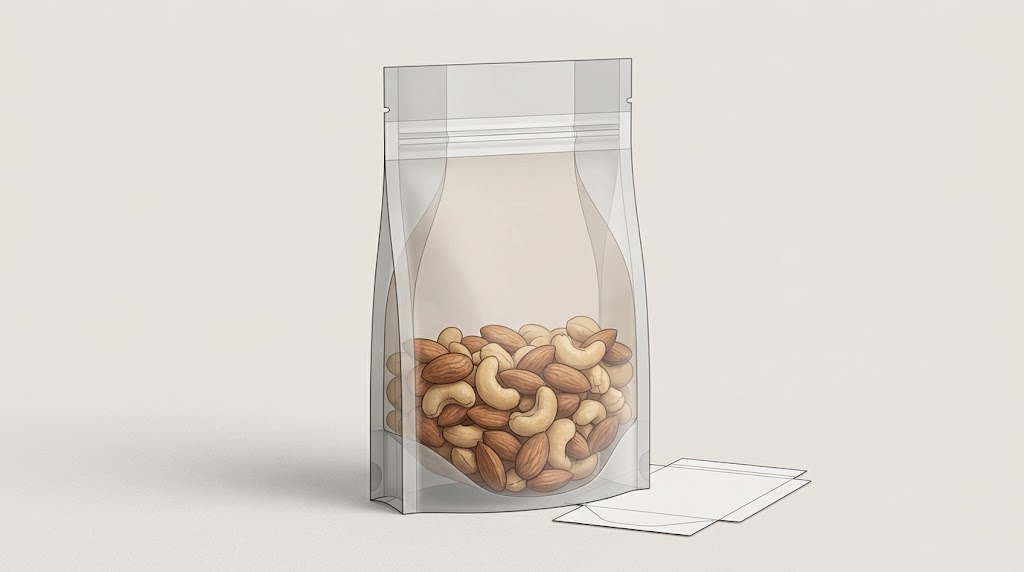
A flat pouch and a stand-up pouch with the same outside width and height will not necessarily hold the same food. One has no expanding bottom gusset; the other may have a larger but irregular cavity. A flat-bottom format changes the base and side geometry again. For a small snack portion, a flat pouch may be worth sampling if the display is in a tray or carton. If the product must stand independently, start a stand-up pouch trial. Choose the format with the real display and filling route in mind, then choose the size within it.
Measure the product consistently before ordering candidate samples
Weigh several representative portions of each nut SKU at the intended pack weight. Use a consistent, clean container that lets you observe the loose bulk volume occupied by the nuts, including the air spaces between pieces. Record the volume just after a normal fill and after a repeatable, gentle settling step that resembles what happens on your line. Do not compact or shake the product so aggressively that pecans break or the trial no longer represents production. A kitchen cup is a rough screening tool; a marked vessel and written method make supplier comparisons more useful.
Repeat the measurement with different lots if the product varies materially. If the bag will carry a mixed-nut recipe, weigh the actual blend, rather than calculating from a single constituent. If the line fills by count for a special product, capture the count as well, but still verify the finished net-content program and actual occupied volume. Do not invent a “cashew density” from an internet chart and treat it as your own recipe's packing behavior.
For a first estimate, loose bulk density = sample mass ÷ observed bulk volume. You can invert that observation to estimate the starting product volume for another weight of the same product and handling method. This is a way to decide which empty bag samples to request, not a formula for approving the finished bag. The product may settle differently when the pack geometry or filling speed changes, and a bag's usable internal volume is not simply its width multiplied by its height and gusset.
For example, imagine an illustrative, not measured customer trial: 227 g of a particular nut mix occupies 520 mL after the team's chosen gentle settling method. Its observed bulk density would be about 0.44 g/mL. At the same density, 454 g suggests about 1.04 L of bulk product. This is not a specification for all 8 oz or 1 lb nuts, nor a one-liter bag recommendation. It merely tells the buyer that the heavier pack should be screened against a suitable range of physical samples. Seal space, product movement, bag geometry and carton handling remain to be tested.
The published US 6 oz nuts-and-seeds pouch project lists a 14 × 20 + 4 cm format, a stand-up bag, a horizontal window, digital printing and a kraft paper/PET/PE structure. It demonstrates a real project-specific combination, not a way to interpolate a 4 oz, 8 oz or 1 lb dimension by multiplying each side. Even if your nuts are similar, request a filled sample for your intended weight and product.
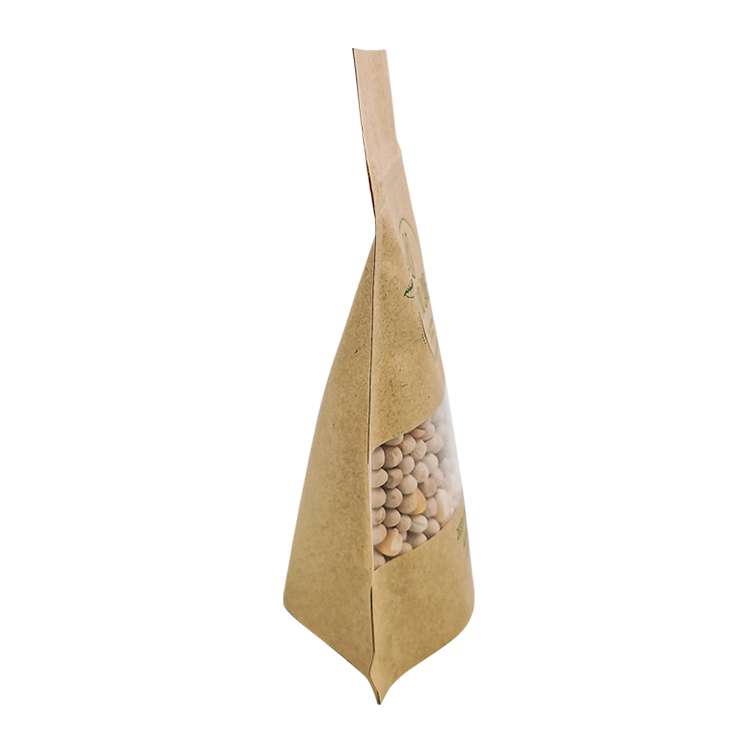
Run a three-stage fill trial with the actual nut SKU
Order at least a smaller, middle and larger candidate in the chosen format, preferably in the same intended closure layout. Weigh the correct food portion. Fill using the intended equipment where possible. Observe the bag immediately after filling, after the normal settling step, and after the filled sample has been handled in its proposed carton. This sequence catches a bag that looks right for thirty seconds but becomes lopsided, too full at the top or visually empty after transport.
At the first stage, note whether the opening admits whole nuts cleanly and whether the bottom gusset opens consistently. Can the operator or machine fill without kernels wedging in the top? A bag that technically contains the weighed food but forces awkward manual rearrangement is a poor production fit. At the second stage, measure the settled product line relative to the window, front graphics, zipper and intended heat-seal path. At the third, check whether the filled bag remains presentable and whether pressure in the carton shifts the food into the closure or stresses the corners.
Test the likely worst cases, not just a convenient average. A SKU with large whole cashews may challenge usable volume; a finer roasted peanut mix may enter the seal area during filling; delicate pecans may fracture when the carton squeezes the bag; a sugar-coated product may leave dust on the top seal. The brand and packer should decide which variants can truly share one pouch size. Sharing artwork dimensions across SKUs can simplify procurement, but it should follow representative product trials rather than precede them.
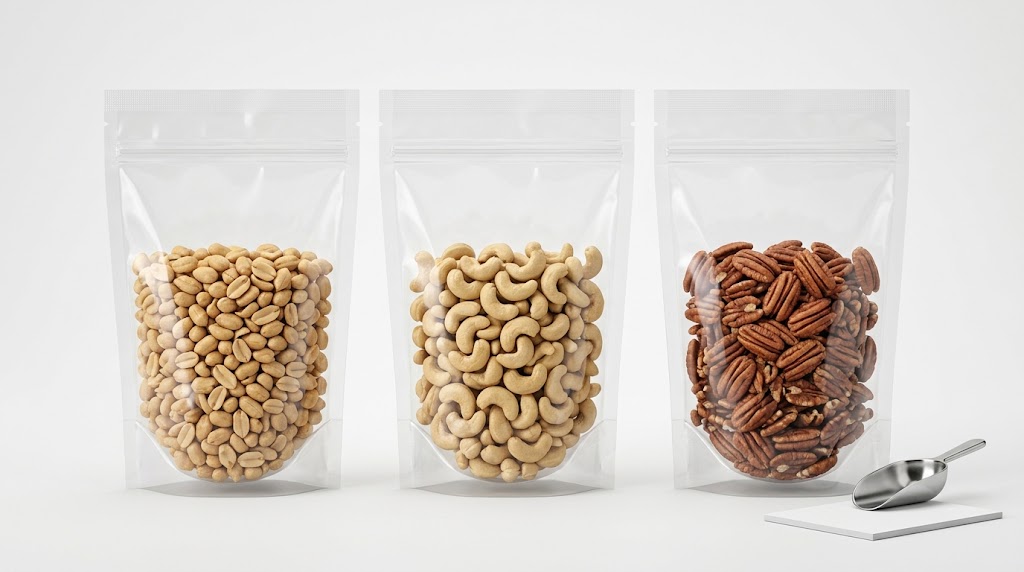
Use the same worksheet for each candidate; record a photograph beside the values. Numbers such as a proposed seal clearance are project measurements, not universal recommendations. Avoid writing a pass/fail result for a trial you have not run.
This table can go into a supplier email. A clear record might say that Candidate A stood upright but left kernels at the heat-seal path, while Candidate B sealed cleanly but presented the window poorly. It should not say “all 8 oz bags pass” based on one fill. Keep actual measurements, photographs and observations tied to a pouch drawing revision and product lot. If the recipe or bag construction changes, repeat the affected checks.
Use 4 oz, 8 oz and 1 lb as separate retail briefs
What size pouch for 4 oz of nuts?
A four-ounce snack may be sold as a flat pouch for a tray, a small stand-up pack for shelf display, or a gift-format bag. Begin by deciding how it will hang or stand, whether it will be eaten in one sitting, and whether a zipper is actually useful. Then trial approximately 113 g of the actual nuts. A small pouch can fail because the top closure consumes too much of its visible height, even when the product fits. If the same SKU appears in multiple bag types, compare completed display faces rather than relying on their identical nominal weight.
Allow the packer to make a clean initial seal with the specified equipment. A top zipper or tear notch needs its own spatial relationship to that seal. Your approved artwork has to reserve room for the brand's real label information and lot code; the food business confirms what the intended market requires. If the product is a large nut such as a whole macadamia, check that the opening does not force the pieces into a narrow neck. Do not copy a “4 oz snack pouch” chart that was populated using powder or small candy.
What size bag for 8 oz of nuts?
At eight ounces, roughly 227 g, the choice often becomes a balance between shelf-facing area, bottom depth and the user's opening experience. A larger flat bag might lay well in a case while a stand-up bag could display better alone; neither follows automatically from the weight. Order real samples of more than one geometry. Trial a representative full portion, record the filled shape and put the pack through the expected carton handling.
If several nut varieties share an 8 oz printed template, the bulkiest and finest products deserve separate attention. The first can press against the top; the second can make the same bag appear unexpectedly low after settling or leave fragments in the seal. A full-height window also changes what a shopper sees when the product drops below its planned visual line. Compare the finished package, not only the empty front panel on a proof. If the brand needs one outer footprint for shelf or case logistics, note that constraint in the supplier brief and adjust gusset and panel choices through samples.
What size bag for 1 lb of nuts?
One pound is 16 oz, about 454 g. Treat this as a new filled-pack trial, not “two 8 oz bags combined” or a two-times-wider print file. Consider how customers lift, pour and reclose it, as well as the effect of the filled bag on the shipping carton. A taller pouch may tip when nuts settle at the bottom; a broader gusset may stand well but present a sparse-looking front panel. A flat-bottom or side-gusset design can be requested as an alternative when the format or case arrangement calls for it, but its nominal external measurements are not directly interchangeable with a stand-up pouch.
At this weight, test the upper corners, bottom folds and pouch-to-pouch contact in a real case. A heavy fill can change how the upper film aligns at a sealer. The packing team should document fill level and inspect a representative sealed sample, not merely confirm that the bag closes once by hand. The food brand controls the actual net-content program and any claim about storage life. The bag supplier should provide a project drawing and material details for candidate samples, rather than claiming that a “1 lb” model guarantees success for every nut.
Compare real project dimensions without turning them into a conversion chart
The US nuts-and-seeds 6 oz pouch described above lists 14 × 20 + 4 cm for its project. Another published Mylarbag Puerto Rico candied-nut and snack pouch appears on the nuts industry page with a printed stand-up format and kraft paper/PET/CPP. A related published shipping article lists 11.2 × 15 + 2.5 cm for that specific project. Its title combines “2 oz/60 g,” which are not an exact unit conversion; verify your own planned net declaration before preparing artwork.
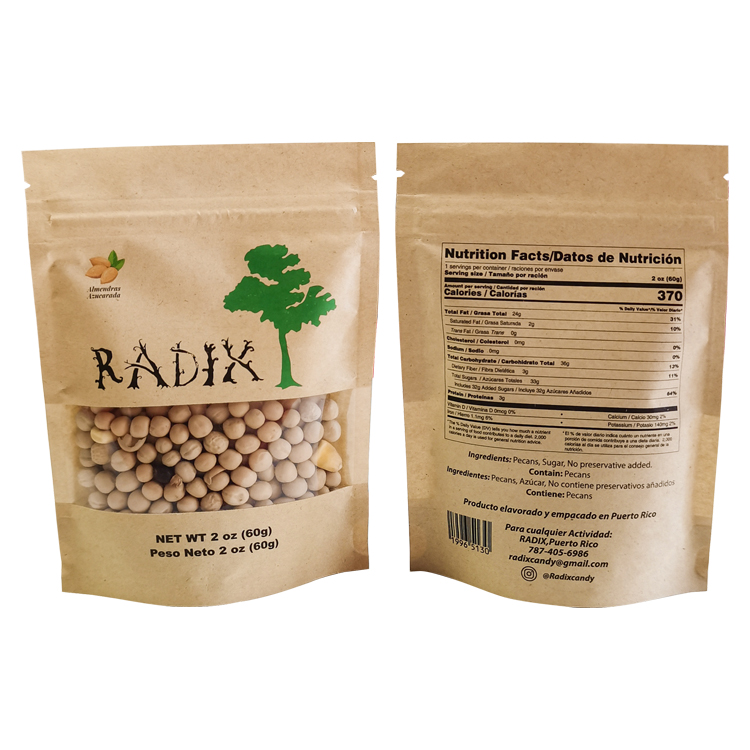
These two records can help buyers ask better questions: What is the outside format? Where does the window sit once food settles? How much height remains for the zipper and initial seal? Which dimensions come from a finished physical sample? They cannot establish a scaling factor between 2 oz, 6 oz, 8 oz and 1 lb because the foods, geometries and intended fills differ. The useful outcome is a better sample request, not a table pretending all nuts share one bulk density.
Check the graphic and carton after size seems settled
A pouch can hold and seal the food yet still fail the retail brief. Photograph both sides of each filled candidate at its normal resting position. Does the product reach the window? Is the transparent panel showing an unattractive empty band? Does the zipper press into the label space? Can a lot code be applied without landing on a crease? Does the filled shape stand or hang as planned? Leave the artwork team enough room to align the real nutrition and allergen information for the intended market; the bag drawing alone cannot approve the food label.
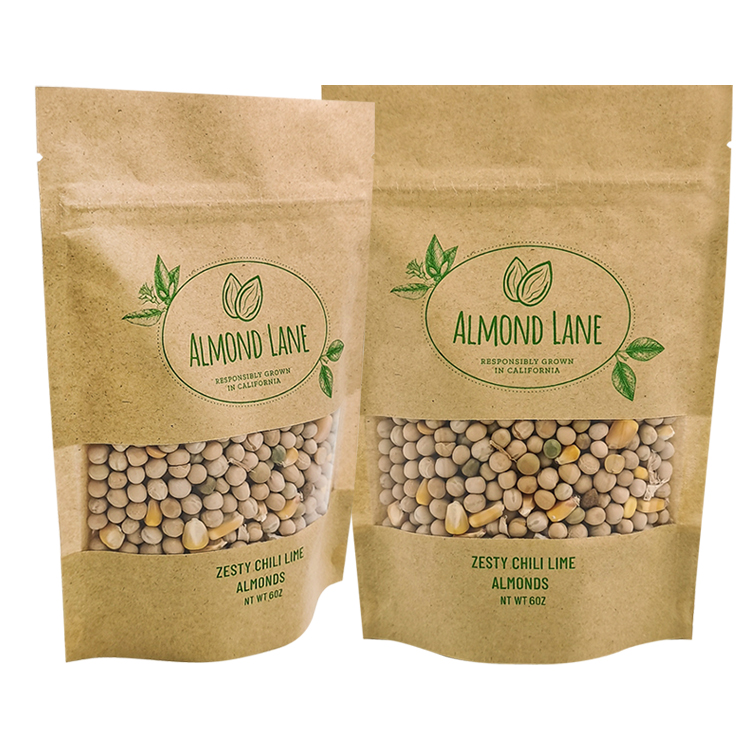
The actual US project photograph shows how a horizontal window and printed panel coexist in one design. Use it as a visual discussion point, not a template that establishes product visibility for an 8 oz mix. When a candidate size changes, the die line, window, front panel and seal positions may all move. Send the revised filled sample or clear dimensions back to the designer before approving another print proof.
Place the selected number of filled, sealed retail pouches into the real shipping carton. Record their orientation and whether one pouch rubs the window or corner of the next. An apparently ideal one-pound bag can require a larger carton or a changed case count; a narrow four-ounce pouch can bend or slide in its display tray. Check the packed case after representative handling agreed by the brand and logistics team. A case trial is part of sizing because the final unit must arrive intact, not merely stand on a photo table.
Approve the closing zone and production sample, then freeze the drawing
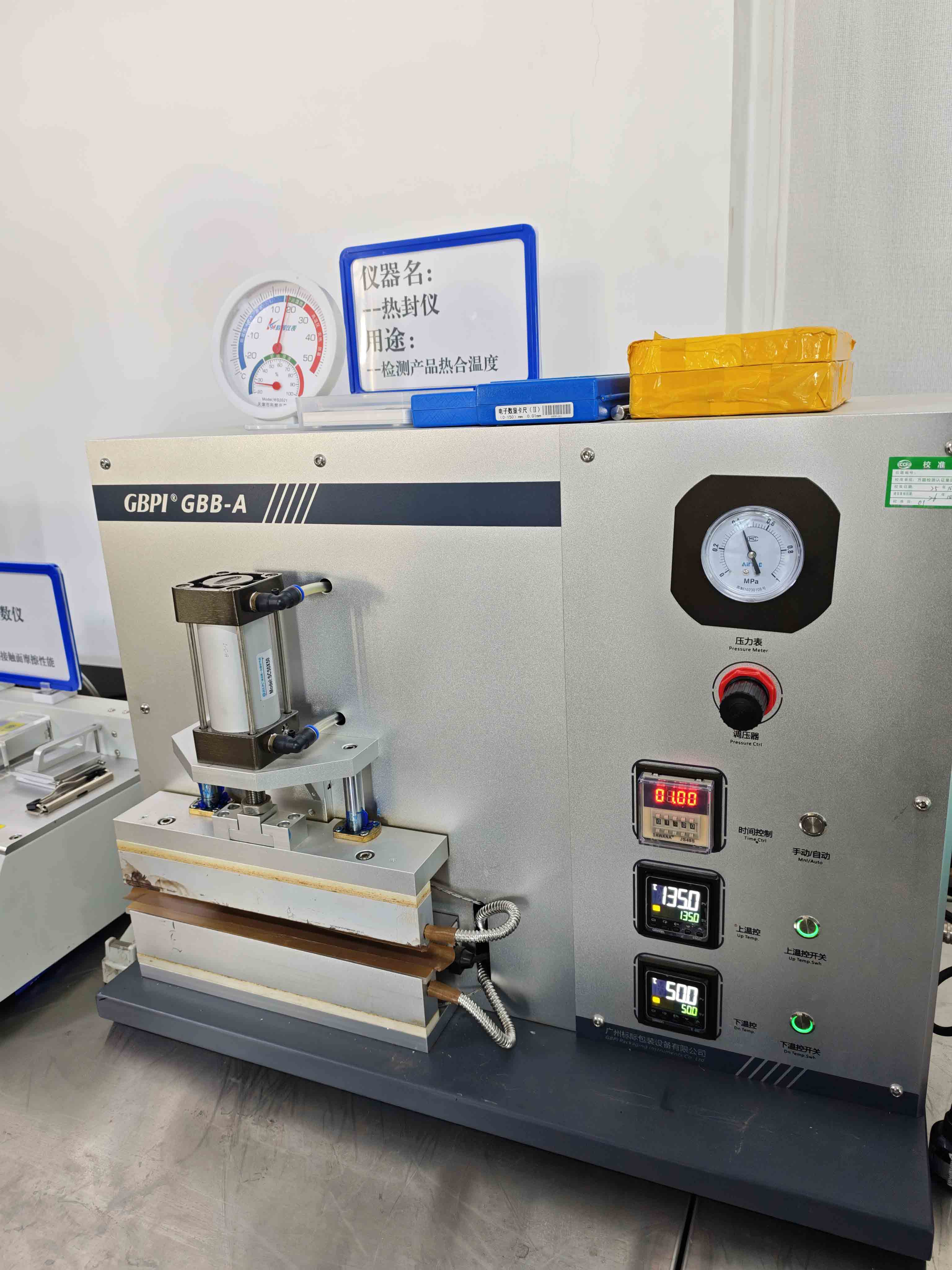
Once the proposed pouch fits, check the clean first-seal region on a representative production fill. Nuts, salt and broken fragments must be kept out of the intended seam. The line owner sets its own seal process for the proposed bag and verifies the result; a picture of a sealed pouch or a zipper closing by hand is not a seal-strength report. If the team needs formal tests, agree the method and acceptance criteria for the actual package rather than borrowing a claim from another SKU.
Keep the approved physical pouch, drawing revision, product lot, fill settings, seal observation, artwork proof and carton configuration together. If the supplier changes the gusset, zipper or film, the sample record tells you what to rerun. If the product mix changes from whole nuts to pieces, repeat at least the volume, visual and seal-clearance portions. Size approval is specific to a product, packaging construction and process. A change in one can make the earlier “8 oz bag” decision incomplete.
Recommended packaging configuration and sample request
For a dry 4 oz single-use snack, request both a flat pouch and a small stand-up candidate if shelf presentation matters. For an 8 oz multi-use retail SKU, sample a stand-up format with a defined initial seal and consider a zipper only if consumers will reclose it. For a 1 lb unit, add a wider-gusset or flat-bottom candidate if the product and case layout call for it. These are formats to trial, not assigned dimensions or material guarantees. The brand still needs to approve the actual food, label, film and distribution route.
Send the supplier the nut variety and physical form, target net weight, representative fill sample or measured loose/settled volume, intended filling equipment, desired window and closure, sales channel, and expected carton count. Ask for two or three candidate finished-pouch drawings and physical samples. On the nuts packaging page, Mylarbag shows related custom formats and project examples; the contact form can start a project-specific sample discussion. A useful response should tell you what must be verified in a filled trial before a final size or price is confirmed.
Frequently asked questions
What size bag holds 1 lb of nuts?
There is no universal outside dimension for one pound. Weigh about 454 g of your actual nut SKU, observe its loose and settled bulk volume, then fill candidate pouches in the intended format. Check the clean top-seal area, filled standability and real carton. Ask the supplier for the drawing's measurement convention before approving a custom size.
What size bag should I use for 8 oz of nuts?
Treat 8 oz as a target food weight of about 227 g, not a fixed pouch size. Trial that product in several candidate shapes, especially if whole and broken nuts share an artwork template. The preferred bag must fit the filling method, close cleanly and present the product at a useful level behind any window after settling.
What size pouch works for 4 oz of nuts?
First choose whether the pack must stand, hang or sit in a tray. Weigh about 113 g of the real product into sample flat and/or stand-up pouches as appropriate. Check the opening, first-seal clearance, visible food level and artwork area. A nominal “4 oz” stock pouch may be a good sample to start with but is not a validated capacity for your particular nuts.
Can the same bag hold 8 oz of peanuts and 8 oz of pecans?
Possibly, but the equal weight alone does not prove it. Whole pecan halves, peanut pieces and coated nuts differ in occupied shape and handling. Run representative filled and sealed samples of both SKUs, then inspect their settled height, seam clearance and carton fit. If one version compromises the pack, change the geometry or use separate sizes.
Do I measure the bottom gusset flat or opened?
Use the supplier's finished-pouch drawing and confirm exactly how its gusset number is defined. Measure the actual physical sample in that convention, then evaluate the opened and filled pouch. A flat-fold dimension on one supplier's chart should not be directly compared with an opened depth on another as though they described the same cavity.
Is a zipper counted as usable space for nuts?
No. The zipper and the required initial heat-seal arrangement occupy upper bag area and need to remain free of product during closing. Their exact geometry comes from the proposed pouch and equipment. Size the food cavity below these features, then verify the consumer opening and reclosure on a filled, initially sealed sample.
Next step: choose a small sample set, weigh and fill the actual nuts, then keep the measurements and photographs with the supplier's drawing. That turns “What size bag?” into a testable packaging decision instead of a guess from a weight label.