
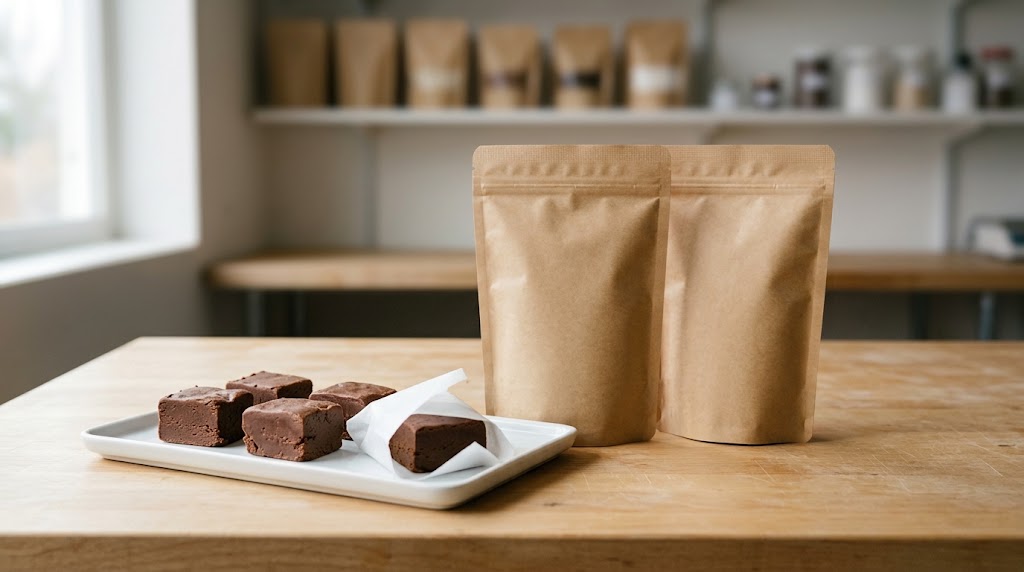
To store fudge in a bag, start with a finished fudge recipe whose handling and storage requirements have been set by its producer. Record the condition of each portion before packing, use an approved food-contact wrap or separator where the product needs one, fill a compatible retail pouch without contaminating its top seal, and apply the specified initial heat seal. Store the finished bags under the conditions the food business intends to use. Compare unopened samples at planned intervals with a same-batch reference for appearance, cut-face condition, texture, wrapper release, aroma and package integrity. The food business must separately assess the safety of its actual recipe and process before setting any shelf-life date.
A bag is one part of that system. It may limit moisture or oxygen transfer under stated test conditions. It cannot reverse a poorly controlled product state at packing, prevent all change at a flawed seam, or turn a recipe that requires refrigeration into a safe ambient product. This guide concerns human-edible, cut or portioned fudge in commercial retail packaging. It is not a duration chart for homemade sweets, a hot fudge sauce guide or a claim that every pouch will work with every formula.
Define the Fudge, the Pack and the Storage Route
“Fudge” describes products with different recipes and handling behavior. A plain chocolate square, a nut-studded slab, a coated piece and a soft dairy-rich portion may not respond alike to the same contact wrap, bag or storage condition. Even one recipe can produce a range of cut sizes and surface states. Treat the actual selling unit as the test object: one small pouch of individually wrapped squares is a different system from a single heavy slab in a large bag.
Write a one-page product and packaging brief before requesting a barrier number. Include recipe version and relevant ingredients; processing and cooling or setting steps; finished piece dimensions and mass; the condition and temperature at wrapping; whether pieces touch each other or an intermediate food-contact layer; the bag's exact construction and lot; fill amount and headspace; top-seal design; and the storage route already established by the food producer. Record any intended window, zipper or hanging hole because each changes the finished bag layout.
| Record before the trial | Why it matters | Evidence to keep |
|---|---|---|
| Recipe and process version | A formula or cooking change can alter product behavior without changing the pouch | Batch record, ingredient changes and process notes |
| Portion geometry and surface | Cut edges, coatings and heavy slabs have different contact and pressure patterns | Reference photographs and size range |
| Contact wrap or separator | Release, sticking and oil marks can start at the food-contact interface | Exact material specification and wrapped sample |
| Pouch version and first closure | An attractive film is irrelevant if the filled pack is not sealed as designed | Material declaration, bag drawing, sealing record and retained pouch |
| Intended storage and display | A room-temperature shelf, chilled case and repeated temperature transition are distinct exposures | Documented route, handling instructions and monitoring plan |
| Acceptance criteria | “Still fresh” cannot be audited if it was never defined | Written quality and safety decisions with responsible owners |
Choose the route before approving a packaging claim. If the producer requires chilled storage for a particular fudge, a pouch does not remove that requirement. If the business is considering ambient sale, it needs recipe-specific safety and quality evidence under the proposed conditions. Do not infer a safe route from the product's sugar content, a “high barrier” description, or another company's date mark.
Keep two reference sets when possible. One is a photograph and initial evaluation of normally produced portions. The other is a retained, identifiable sample from the same batch held under the business's prescribed reference conditions. These comparisons help separate a pack-specific change from a change occurring across the whole batch. They do not replace the producer's approved food-safety controls.
Product condition at the moment of sealing
Inspect the fudge and its contact wrap before the outer bag is closed. Is the cut face stable enough to release from the wrapper? Are droplets, syrup, crumbs or oil marks already present? Has a newly made portion had the process-defined time and environment needed before packing? The answer depends on the recipe and process. Packing warm product into a tight bag can create a different headspace and surface condition from packing it at the established production state.
Photograph a representative range, including ordinary variation, rather than only a perfect display piece. Note which face touched the wrapper and which face will touch another piece. For a mixed assortment, preserve the flavor and allergen version in the record. If one inclusion-rich portion leaves particles near the sealing area, that is a filling and closure problem to control before a long storage study begins.
Moisture Content and Water Activity Answer Different Questions
Moisture content describes how much water a product contains. Water activity describes the availability of water in equilibrium with the food at a specified temperature. Foods with similar total water can have different water activity because ingredients bind water differently. The FDA's water-activity technical guide explains why water activity matters to stability and why measurement temperature and equilibration matter. A small change in a product's condition can affect texture without furnishing enough information to declare it safe or unsafe.
There is an easy source trap here: the FDA page lists a value for fudge sauce among example foods. Pourable sauce is not the cut confection in this article. That table is not a specification for all fudge squares, and its regulatory discussion cannot be turned into a universal ambient-storage rule. Measure the actual finished product with appropriate methods and have the food business interpret results alongside its formulation, process, intended storage and applicable requirements.
Water can move within a portion, between neighboring pieces and their wraps, and between the package interior and its environment. A measured film water-vapor transmission rate speaks to one possible route across a specimen of film. It does not describe a leaking top seal, liquid water introduced during filling, or a cold bag opened in humid air. Likewise, a fudge square that looks dry may have changed because of recipe and process, contact material, moisture exchange or temperature history. The observation starts an investigation; it is not the diagnosis.
What a texture change may mean
For a saleable fudge portion, define its reference bite and cut-face appearance in ordinary words that the quality team can apply consistently. A granular or firmer piece may involve changes in its sugar structure, water distribution or handling; a softer or tackier surface may involve the product state, a contact interface or storage exposure. These are hypotheses to compare, not claims that a particular barrier layer caused the change. Include both product-level and package-level evidence.
Use a simple sample notation: SKU and batch, bag material and lot, wrap lot, filling and seal settings, storage condition, sample date, whether the package was unopened, and the position of the sampled piece. Compare top and bottom pieces in a multipack. If only the lower pieces are marked where they touch a divider, a pressure or contact path deserves attention. If every sample, including the retained control, changes similarly, first investigate the product and shared environment.
| Finding | Initial questions | Evidence that helps separate causes |
|---|---|---|
| Firmer or crumbly cut face | Did the reference batch also change? Is there a measured moisture trend? | Same-batch control, product measurements, pack integrity and storage log |
| Sticky surface or wrapper transfer | Was it present at sealing? Which wrap face contacted the fudge? | Packing photographs, wrapper release trial, repeated samples |
| Surface crystals or color shift | Is the pattern on all pieces, only a face, or a location near a seam? | Close-ups, recipe/process record, comparison across pack positions |
| Oily mark or altered aroma | Is the mark on contact wrap, inner pouch or an exposed surface? | Material compatibility review, retained product, sensory and appropriate analytical checks |
| Droplets inside a pouch | Was the bag moved between conditions or filled at a different product temperature? | Time-temperature and handling records, affected pack locations |
| Weak or contaminated top seam | Is a fold, particle or oil visible at the sampled failure point? | Seal samples, setup records, pouch lot and inspected rejects |
None of these rows assigns a safety outcome. If a sample is suspect, follow the food producer's hold, testing and disposition process. Do not taste an abnormal sample to decide whether it is safe to sell.
Read Film Barrier Data in the Conditions That Produced It
The bag material should be chosen against the product's actual failure modes. Ask the converter for the full construction and the role of each layer: print and appearance, mechanical support, moisture or oxygen control, and the inner sealing/contact interface. A brown paper look is an appearance. A shiny or silver look is not a measured oxygen or moisture result. The physical laminate, any clear window and its seam geometry must be specified.
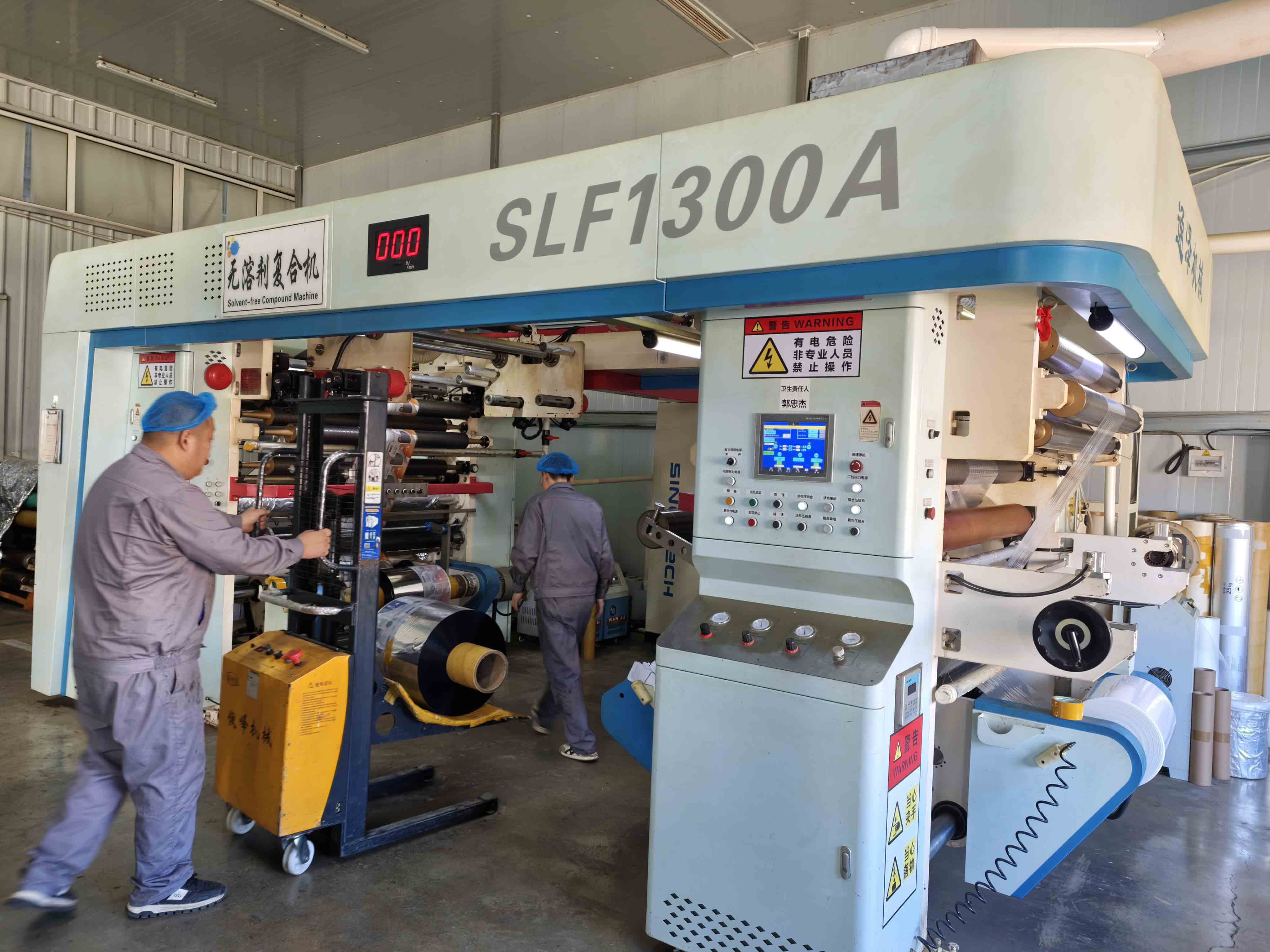
Water-vapor transmission rate, usually written WVTR, is a rate measured for a film or sheet under defined conditions and is often expressed in grams per square meter per day. Oxygen transmission rate, OTR, is commonly expressed as a gas volume per area per day under defined conditions. These are not free-standing adjectives. The temperature, relative humidity, specimen structure, test method, unit, date and sample source belong beside each number. Avoid comparing two numbers when their conditions or units differ.
The current ASTM F1249-25 method covers determination of water-vapor transmission through flexible barrier materials. ASTM F1927-20 covers oxygen transmission at a given temperature and controlled relative humidity; ASTM expressly notes that oxygen transmission alone is not the sole determinant of package protection. A report for a flat specimen helps screen materials. A converted pouch adds folds, interfaces, windows and seals. Ask for evidence appropriate to the finished, filled pack as well as the film.
| Supplier statement | Follow-up question | What the answer can and cannot establish |
|---|---|---|
| “High barrier” | Which complete structure, test method, unit, temperature, humidity and tested lot? | Can support comparison of specified films; does not set a food expiry date |
| “Metallized” or “foil look” | Is it metal foil, metallized film, printed effect or another layer? What is the measured construction? | Identifies a real structure; appearance alone proves nothing about transmission |
| “Clear window” | What material forms the window, how is it joined, and where does it sit relative to seal/fill? | Describes a potential design boundary; requires its own whole-pack review |
| “Food grade” | Which substances and intended food type and contact conditions are documented? | Supports a material review only for the applicable use, not a recipe's safety period |
| “Suitable for cold storage” | Was the filled pouch sealed and handled under the actual low-temperature and transition sequence? | Points to a relevant package trial; does not itself validate the food route |
The FDA's food-contact types and conditions of use illustrate why a food-contact claim needs more than a generic badge: food types and room-temperature, refrigerated and frozen use appear as different considerations. The exact regulatory documentation depends on the intended market and material. Ask about the actual contact layer and use case; do not assume all grades with the same polymer abbreviation share one approval.
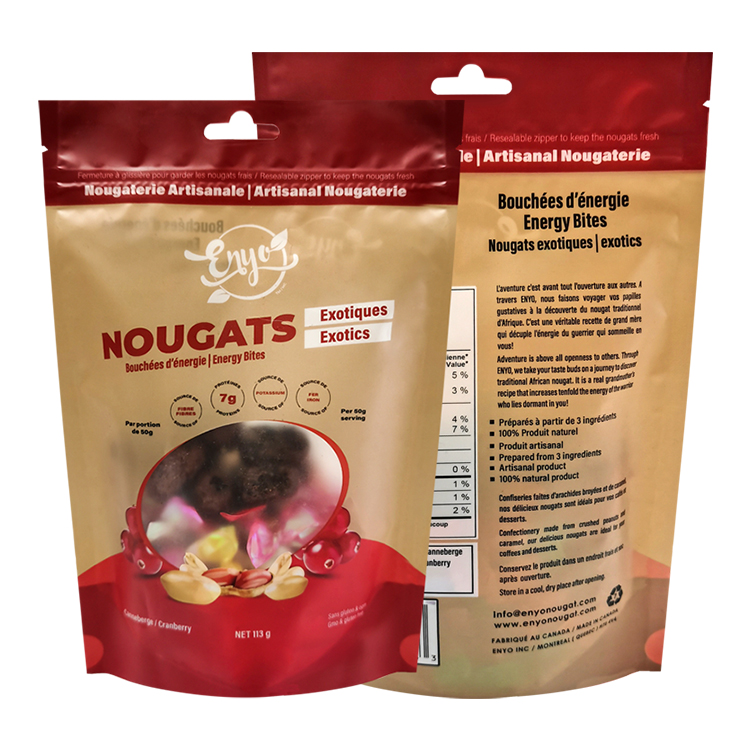
Windows and an adjacent confectionery pouch example
A window may help shoppers see a portion, but it changes the specified pack. Ask whether the clear area uses the same barrier construction as the opaque face, how its edge is made, whether the product can rub against it, and whether the proposed artwork leaves sufficient space for filling, code placement and the initial top seal. If the window and opaque area differ, a single property quoted for one film should not silently stand for both.
Mylarbag's published nougat and energy-bites stand-up pouch case shows a real retail format with a shaped window and printed front and back. The case lists MATOPP/PET/PE, digital printing and a nominal 14 × 21 + 4 cm size for that project. It is a useful object to ask where a fudge product window, information panel and top closure would sit. It is not a fudge customer project, a barrier test or a demonstrated storage period. Do not copy its dimensions or the case page's promotional “complete barrier” language into a fudge specification.
Validate the First Heat Seal Before Studying Storage
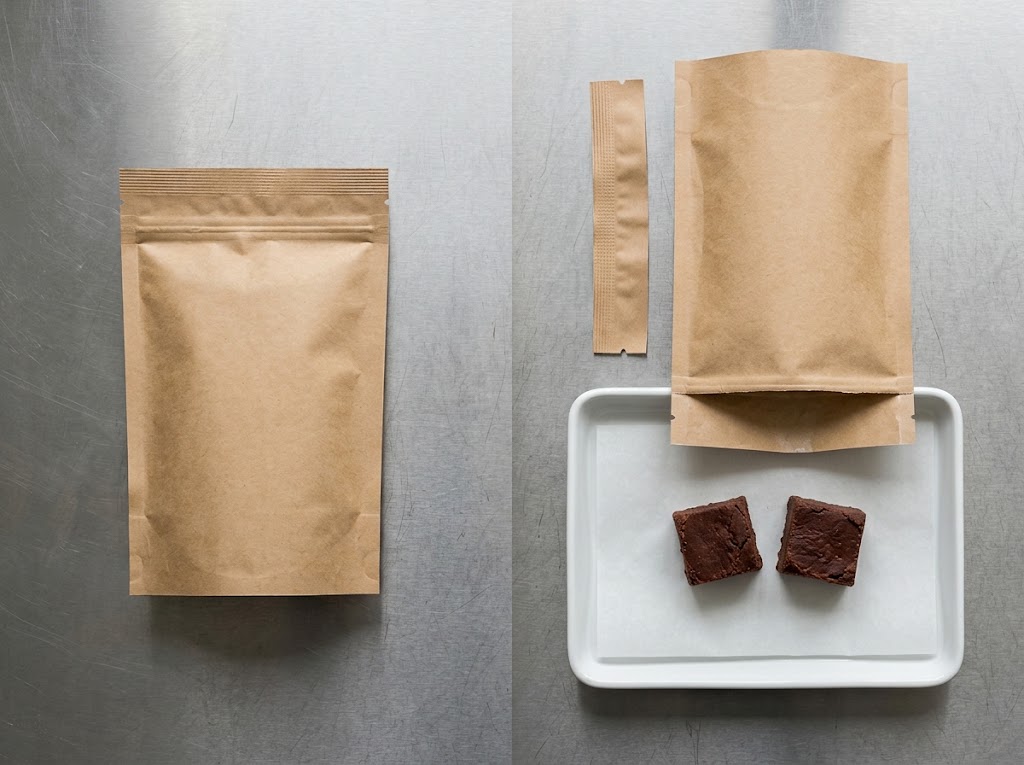
An unopened retail pouch needs the closure specified for its design. A top-filled bag may have a heat-seal strip above a tear feature and a reclosable zipper below it. Confirm that geometry on the supplier's drawing. Some bags have no zipper, while some closure systems differ; do not infer the sequence solely from a photograph. During filling, keep fudge, crumbs, wrapper tails and oil away from the area to be joined. Check the filled bag, not an empty sample that never saw the actual production line.
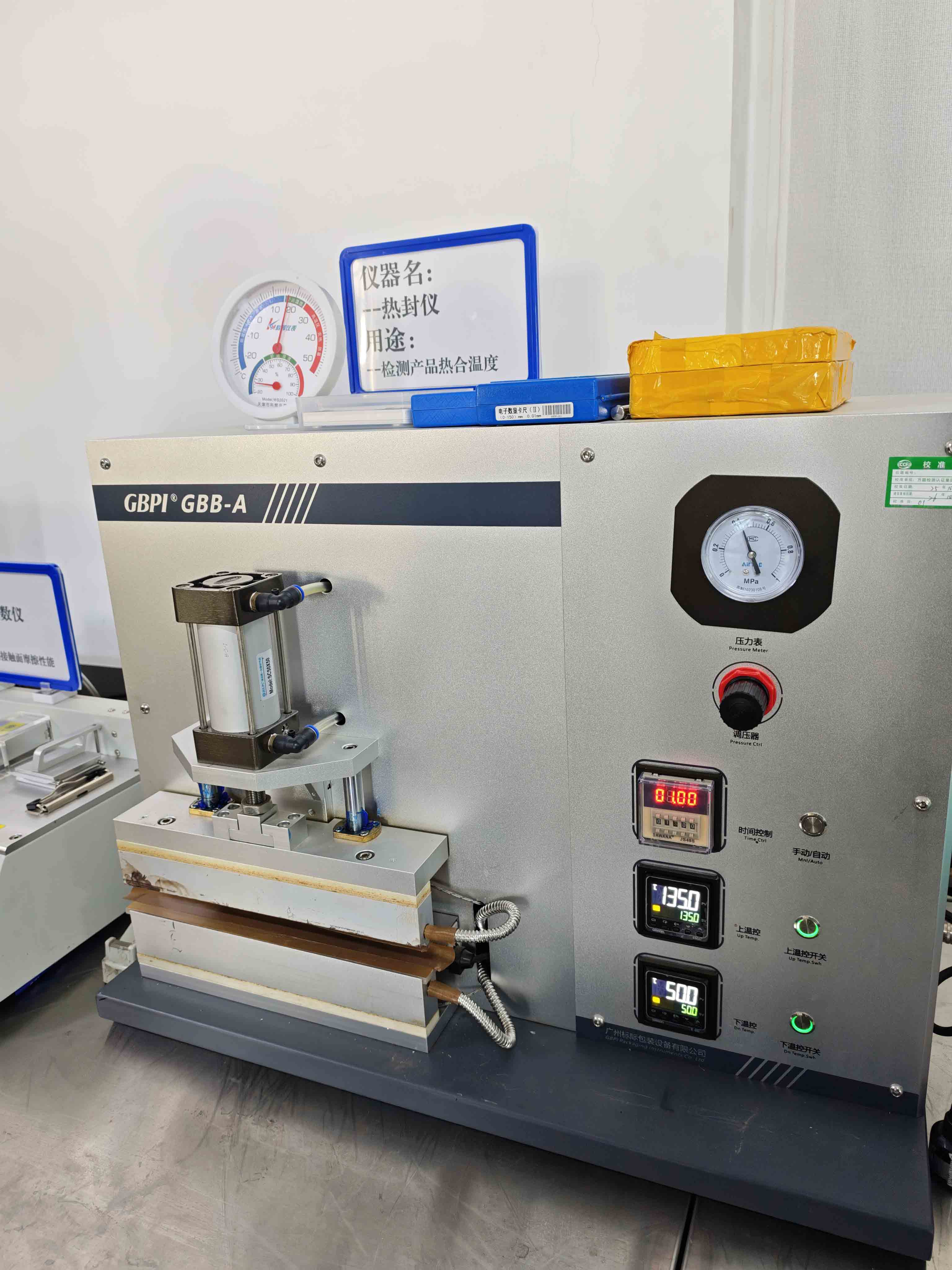
Run a sealing trial with the specified film, pouch size, fill, machine and process window. Include routine variation in operators, setup and production. Record rejected packs and the reason for rejection instead of quietly removing them from the evidence set. A seam that looks straight can contain a thin channel, a fold or contaminated spot. The exact integrity and acceptance tests should be chosen for the package and intended use by the responsible team.
ASTM F88/F88M-23 is a method for measuring the strength of sampled flexible barrier seals. It can help monitor a sealing process, but its result is for the sampled strip and test setup. It is not a blanket declaration that every pouch is leak-free, that every zipper is closed, or that the food has a validated quality period. Use visual inspection and an appropriate finished-package integrity plan alongside process records when those are needed.
A zipper is a different experiment
The first, unopened pack and the opened pack have different histories. After the consumer removes the initial closure, the zipper may allow reclosure, but it does not restore the initial seal, remove newly introduced air, or undo handling of the pieces. Test usability with fudge crumbs or wrapper folds in realistic positions. Define who is expected to open the bag, how many times in a proposed usage study, and what storage instruction the food producer intends to give after opening.
Do not append “resealable” to an unopened quality-period statement as if it automatically extends that period. If the product needs a separate after-opening instruction, validate it for the actual food and use pattern. The site's general candy-bag sealing guide explains the mechanical difference between initial heat sealing and later zipper reclosure; this guide keeps its focus on what those states mean for fudge storage evidence.
Design Storage Conditions Around the Product's Established Requirements
Begin with the route that the food producer has determined for the product. The relevant storage environment is not merely the temperature printed on a test cabinet. It includes the state of the fudge when sealed, transit and warehouse exposure where applicable, display conditions, handling by retailers, and the manner in which a consumer opens the pack. Record realistic upper and lower boundaries if those belong to the intended route. Deviations and excursions must be interpreted under the producer's own safety and quality procedures.
| Trial route or event | Question to answer | Observe and document |
|---|---|---|
| Approved unopened storage route | Does the product remain within its prewritten quality and safety criteria through the proposed date? | Actual condition, time, package state, food observations and specified tests |
| Proposed ambient route, if the producer is evaluating one | Does the formula and process qualify for that route, separately from the bag's properties? | Food-safety assessment, product measurements and quality trend under representative exposure |
| Approved chilled route | Does the filled bag, wrap and food behave as intended through storage and handling? | Seal and film condition, surface and wrapper release, temperature record |
| Movement between cold and warmer environments | Is moisture visible inside or outside the package, and when did it appear? | Pack temperature/history, whether and when opened, photographed location of droplets |
| Open-and-reclose use | What changes after the initial barrier is broken and handled repeatedly? | Opening count and method, closure condition, piece handling and post-opening instructions |
This matrix does not direct every fudge maker to run every route. If room-temperature sale is outside the producer's approved plan, do not create a casual ambient challenge just because a pouch vendor advertises “shelf stable.” If a chilled product is temporarily exposed during a planned process step, treat that event according to its validated food-safety plan. Packaging alone cannot determine an allowable time or temperature.
Condensation deserves careful language. Droplets can appear when a cold object encounters humid air, but a visible drop inside a pouch can also have other origins and consequences. Distinguish exterior droplets from interior ones, and record whether the bag was opened before the photograph. A cloudy window does not by itself prove a failed seal, and an apparently dry window does not prove that the product has met its safety criteria. Do not advise consumers to leave a chilled food unrefrigerated until “room temperature” without a product-specific instruction.
Build a Real-Time Sampling Plan That Can Support a Date
A meaningful storage study begins with a written question: “Under these actual conditions, does this exact product in this exact pack meet these defined criteria through the proposed date?” Name the formula, production process, pouch construction, contact wrap, fill size, seal process and route. If one of them changes, decide whether the original evidence still applies or a new trial is needed. A result for plain chocolate fudge may not cover a nut-containing or coated variant.
Set sample points before opening any trial bags. A baseline establishes the starting condition. Intermediate checks show how a change develops. A check at the proposed end of the period addresses the intended claim. The number of batches, units and time points must be chosen by the responsible food and quality team; one attractive sample opened at the end is weak evidence. Keep sealed, identifiable units for later examination and document how each was stored and handled.
| At each planned point | Unopened-package check | Product-level check after controlled opening | Owner of interpretation |
|---|---|---|---|
| Baseline, before storage | Bag identity, seam, window, visible marks, fill and code | Portion shape, cut face, wrap release and appropriate starting measurements | Packaging and food teams establish reference |
| Intermediate point | Any localized seam or film change, unexpected droplets, pack distortion | Trend in appearance, texture and other approved quality measures | Food team compares with baseline and retained control |
| Proposed end point | Complete pack condition and evidence of exposure | Predefined quality criteria plus safety tests selected for the product | Food business makes date and disposition decision |
| Suspected failure or excursion | Photograph unopened state first; preserve lot and route records | Open only under the investigation procedure; do not taste a suspect sample | Responsible quality and food-safety personnel |
Decide how an assessor will describe texture before the samples arrive. A short, repeatable score or instrument method is better than “seems fine.” For wrapper release, specify whether a piece can be removed without tearing its surface or leaving a defined unacceptable amount behind. For aroma, decide who may perform an approved sensory assessment and when it is appropriate. Safety testing is separate; a pleasant smell is not a microbiological result.
Use the same view, lighting and handling order for sample photographs when possible. Open one pack at a time and record the unopened top seal before cutting it. Note the position of each piece. If a bag includes a window, photograph marks at the window and at the opaque face separately. If a sample fails, preserve the unused units and applicable records so the team can investigate the location of failure rather than merely report that the product “went bad.”
Accelerated exposure may help compare candidate materials or explore a mechanism, but it does not automatically translate into a real-time shelf life. High temperature can change fudge texture or fat behavior in ways unlike the intended route. Use accelerated data only within a study design that demonstrates how it relates to the actual product and conditions. A film coupon in a transmission test is even further from a filled food pack. Keep the claims at the level the evidence supports.
Read a Failed Sample Without Blaming the Wrong Layer
Suppose a customer says the fudge is sticky. Ask whether the defect appeared on every piece, only the cut face, only the contact side, or only after a bag was opened. Check the same-batch retained reference under its documented condition. Examine whether the inner wrap adhered, whether the bag seal was intact, whether there were droplets, and whether there is a temperature-handling record. The answer may involve several factors. A new film cannot correct a product-state problem if the sticky surface existed before packing.
Use a “first comparison, next test” table instead of naming a culprit from one photograph:
| Reported problem | Compare first | Next controlled question |
|---|---|---|
| Pieces firm throughout several packs | Same-batch retained product and initial composition or moisture observations | Does the trend follow batch, storage environment or bag version? |
| Only food-contact faces stick | Alternative approved wrap and reference piece with matching handling | Is contact release the issue before changing outer film? |
| Change near one top seam | Seal location, fold, trapped particles and sampled rejects | Does improved filling or sealing remove the local path? |
| Change near a transparent window | Window construction, rubbing/contact pattern and other bag faces | Is the window region a distinct exposure or pressure point? |
| Oily marks across packs | Product formulation, wrapper and inner film contact suitability | Does the change follow the product or a material lot? |
| Droplets after a cold-to-warm movement | Interior versus exterior location and time of opening | Which handling event introduced the observed moisture? |
| Only opened and reclosed packs change | Initial unopened controls and recorded opening frequency | Is the after-opening instruction realistic for the product? |
These are investigation prompts. Do not recast a finding as a validated defect mechanism without a controlled comparison. The packaging supplier can provide the exact laminate, material test conditions, seal-design and lot records. The food producer owns the recipe, process, safety review and consumer date mark. When the evidence points to multiple factors, change one meaningful variable at a time where practical, or use a designed comparison that can separate them.
Send the Converter a Brief That Can Be Tested
For a custom fudge packaging bag, provide the finished portion and wrapping dimensions, fill mass and bag count, product-contact characteristics, target storage and display conditions established by the food business, proposed opening pattern, filling and sealing method, and any window or zipper layout. Ask for complete material identification, the intended contact layer and documentation for the target market and conditions. Request WVTR or OTR data only with method, unit and test conditions, and ask how the finished pouch, window and seals will be checked.
If two candidates look similar, compare them in filled, initially sealed packs using the same product batch and route. Decide which product quality difference matters before asking for a more elaborate barrier-layer construction. A more opaque or thicker-looking bag is not necessarily the appropriate answer. Conversely, a visually attractive window or convenient zipper should be evaluated against its real contribution to the complete pack and intended use.
Use the trial to approve a specification, not a slogan. The useful supplier conversation is: “Here is our product and storage brief, our observed failure and our current bag data. Which structural or seal variable would you change, and how can we test that change?” A converter can help produce and document the selected package. The food business must validate the packed food's safety, quality period and label instructions before it is sold.
Frequently Asked Questions
Can fudge be kept in a sealed bag at room temperature?
Only if the specific recipe, process and distribution plan have been assessed and approved for that route by the responsible food business. A sealed bag may contribute to quality protection; it cannot by itself establish that the food is safe at room temperature. Use the product's actual storage directions until a new route is validated.
How long does fudge last in a heat-sealed pouch?
There is no reliable universal number. The date depends on the product, its initial condition, contact materials, filled-package design and integrity, intended storage conditions, and the business's quality and safety evidence. Do not copy a date from a different fudge recipe, a pouch advertisement or the FDA's fudge sauce example.
Does a high-barrier bag stop fudge from becoming hard or sticky?
It can reduce a specified exchange across a measured material under the stated conditions. It does not correct a product that was already changing at packing, a weak seam, contact-wrap adhesion, pressure damage or unsuitable storage. Compare a same-batch reference and inspect the filled pouch before concluding what changed.
Is water activity the same as moisture percentage?
No. Moisture percentage concerns the amount of water; water activity concerns its availability in equilibrium at the measurement temperature. The FDA explains the distinction through water binding and sorption behavior. Both need interpretation for the actual food rather than a borrowed threshold.
What do WVTR and OTR tell me about a fudge bag?
They describe measured transport through a specified test specimen under stated conditions: water vapor for WVTR and oxygen for OTR. They are useful for comparing materials when units and conditions are comparable. They do not independently report the integrity of every finished pouch or the food's shelf life.
Does a clear window make a pouch unsuitable for fudge?
Not automatically. The window material, size, location, joint to the surrounding construction, product contact and finished-bag performance need review. Ask for the actual window construction and test the filled format. Do not assume one opaque-film value covers the whole pouch.
Can I use the zipper instead of an initial heat seal?
Use the closure specified and validated for the unopened retail package. A zipper is commonly intended for reclosure after opening; it is not interchangeable with a required initial heat seal. Confirm the physical positions and filling sequence on the bag drawing. An opened and reclosed pack also needs its own handling and quality assumptions.
Should I open a chilled fudge pouch as soon as it leaves the refrigerator?
Follow the producer's validated handling instructions for that product. Moving a cold pack into humid air can create condensation under some conditions, and opening changes the pack environment. Neither a blanket instruction to wait at room temperature nor an automatic “open immediately” rule is justified for all fudge, especially where chilled storage is a safety requirement.
Is a metallized pouch the same as aluminum foil?
No. Metallized film, an aluminum-foil laminate and a printed metallic effect are different constructions. Ask for the full layer specification and measured data under relevant conditions. The visual color of the outside does not identify an approved food-contact layer or prove storage performance.
Can an accelerated study replace real storage samples?
Not without a defensible relationship to the actual product and route. Elevated temperatures may change the food in a different way, and a bag film result is not a filled-pack result. Treat acceleration as a complementary design tool where the food team has validated the model; retain real-time evidence for the proposed quality period.
What if an unopened bag looks normal but the fudge tastes or feels wrong?
Stop sale or distribution decisions under the producer's quality and safety procedure, preserve the batch and package identity, and compare retained samples. A normal-looking seam or intact outer bag is insufficient to declare the food acceptable. Sensory evaluation should follow the responsible team's controls; do not taste a suspect product as an informal safety test.
What should I ask a pouch supplier first?
Send the product, wrap, fill, seal and intended-condition brief. Ask for the exact film and contact-layer specification, food-contact documentation for the proposed use, comparable WVTR/OTR reports when relevant, a finished-bag layout, and trial samples. Then assess the filled and sealed product in the food business's own storage program before approving a quality-period claim.