
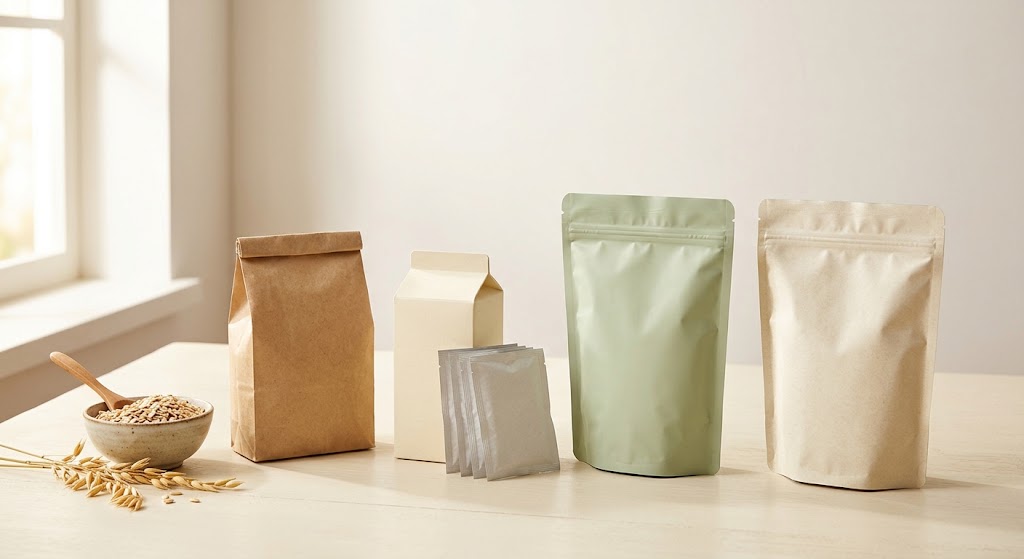
The short answer is sometimes, but the word “oatmeal” does not determine the bin. A plain paper bag, paper with a functional lining, a metallized flexible pouch, a PE-family pouch and an instant-oatmeal sachet can have very different disposal routes. Even two brown bags that look alike may be built differently.
For a shopper, the safest starting point is the actual package label and the local collection program. For a brand, the job starts earlier: identify every component, test the finished construction against the intended recycling or composting route, and write a market-specific instruction that the evidence supports. A recyclable resin or a compostable film on a supplier sheet does not automatically make the filled, printed, zippered retail pack recyclable or compostable.
This guide answers common consumer questions while giving oat brands and co-packers a procurement framework. It does not assign a disposal route to an unidentified competitor's packet or promise that one design is accepted everywhere.
First Separate Four Different Questions
“Is this bag recyclable?” sounds like one question, but it hides four decisions.
- What is the complete package made of? Identify the bag wall, coatings, adhesive, zipper, window, label, ink and any separate carton or inner sachet.
- Can a relevant facility process that finished package? A paper mill, PE-film recycler and composting operation need different inputs. Technical compatibility must be shown for the correct process.
- Will the consumer's market collect and sort it? A laboratory result does not create a local collection route. A route that exists in one country may be unavailable in another.
- What can the brand say on the pack? The exact wording, symbols and directions must match substantiated evidence and the market's rules.
| Common observation | What it might mean | What it does not establish |
|---|---|---|
| Brown, fibrous exterior | Paper may be one layer | That the entire pouch belongs with paper recycling |
| Shiny silver interior | A metallized layer or foil may be present | The exact metal layer, thickness or recycling route |
| “PE” in the specification | A polyethylene-family design may be possible | That every coating, closure and label is compatible or collected |
| “Compostable” on a material sheet | One component may meet a test scheme | That the complete commercial pack is certified for home or industrial composting |
| Chasing-arrows style icon | A consumer may read a recycling message | That appropriate facilities are widely available |
The US Federal Trade Commission's Green Guides summary says marketers must substantiate environmental claims, including the express and implied claims made by certifications and seals. That is a useful discipline for every market: write down what the claim actually tells a consumer, then check the whole package and the collection route.
Read the Package as an Assembly, Not a Surface
Before approving artwork or answering a customer, ask the converter for a bill of materials. Include the outer print web, all barrier and sealant layers, any paper, tie layers, coatings and adhesives, and every part attached to the pouch. For a carton containing individual servings, treat the carton and each inner packet as separate components.
A practical identification sheet should record:
- The complete layer sequence and individual material names, not only “kraft,” “Mylar” or “eco film”
- The inner food-contact surface and heat-seal layer
- The print method, ink coverage, varnish and metallic decoration
- Windows, zippers, tear strips, valves, stickers and labels
- Whether a liner is bonded, loose or consumer-separable
- The countries or regions where the package will be sold
- The proposed collection or composting route and evidence for that exact construction
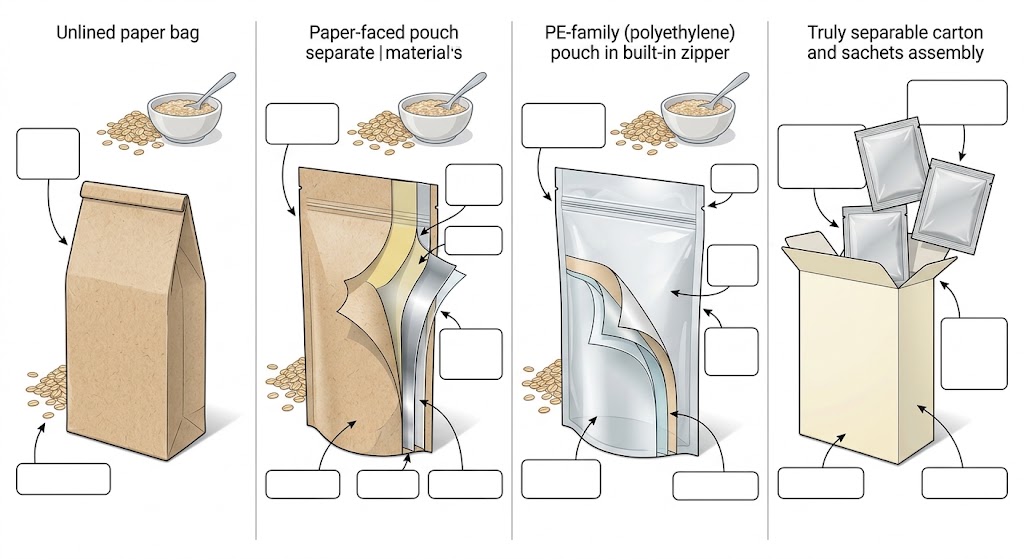
A detachable paper sleeve can have a different instruction from the pouch inside it. A bonded paper/film laminate generally cannot be treated as two separate consumer-sortable pieces merely because both materials appear in the specification. Do not ask consumers to peel apart layers that are laminated together.
Can I Recycle the Brown Bag That Oatmeal Comes In?
Possibly. Start by finding out whether it is a relatively simple paper bag, a coated paper package, a paper bag with a separate liner, or a paper-faced plastic laminate. The visible brown surface does not settle the question.
An unlined paper bag that meets the receiving program's conditions may have a straightforward paper route. A light functional coating can change how the pack behaves in a mill. Heavy polymer laminations, metallized films, grease-resistant layers, windows and adhesives may cause a different result. The package must be evaluated as it is sold and emptied, including the features that remain attached.
The 4evergreen Recyclability Evaluation Protocol assesses how paper-based packaging performs in different mill processes. It includes laboratory testing, technical evaluation and scoring for conventional, flotation-deinking and specialised recycling. A positive technical result is valuable evidence for the tested route; it still should be connected to the market's collection and sorting system.
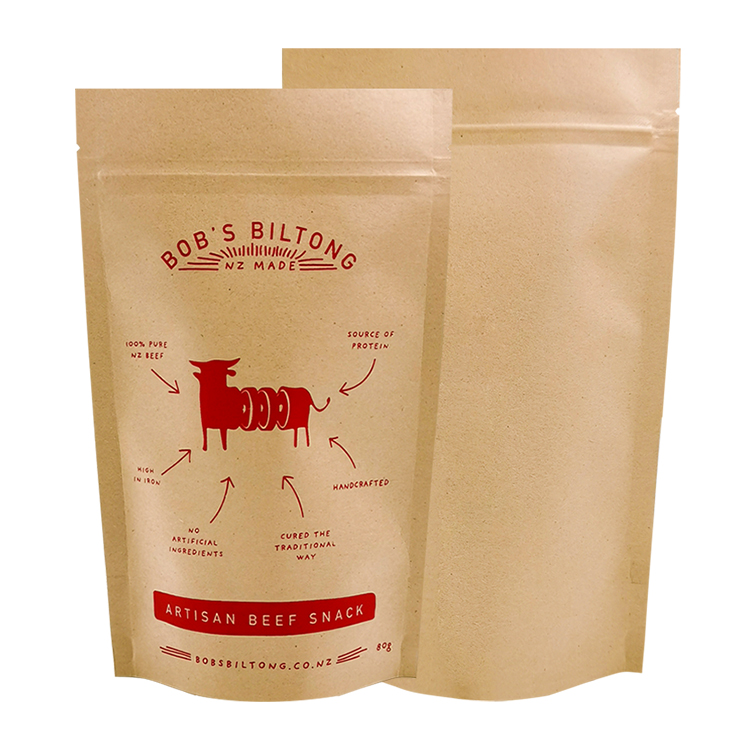
Mylarbag's published 80g New Zealand jerky project lists MATOPP/kraft paper/VMPET/PE. It is a useful visual example of a kraft surface over a multi-material barrier structure. It is a jerky pouch, not an oatmeal case, and its product page does not establish that the finished pack can be recycled with ordinary paper.
If a buyer wants a natural appearance and a paper-recycling objective, write those as two separate requirements in the RFQ. Ask the converter to propose a construction and the relevant mill-test evidence. Choosing kraft for its look is a legitimate design decision; calling the finished pouch paper-recyclable requires another decision and another evidence set.
Can I Recycle Instant Oatmeal Packets?
There is no reliable answer from the phrase “instant oatmeal packet.” A retail product might include a paperboard outer box, several single-serve flexible sachets and perhaps separate labels or inserts. The outer box may have a different route from the sachets. Each packet can be paper-based, plastic-based, metallized or another structure.
Do not decide by touch, print colour or a single material code. A silver appearance does not prove the presence of a solid aluminium-foil layer. A paper-like hand feel does not prove repulpability. A packet that opens easily may still be a bonded multi-layer film.
For a shopper, a sensible sequence is:
- Look for disposal instructions that identify the box and the individual packets separately.
- Check any country or region qualifier. Follow the instruction for the place where the package is discarded.
- Empty food residue as directed, then confirm the local program accepts that item and format.
- If no reliable instruction exists, ask the brand for the packet's full structure and assessed route rather than putting an unknown laminate into paper or film collection.
For a brand, make the label component-specific. “Recycle the box” should not silently imply “recycle the sachets.” If a future packet redesign changes the liner, adhesive or ink, review the disposal instruction again. The How2Recycle label explanation shows why component names and geographic qualifiers matter; a label assigned to one package is not a generic rule for every cereal packet.
What About Conventional High-Barrier “Mylar” Oatmeal Pouches?
“Mylar bag” is commercial shorthand, not a complete material declaration. A pouch may combine PET, nylon, metallized PET, aluminium foil, PE or other layers. Different structures have different recycling implications. A strong barrier and a good seal can protect food, but they do not by themselves define an end-of-life route.
The published 500g Açaí and oatmeal pouch lists a Venezuela project with PET/NY/PE, gravure printing and a stand-up format. It demonstrates a real multi-polymer oat-related construction. The listing does not supply a recycling assessment for a particular destination, so the article does not assign a consumer bin to that case.

When comparing a conventional laminate with a redesigned pouch, measure product protection as well as disposal fit. Oats that become unsaleable because the pack admits moisture create a different waste problem. The paper-versus-laminate-versus-mono-PE material guide covers the material choice in depth; this guide addresses the evidence needed before telling a consumer how to discard the chosen package.
Does Mono-PE Mean the Oatmeal Pouch Is Recyclable?
It means the converter is designing around a polyethylene-family material route. The finished package can still contain barrier treatments, inks, adhesives, labels, zippers and other attachments that affect compatibility. Its appearance and nominal PE percentage are not enough.
The Association of Plastic Recyclers' PE Flexible guidance evaluates design features across the full package, including barriers, coatings and layers. Ask which guidance and testing were applied to the exact commercial structure, and whether the proposed collection system handles that type of flexible film.
Mylarbag's published 100g US mushroom-powder project lists PE/PE, digital printing and a stand-up pouch. Its title calls it “100% recyclable.” The published material identity is a useful adjacent-category example; the title alone is not evidence that every consumer can recycle an oatmeal version or that the complete commercial pack passes a particular local assessment.

In the United States, an eligible PE-film package may receive a store-drop-off instruction rather than a curbside one. How2Recycle's US store-drop-off guidance includes some cereal bags among possible applications, while explicitly saying that not every item in those categories qualifies. Food-contact items must be clean and dry for that route. Do not copy a store-drop-off mark from another SKU or assume that a participating store accepts every flexible pouch.
The buyer's question is therefore: Which exact finished pouch passed which design assessment, and where can the intended consumer actually take it? A PE-family design and a market-wide recyclable claim are different stages of the project.
Can You Compost Oatmeal Bags?
Sometimes a specific finished package can be composted under a specified system. The oats themselves being plant-based does not make their packaging compostable. Paper, PLA, PBS or another bio-based-sounding ingredient does not by itself establish the outcome for inks, adhesives, coatings, zippers and labels.
Separate industrial or commercial composting from home composting. They use different conditions and may require different evidence. BPI's commercial certification program uses ASTM D6400 as its base assessment standard and has additional applicable routes for eligible items. Its home certification program is a separate scheme. A commercial certification should not be rewritten as “home compostable,” and a certified component should not be portrayed as certification of a different finished pouch.
The published UK side-gusset tea project lists white kraft paper/NKME/PBS and uses “100% compostable” in its title. It shows a manufactured adjacent-category material concept. The product listing, by itself, does not give this article a certificate number, tested full-pack identity, eligible composting environment or consumer access information for an oatmeal adaptation.

The FTC Green Guides summary advises that a compostable claim needs reliable evidence that all materials become part of usable compost safely and in an appropriate time. It also calls for qualification where home composting is not supported or relevant facilities are not available to a substantial majority of consumers. The local composter may have its own acceptance rules even when a technical standard is met. Never tell buyers to place a package in a food-waste bin solely because one layer is bio-based.
Recyclable, Compostable, Biodegradable and Bio-Based Are Different Claims
These words describe different properties or routes. Treat them as separate fields in a specification, not interchangeable badges.
| Proposed term | Evidence to request | Common mistake |
|---|---|---|
| Paper-recyclable | Full-pack fibre-mill assessment and destination collection/sorting | Assuming a kraft exterior decides the route |
| PE-film recyclable | Complete design assessment and appropriate film collection access | Equating “PE/PE” with universal curbside recycling |
| Industrially compostable | Applicable full-item test/certification and facility access | Omitting “industrial” from the consumer instruction |
| Home compostable | Evidence for the home environment and the exact finished item | Borrowing a commercial compost certificate |
| Bio-based | Verified origin/content claim for identified components | Treating plant origin as proof of compostability |
| Biodegradable | Evidence for a clearly defined environment and timescale under local claim rules | Assuming landfill disposal produces an environmental benefit |
For US marketing, the FTC Green Guides say recyclable claims should be qualified when suitable recycling facilities are not available to at least 60 percent of consumers or communities where the item is sold. They separately address compostable and degradable claims. This is not a universal global threshold; review each destination's rules and facts.
For the EU, Regulation (EU) 2025/40 is the packaging and packaging waste framework that generally began applying on 12 August 2026. It contains requirements with different implementation dates and related technical measures. Identify the packaging category, market, claim and currently applicable provisions before approving artwork. Do not use “EU compliant” as a substitute for a product-specific legal and technical review.
A Consumer Disposal Decision Tree
If the brand has provided an assessed, location-specific label, follow it. If not, use this sequence to find the missing information rather than guessing a bin:
- Separate what is truly detachable. Take a paperboard box away from inner sachets if the components are meant to separate. Do not peel bonded pouch layers apart.
- Read each component instruction. A box, paper liner, film pouch and zipper may have different assessed directions. Follow country-specific qualifiers.
- Identify the full material. Ask the brand for the carton and sachet constructions if a label is missing or unclear.
- Check the receiving program. Confirm that your local paper, film or organics operator accepts that actual format and condition.
- Prepare it as directed. Empty food and follow clean-and-dry instructions where applicable; do not contaminate a recycling or compost stream with an unknown pack.
- When evidence is unavailable, do not invent it. Ask the brand to supply a clear route. A disposal answer for another oatmeal SKU may not apply.
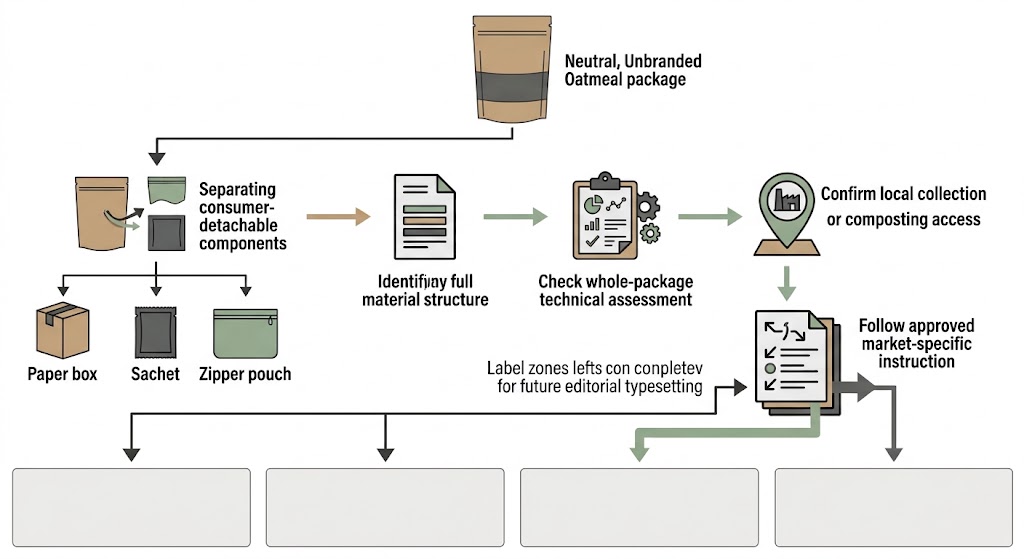
This is deliberately a decision process, not a printed universal bin chart. The same construction can encounter different collection systems across markets, and a redesign can change its technical assessment.
What a Brand Should Request Before Printing a Claim
Make the environmental brief part of the packaging RFQ. Ask for performance and disposal evidence together, since neither alone produces a successful retail pack.
| RFQ or approval field | Required detail |
|---|---|
| Target food and function | Oat type, fill weight, moisture/oxygen/light requirements, intended shelf life and line conditions |
| Full package identity | Every layer, coating, adhesive, ink, zipper, label, window, carton and sachet |
| Proposed route | Paper recycling, PE-film recycling, commercial composting or home composting, stated precisely |
| Technical evidence | Protocol, tested construction, report/certificate identity, limitations, validity and change control |
| Market evidence | Collection or facility access in each destination and instructions for food residue |
| Claim artwork | Exact words, symbol, qualifier, component named and review by the responsible brand team |
| Production control | Material substitutions, supplier changes, print coverage and attachment changes that trigger reassessment |
| Food performance | Finished-pack barrier, seal, handling and shelf-life evidence for the oat SKU |
For a project enquiry, send this brief through Mylarbag's oatmeal packaging page. Its paper options and eco-friendly packaging options are useful candidate routes. Ask for the exact construction and relevant reports before committing the artwork. A sales-page adjective is not a controlled technical specification.
Keep Product Protection in the Approval
A package with an attractive end-of-life story still needs to keep the oats acceptable through the stated distribution and shelf-life conditions. Test the actual filled pouch for seal integrity, moisture uptake, oxidation-sensitive flavors where relevant, handling and consumer use. Do not substitute a recyclability certificate for a shelf-life study, or a good barrier result for a recycling claim.
Plain rolled oats, oat flour and granola with oil-rich inclusions can have different limiting risks. Paper-based, conventional multi-material and PE-family candidates should be compared against the same food and storage brief. The separate material guide addresses that engineering selection; the freshness and finished-pack validation guide addresses those checks.
If a supplier changes the pouch wall, coating, adhesive, zipper, printed coverage or label, ask whether the disposal assessment and food-performance approval remain valid. A claim can become stale even when the artwork file has not changed.
Frequently Asked Questions
Can I recycle brown bags that oatmeal comes in?
Only after identifying the full bag and the local receiving route. A simple paper bag may be accepted where suitable paper collection exists. A brown paper-faced pouch with bonded plastic or metallized layers needs separate assessment; the colour and texture are insufficient evidence.
Can I recycle instant oatmeal bags or packets?
Not from the product name alone. The outer paperboard box and each individual sachet can be different materials with different instructions. Read component-specific, location-specific labeling or ask the brand for the exact packet structure.
Can you compost oatmeal bags?
Only when the finished bag has evidence for a defined composting environment and the intended collection route accepts it. The oats inside are a separate material. A paper look, plant-based resin or “eco” name does not establish compostability.
Is a paper oatmeal bag always recyclable with paper?
No. Coatings, bonded films, metallized layers, adhesives, windows and closures can alter mill performance. Request a finished-package assessment for the relevant paper-recycling process and check local collection.
What if the oatmeal bag has a plastic liner?
Find out whether the liner is truly detachable or bonded. If it separates as designed, the components may need separate instructions. A bonded liner makes a new composite package that cannot automatically follow the unlined paper route.
Does a silver inside layer mean aluminium foil?
No. It could be a metallized film or another structure. Request the converter's layer sequence rather than identifying a material from reflected light.
Are Mylar oatmeal bags recyclable?
“Mylar bag” can refer to several laminates. A PET/NY/PE or PET/VMPET/PE pouch should not be assigned to a common stream merely from its trade description. Confirm the whole construction and any applicable collection program.
Is a mono-PE oatmeal pouch recyclable everywhere?
No. Check coatings, inks, adhesives, closures and labels against a relevant design guide, then confirm collection and sorting in the destination. A PE-family design is a starting point for assessment, not a universal access claim.
Can a PE oatmeal bag go in a curbside recycling cart?
Only if the local program and the assessed label say so. In the US, eligible flexible PE packages may instead have a store-drop-off instruction; many curbside programs do not accept film. Follow the instruction for the actual pack and location.
Can the paper box and instant sachet share one recycling label?
One label can show separate instructions for each component, but a single unqualified “recyclable” statement can mislead if the box and sachet have different routes. Name the component, market and action clearly.
Is “industrially compostable” the same as “home compostable”?
No. The environments and assessment schemes differ. Ask for evidence for the intended setting and the exact printed, closed pack. Do not remove “industrial” from the claim merely because the base film is certified.
Is PLA automatically compostable?
No. A polymer name does not assess the full package, its inks, adhesives and attachments, or the composting environment. Verify the applicable finished-item evidence and receiving facility.
Does a compostable certificate mean my town accepts the pack?
No. A certificate addresses its defined test scheme. The local organics operator controls what it collects and processes. Check both the technical evidence and actual access before writing disposal directions.
Does a recycling symbol prove local acceptance?
No. Symbols can imply claims that need substantiation. Follow a credible package-specific label and local program information. Brands should review the message a symbol conveys, not only its graphic design.
What should an oatmeal brand approve before printing “recyclable”?
Approve the full package specification, applicable technical assessment, destination collection evidence, component-specific wording and change-control plan. Also verify that the selected pack protects the actual oats on the filling line and through shelf life.