
Short answer: Start with a commercially produced product in a verified, properly labeled retail pouch. Check the product's actual storage requirements and the carrier's current rules. Then protect that sealed pouch inside an outer package sized for the order, test the complete parcel through a representative handling route, and inspect the pouch when it arrives. A stronger bag alone cannot make an unverified product suitable for ambient mailing.
A parcel can arrive with its outer box scuffed while the selling units remain sound. It can also arrive in a pristine-looking box with one pouch corner abraded by another pouch's zipper. Those are different outcomes. The purpose of a shipping plan is to protect the primary food package, preserve its readable information and retail appearance, and make a damaged shipment easy to investigate.
This article is for US domestic orders of already packaged beef jerky from a food business or its fulfillment partner. It focuses on retail pouches inside mailers or cartons. It is not an instruction for making jerky at home, establishing shelf stability, choosing a preservation process, or shipping refrigerated meat at room temperature. For the wider commercial-packaging sequence, see how to package beef jerky for sale. Here the product is already made and packed; we follow it from fulfillment bench to recipient.
First determine what the product is allowed to endure
“Jerky” on the front of a bag does not tell a shipper its approved distribution conditions. The responsible food business should have a product specification, approved label, and supported storage and distribution plan. Some commercially produced jerky is intended for ambient sale; another product or variant may have handling requirements that differ. The pouch supplier cannot assign a safe temperature range or shelf life to a recipe by looking at the laminate.
The USPS Publication 52 section on meats and meat products states that domestic mailability depends on compliance with USDA regulations and applicable packaging requirements. That does not mean every item called jerky can be mailed under any conditions. For a product requiring temperature control, consult the processor's validated handling plan and relevant USDA FSIS mail-order food safety guidance. Carrier rules and destination conditions should be checked for the actual shipment. This article does not address international export permissions or customs.
Do not turn a claim such as “high barrier” into a shipping permission. Barrier properties may matter to a product-and-package validation plan; they do not replace that plan. Likewise, a two-day service name does not prove a temperature-sensitive product remained within its required conditions. Define the product first, then choose the transport system that can support it.
Think in layers: food pouch, order arrangement, outer parcel
The retail pouch is the primary food-contact package. It holds the product, provides the initial closure, carries the approved information, and gives the customer the intended first-open experience. The order arrangement keeps one or several retail pouches from rubbing, folding or concentrating force against one another. The outer mailer or box is the carrier-facing package that must survive sorting, stacking and delivery handling. Each layer has a distinct job.
The outer carton cannot repair an already weak top seal. The inner pouch cannot make a flimsy box resist crushing. A loose fill material cannot stop a pouch from scuffing if the order is free to slide against a hard box edge. Start with a passing retail pack and test the whole order configuration rather than selecting each component independently.
Check the selling unit before it reaches the parcel bench
The fulfillment team should have a simple visual acceptance rule for incoming finished food packs. It should know which seam is the factory's initial seal, which feature is a consumer reclosure, and where to find the lot or date code. A zipper is useful after opening; it is not evidence that an unsealed top was ready to ship. A tear notch belongs outside the sealed food area as designed and should not become a new split during picking.
Inspect representative pouches for apparent damage, contamination on the exterior, print/code readability, and whether the pack matches the current released SKU. A pack with a suspect seal or puncture belongs in the food business's hold-and-investigate process, not in a sturdier shipping carton. Do not press damaged film flat and treat it as a cosmetic issue without the quality team's decision.
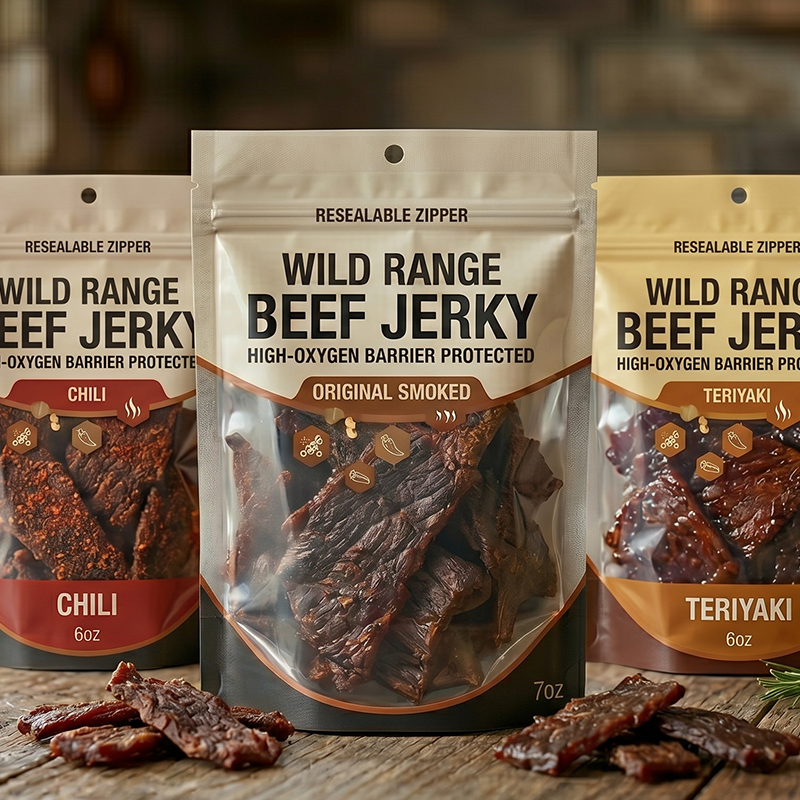
The bag format affects placement in the parcel. A small, flat three-side-seal pouch may lie neatly within a divider or rigid insert. A full stand-up pouch with a zipper can have a thicker top edge and a gusset that catches at a box corner. Use the actual filled selling units in the packing trial; empty bag samples will not have the same shape or weight.
Design separately for one pouch, a pair, and a mixed order
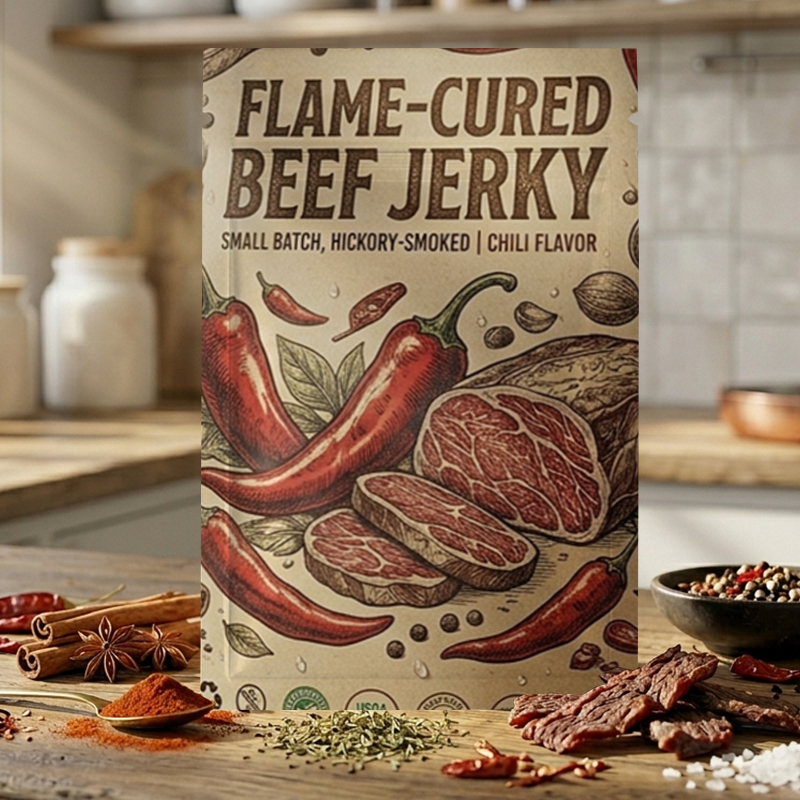
Many shipping failures start when a packaging setup proven with one pouch is used for four. The total weight rises, the stack becomes thicker, and stiff features can face each other. A variety pack adds SKUs and lot records to the physical problem. Test each actual order pattern that the business intends to offer.
Single-unit orders
Measure the filled pack, not just the empty bag's flat width and height. Place it in the proposed mailer or box and assess whether a corner, zipper or tear feature takes the first impact if the parcel is squeezed. A padded mailer might be adequate for some configurations, but padding is not a substitute for a trial. A rigid box may offer more shape protection, yet an oversized box lets the pack move and strike its walls. Compare candidates with the same retail pouch and route assumptions.
If the retail artwork must remain presentable for gifting or resale, document scuff and crease expectations explicitly. A pack can be food-package intact and still arrive with an unacceptable front-panel scratch. Those are separate criteria. Decide who owns the decision to re-ship, credit, or accept cosmetic damage before a customer complaint arrives.
Two- and three-unit orders
Arrange pouches so hard or raised features do not rub against the face or seal of another pouch. Try alternating orientation only if it remains stable under handling; a neat starting layout that collapses into a pile after vibration has not solved the problem. A separator, sleeve or paperboard insert may keep the selling units in place. Avoid adding material solely because it looks protective in an assembly photograph. Keep a before-and-after record to see what actually happened.
Record the number of pouches and their orientation. A “two-pack” shipped side by side is a different parcel from two pouches stacked face to face. If a brand offers both, either validate both or standardize the fulfillment method. The shipping specification should include the order configuration, not merely the name of the box.
Mixed or subscription orders
These orders may combine pouch sizes, flavors, promotional inserts, or other objects. A rigid insert can become an abrasion source if it bears against a printed pouch. A second item can push a top seal into a carton seam. Test the heaviest and most awkward normal mix, not only a photogenic combination. The picker needs a clear placement instruction that works even when one SKU is temporarily unavailable.
Keep a record that links the order to the included retail SKUs and the packing configuration. If a buyer later reports one swollen or damaged pouch, the brand should be able to distinguish a food-quality investigation from an outer-box or fulfillment issue. The Mylar bag and shelf-life article addresses abnormal pack expansion; a shipping scuff is a different observation and should be recorded as such.
Choose a mailer or box by received condition
There is no universal answer that a mailer is cheaper and safe, or that a corrugated box is always required. The choice depends on the filled retail pouch, order quantity, handling route, acceptable appearance, and any carrier requirement. Price the complete method, including inserts, labor, returns, and damaged deliveries, rather than comparing only the purchase cost of a mailer with a box.
“Right-sized” has two meanings. The carton must fit the intended order and give room for whatever protection the validated design calls for. It should not be so large that the pouches accelerate across an empty space, or so tight that closing it bends a zipper or top seal. The completed carton should close without pushing hard into its contents. Try the smallest and largest normal order built under the same packing instruction.
Do not reuse a box simply because it is available at the packing station. The team should know whether the board, closure and condition are suitable for the order and carrier. A box with a compromised corner or old adhesive may fail for reasons unrelated to the retail pouch. USPS's meats-and-meat-products rule refers mailers to its packaging strength and sealing requirements; confirm current rules for the chosen service rather than assuming an old template remains acceptable.
Protect seams, corners and codes without hiding problems
Pay particular attention to three locations. First, the top heat seal: a stiff parcel edge or another pack's zipper should not bear on it under compression. Second, the corners and notches: sharp jerky pieces or a folded pouch can concentrate force there, so look for pinholes, whitening or tears after the trial. Third, the variable code and approved label information: a barcode, lot code or product identity that becomes unreadable in a damaged pack is an operational problem even if the food barrier appears intact.
Protection can change how a pouch is restrained, but it does not make an unvalidated seal acceptable. If a trial reveals leakage or seal weakness, the food business and pouch supplier should identify whether the cause is product in the seal, sealing parameters, a damaged pouch, or parcel force. Fixing a carton can help with external force; it cannot fix inconsistent sealing at the filling line.
Run a parcel trial that can answer a question
One parcel mailed to a colleague can be a useful observation but not a complete release study. The team should agree what routes, order configurations, handling exposures, and pass criteria represent its business. The trial must include the actual retail pack, not a stand-in filled with a different product. Record the pouch specification and artwork revision, product SKU and lot where appropriate, outer packaging, order count, assembly method, and route.
The International Safe Transit Association's procedure catalog describes ISTA 3A as a test for individual packaged products distributed through parcel systems. A brand and its testing partner may use an appropriate current protocol or build a documented route-specific validation plan. Merely mentioning “drop test” does not mean the parcel passed ISTA 3A, and an in-house test is not a certification. Choose the method and acceptance criteria for the real shipping system before testing.
Capture the pre-shipment baseline
Photograph the front, back, top seal, corners, code and zipper of representative retail pouches. Note any pre-existing print rub or fold. Photograph the order arrangement inside the carton before closing it, then the closed box and label. Record the weight and dimensions of the parcel and how the box is sealed. The point is to know what condition left the fulfillment center.
If you are comparing two outer packs, hold the retail pouch SKU, order quantity, and product lot steady. If the product or pouch changes at the same time as the carton, you cannot easily say which change improved the result. Use enough samples and route exposure to see normal variation under your quality plan. One carefully packed showpiece is not the fulfillment operation.
Record what the recipient actually receives
Have the receiving person photograph the unopened parcel and note visible damage before opening it. Then record the position of every retail pouch and inspect its front finish, seams, corners, tear feature, zipper, lot code, and any suspected puncture or leakage. A pouch may be physically intact but shifted so its front panel creased badly; record that separately from a barrier failure. If anything suggests a food-quality issue, follow the business's hold procedure rather than making a taste-based judgment.
Use pass/revise/fail against criteria set before the parcels go out. “Looks okay to me” is not a repeatable standard. A practical scorecard can distinguish food-package integrity, retail appearance, code readability, carton containment and assembly consistency. Retain the tested configuration and photos so a later cost-cutting proposal can be compared with the release baseline.
Test the packing instruction as well as the box
Ask two trained people to pack the same order using the written instruction. Do they place the zipper edges in the same direction? Do they use the same number of separators? Can they close the box without squeezing the pouches? A system that only works when its designer personally assembles it is not ready for fulfillment.
Run the trial at a pace that resembles normal picking. If a divider takes too long or slips out of position, that is a design finding. If the label hides the opening seam and a recipient cuts into the pouch while opening the carton, note it. These observations often produce a cheaper and more effective revision than increasing film thickness without evidence.
Handle temperature and route changes as product decisions
The processor's validated storage and distribution conditions determine whether ambient parcel service is appropriate for a particular SKU. If the product requires refrigeration, the brand needs a temperature-control plan suitable for its route and carrier, with its own monitoring and acceptance criteria. Adding an insulated liner or a faster service without validation does not establish safety. Dry ice, if used, has separate carrier conditions; refer to the current rule rather than copying another seller's arrangement.
Even for a product released for ambient distribution, route and season can affect package appearance. Heat exposure can soften a finish or make adhesive labels scuff; low pressure and temperature changes may alter the appearance of a gas-containing flexible pack. None of those visual observations alone diagnoses food safety. Record the route and compare the received pack to the initial baseline. If the shape changed unexpectedly, hand the lot information to the responsible quality team.
Build a change trigger into the shipping specification. A new pouch material, revised zipper, different fill weight, new box supplier, extra promotional item, or additional destination region should prompt a review of the relevant trial. Do not assume that a pass for a two-pouch order in one box transfers to a six-pouch order in a different mailer.
Use the real meat-snack case without inventing a shipping result
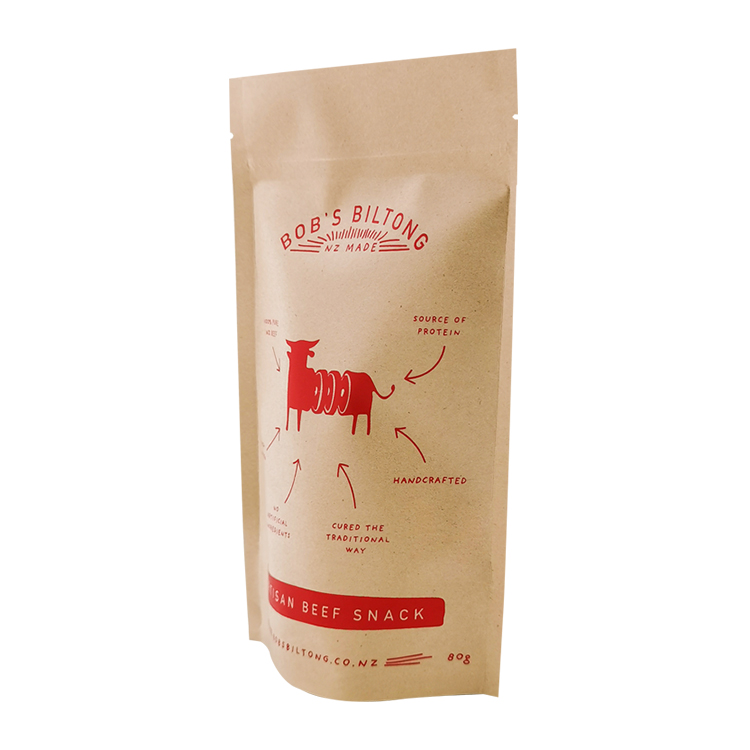
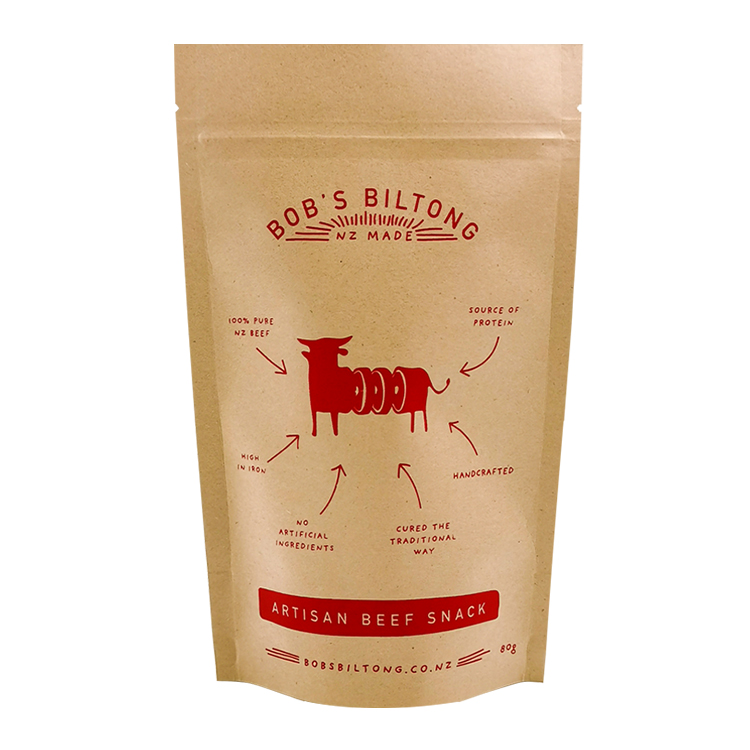
The published New Zealand 80 g meat-snack pouch project records a stand-up pouch with zipper, MATOPP/kraft paper/VMPET/PE construction, 13 × 21 + 4 cm dimensions, and gravure printing. The photographed retail branding identifies biltong. It is a useful example of an actual printed primary pack, though the food is not interchangeable with every jerky formulation.
The case does not publish an order-box design, a US domestic mailing route, temperature logger, parcel test, or received-condition report. Therefore this article does not call it a proven mailing solution. To turn such a retail pouch into a mail-ready selling unit, a brand would need the product's own release conditions and a parcel trial using filled samples, the proposed order count, and the actual outer packaging.
That difference matters in an RFQ. A bag supplier can discuss pouch dimensions, materials, seal features, and empty-pouch sample evaluation. The brand or fulfillment partner chooses and validates the external shipment. A reference photo helps explain what kind of pouch is being ordered; it cannot authorize a carrier route or establish that the finished food will arrive in condition.
What a buyer should send to the pouch supplier
When the shipping trial points to the retail pouch, the buyer should provide the actual product size, pouch dimensions, material and closure specification, fill and sealing method, the failure location, and before/after photos from the parcel. Say whether the concern is a punctured corner, weakened top seal, scratched print, unreadable code, or an awkward arrangement in a multi-unit box. Those are different engineering and artwork questions.
Ask for a sample or revised specification tied to the failure. For example, a different pouch geometry may keep the zipper from bearing on a neighboring pack; a material change may be investigated if there is evidence of puncture from normal product edges. Neither proposal should be described as a guaranteed fix until the packer has filled, sealed, and retested the revised system. If the problem is an oversized outer carton, solve that with the fulfillment team rather than changing the food pouch without a reason.
For a new project, the custom beef jerky bags page is a starting point for pouch samples and specifications. Share your intended retail fill, closure, target market, order mix, and observed shipping problem. Keep the processor and logistics team involved so the resulting retail pouch can be tested inside the actual parcel the customer will receive.
FAQ
How do I package beef jerky for mailing?
Use a commercially produced product in a released, properly labeled and sealed retail pouch under its supported storage conditions. Choose an outer package for the actual order quantity, restrain the pouches, verify carrier rules, and test the completed parcel. Inspect the retail pouches after representative handling and delivery.
Can I mail beef jerky in just its retail pouch?
Do not assume a retail pouch is a suitable carrier-facing parcel. It may need an outer mailer or box to protect seals, corners, print, labels and the complete order. Check the applicable carrier requirements and compare received condition from tested configurations. A flexible pouch's food-barrier role is different from a parcel's transport-protection role.
Is a padded mailer enough for a single bag?
It may be a candidate for some products and routes, but the result depends on the actual filled pouch, corner and zipper features, handling, and acceptable arrival condition. Compare it with a right-sized box using the same SKU and documented pre- and post-shipment checks. Do not select it solely from its postage cost.
Does vacuum sealing make jerky safe to ship without refrigeration?
No package style alone establishes that a product is suitable for ambient distribution. Follow the responsible food business's validated process, label and storage directions. A chilled product needs a supported temperature-control plan and carrier-compliant packaging, regardless of the retail pouch's closure.
What should I check when a beef jerky parcel arrives damaged?
Photograph the unopened outer pack and its label, then the internal arrangement and each retail pouch. Record order contents, route, lot and damage location. Separate external carton damage, print scuff, seal or puncture damage, and any unusual change in the food package. Put suspect product on hold under the brand's quality procedure; do not judge safety from a photograph.
Do I need an ISTA 3A test for every jerky pouch?
ISTA 3A is a published parcel-delivery test procedure for packaged products in its defined scope. The brand and testing partner should decide what protocol or documented route trial fits its shipments and customers. Mentioning the procedure does not mean a pouch or parcel has passed it; a test result applies to the configuration actually tested.