Are Coffee Bags Recyclable? The Honest Truth & Sustainable Alternatives
It’s a question every eco-conscious coffee roaster eventually asks: Are coffee bags recyclable? If you’re throwing your empty beans bag into the blue curbside recycling bin, you might actually be doing more harm than good.
The reality of coffee packaging is complicated. As manufacturers who run flexible packaging production lines every day, we've seen firsthand why the industry standard is a nightmare for recycling facilities. But we’ve also spent years developing the exact materials to fix this problem.
Let’s cut through the greenwashing. Here is the honest truth about recycling traditional coffee bags, and how modern material engineering is finally changing the game for coffee brands.
Why Are Traditional Coffee Bags Hard to Recycle?
To understand the problem, you have to look at how a standard coffee pouch is built.
Most traditional bags—especially those premium flat-bottom bags or stand-up pouches you see on supermarket shelves—aren't just paper or plastic. They are multi-layer laminates.
Typically, a factory binds three distinct layers together:
- The Outer Layer: Usually PET or Kraft paper for high-quality printing.
- The Middle Layer: Aluminum foil (AL) or metalized film (VMPET) to block out oxygen, moisture, and UV light.
- The Inner Layer: Polyethylene (PE) to keep the bag airtight and allow for heat sealing.
While this 3-ply structure is incredible at keeping freshly roasted coffee beans fresh for 12 months, it’s a recycling disaster. Standard municipal recycling plants simply don't have the technology to separate paper, plastic, and metal layers that are bonded together with heavy-duty adhesive. As a result, these bags get sorted out at the facility and sent straight to the landfill.
Can Foil Coffee Bags Be Recycled?
The short answer? Not in your home recycling bin.
If a coffee bag has a foil lining, the aluminum is permanently fused to the plastic. You can't just peel them apart.
There are a few specialized exceptions. Third-party programs like TerraCycle partner with specific coffee brands to collect empty foil bags. They use specialized industrial processes to shred, melt, and separate the materials to make low-grade plastic products (like park benches).
While this is better than throwing them in the trash, it requires consumers to mail their empty bags in or find a very specific drop-off location. Let's be honest: the vast majority of consumers won't do that. As a coffee brand, relying on your customer to mail their garbage away isn't a scalable sustainability strategy. You need packaging that is sustainable by design from day one.
The Game Changer: 100% Recyclable & Compostable Coffee Bags
This is exactly why we retooled our manufacturing processes. You don't have to choose between keeping your coffee fresh and protecting the planet anymore. We've developed two distinct paths for truly eco-friendly packaging that solve the recycling dilemma.
Solution 1: Mono-Material PE (Fully Recyclable)
The biggest breakthrough in flexible packaging right now is "mono-material" technology. Instead of mixing PET, foil, and PE, we manufacture the entire bag using MDO-PE (Machine Direction Oriented Polyethylene) laminated with standard PE.
Because the entire bag is made from a single polymer family, it is 100% recyclable. Your customers can drop these off at local grocery store plastic film recycling bins (usually classified under SPI code #4).
But here is the technical detail that most suppliers miss: the degassing valve. A recyclable bag is completely useless if it has a non-recyclable nylon valve welded to it. Recycling sorters will reject it. That’s why our mono-material bags use a specialized PE degassing valve. The bag, the zipper, and the valve are all PE.
If you're looking to transition, check out our custom printed coffee packaging bags. These side-gusset and flat-bottom designs offer the exact same premium feel and shelf-life as traditional bags, but with a clear conscience.
Solution 2: Compostable Kraft & PLA
If you want your brand to move away from traditional plastics entirely, composting is the ultimate answer.
For this, we use a White Kraft paper outer layer combined with a PLA (Polylactic Acid) inner lining. PLA is a bio-plastic derived from renewable resources like corn starch. Under industrial composting conditions, the bag will break down into water and biomass within a few months.
Just like our PE bags, we don't cut corners on the accessories. These pouches are fitted with a certified PLA degassing valve, making it a completely plastic-free structure.
You can explore our full range of eco-friendly sustainable coffee packaging to see how independent roasters are using these compostable pouches to stand out on the shelf and align with their customers' values. 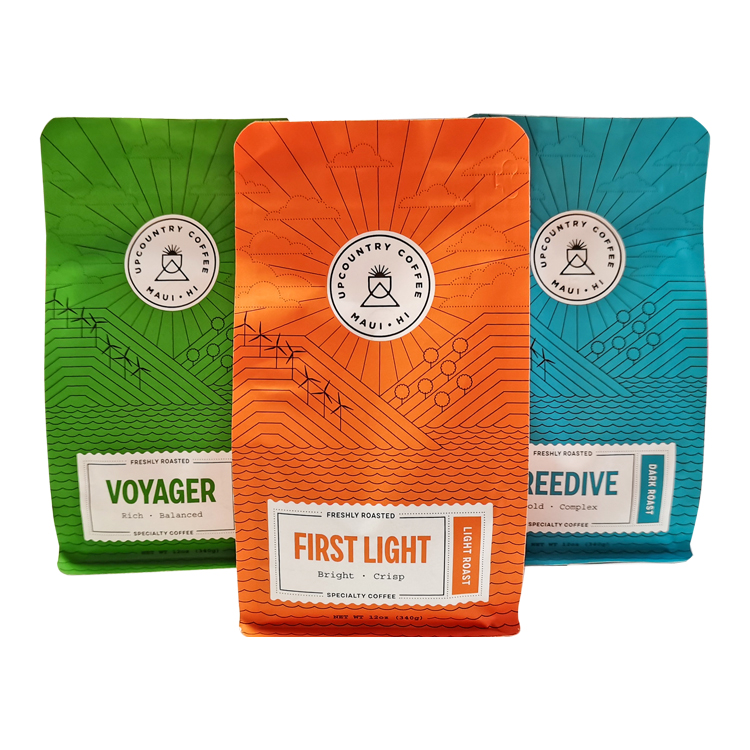
How to Transition to Sustainable Coffee Packaging?
Switching your packaging material is a big decision for any roasting business. Here is what we tell our B2B clients before they make the jump:
1. Don't panic about shelf life. Our MDO-PE bags provide an exceptional oxygen and moisture barrier. Unless you plan to store your roasted coffee in a hot warehouse for over two years, mono-materials will keep your beans perfectly fresh.
2. Communicate clearly on the bag. If you spend the money on recyclable or compostable bags, tell your customers! Print clear disposal instructions right on the back of the bag. A "Store Drop-Off Recyclable" logo or "Compostable" certification mark adds massive trust to your brand.
3. Test before you buy. Ask us for samples. Fill them with your beans, heat-seal them, and see how they feel in your hands.
Frequently Asked Questions (FAQ)
Can coffee bags be recycled curbside?
Generally, no. Traditional multi-layer coffee bags cannot go into your blue curbside bin because recycling plants cannot separate the plastic and foil layers. However, if your bag is made from mono-material PE, it can be recycled at specific store drop-off locations that accept flexible plastic films.
Are coffee bags with valves recyclable?
It depends entirely on the valve material. If a bag is made of recyclable PE but has a standard nylon valve, the recycling facility will reject it. The entire pouch—including the valve and zipper—must be made from the exact same material (like a PE valve on a PE bag) to be truly recyclable.
What is the most eco-friendly coffee packaging?
There are two main contenders for the most eco-friendly option: Mono-material PE bags (which are fully recyclable in plastic streams) and Kraft/PLA bags (which are fully compostable in industrial facilities). The "best" choice depends on your brand's values and your local waste management infrastructure.