Cannabis Packaging Materials: How to Compare Pouch Structures
A cannabis pouch material is not a single marketing word such as "Mylar," "foil," or "high barrier." A useful comparison starts with the complete listed structure, then connects it to the product, pouch format, visual direction, closure and top-seal plan, filling process, target market, and the sample or evidence questions that still need to be resolved. That gives a brand a specification conversation rather than a bag-name conversation.
This guide is for teams planning legitimate commercial cannabis packaging. It is not legal advice, a universal material specification, or a claim that one pouch construction will give the same result for every product and process. The aim is to make the next supplier conversation more specific.
Start with the project, not a material nickname
Material names can be useful shorthand inside a packaging conversation, but they become misleading when used as the full brief. A brand may ask for a "Mylar bag" while actually deciding between an opaque retail pouch, a paper-led visual direction, a reflective finish, a clear-window treatment, or an existing packing process with a particular seal area. Those are related choices, but they are not interchangeable.
Start by writing down what the package has to help the team discuss. The list does not need to be final before the first inquiry. It does need to separate what is known from what is still open. Product category, approximate physical fill, preferred pouch format, artwork direction, target market, closure idea, and filling method all change the questions a supplier needs to ask about the material.

For example, a team may know that it wants a stand-up pouch with a sober, opaque look and a small number of launch designs. Another may want a natural paper-led visual direction, a clear window to be evaluated, and a still-developing artwork system. A third may be considering a reflective retail treatment but does not yet know whether its product will be filled manually or on equipment. None of those descriptions is a completed material specification. Each is a productive starting point.
The most useful question is therefore not, "Which material is best?" It is, "Which material direction should we evaluate for this product and this pouch plan?" That framing makes room for the questions a material string cannot answer alone.
Read a pouch structure by role, not by one layer name
Flexible pouches are often multilayer constructions. A listed structure may describe an outer visual or print-facing layer, a middle layer that contributes to the chosen material direction, and a sealant-side layer. The exact role of each material depends on the specified construction and intended project. It should not be guessed from a generic illustration or from the word "metallized."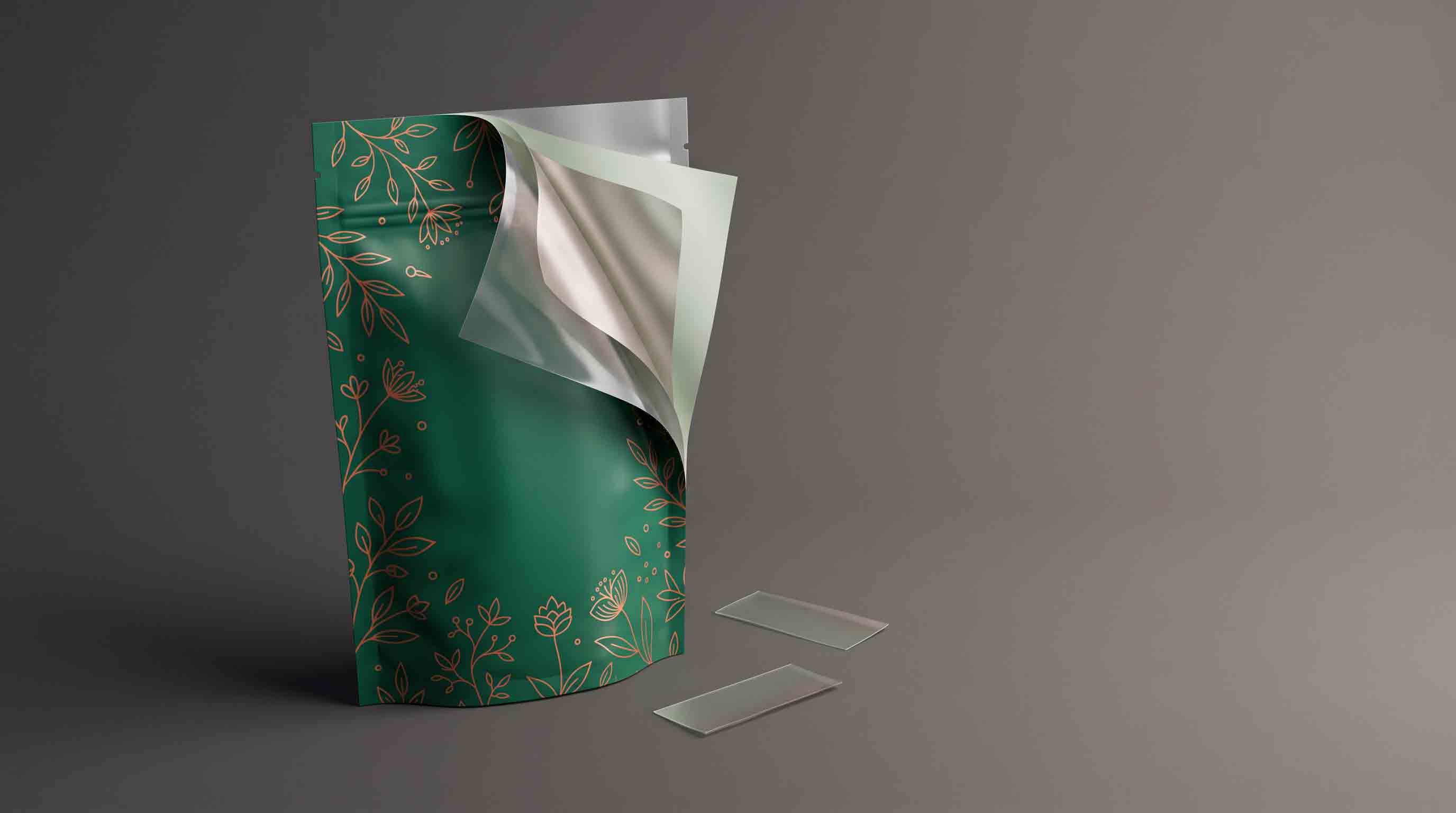
The visual side of a pouch can be important for artwork, surface feel, opacity, and how the printed design is read under retail lighting. A paper component can change the look and tactile direction of a pouch, but it does not turn a printed product image into a complete technical description. A metallic or laser-treated component can create a different visual effect, but it does not by itself tell a buyer how a finished pouch will behave in every packing or storage condition. The sealant side must also be considered with the selected pouch format and the real filling and sealing plan.
This is why a buyer should ask for the structure in a comparable form. "PET / VMPET / PE," "MATOPP / kraft paper / VMPET / PE," and "PET / Aluminized Laser (Holographic) / PE" are more useful starting points than "foil bag," "paper pouch," or "premium Mylar." They show that the project has more than one material element. They still do not answer every product-specific question.
Some projects need a particular type of measured material information. ASTM D3985 describes a method for determining oxygen-gas transmission through plastic film, sheeting, laminates, coextrusions, and coated papers or fabrics; ASTM F1249 addresses water-vapor transmission through flexible barrier materials. Those methods are useful only when the buyer and supplier define the material, sample, conditions, and question to which the number applies. They are not a shortcut from a material name to a universal finished-pouch result. ASTM D3985 and ASTM F1249 are technical reference points for a qualified discussion.
Compare listed material directions as starting points
The most practical way to compare materials is to place them beside a real project brief. Three public Mylarbag cannabis project records show how different material directions may be listed for different visual and format choices. These are configuration references, not proof that the same pouch will fit another brand's product or establish a performance claim. You can review the public examples in the cannabis packaging collection.
PET / VMPET / PE: begin with the complete opaque-pouch brief
A published Mylarbag matte-black stand-up pouch record lists PET / VMPET / PE and shows a dark printed retail presentation. For a brand that prefers an opaque visual direction, this can be a useful way to make the first material conversation concrete. The decision should then move to the actual product, pouch dimensions, visual hierarchy, closure plan, usable top-seal area, packing method, and any sample questions.
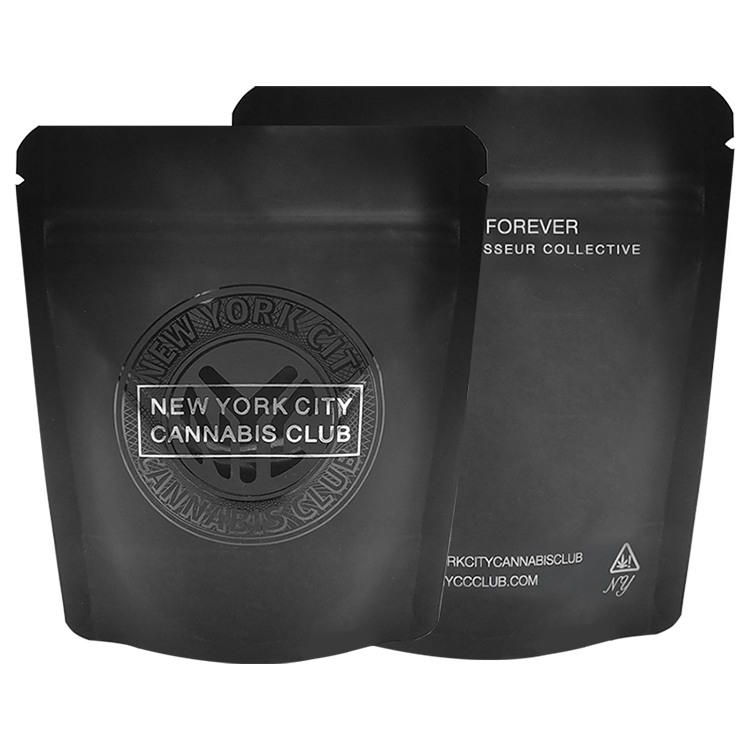
It is tempting to treat a short material string as a full recommendation. It is not. The same listed structure can be part of projects with different pouch formats, art coverage, top-seal arrangements, product volumes, filling behavior, and destination-market information needs. A buyer should ask which facts about the actual project are needed before the proposed configuration can be evaluated.
This is also a useful point to separate what the pouch may visually communicate from what the brand is entitled to claim. A dark, printed pouch may suit an intended visual system. The photograph and listed structure do not prove a fixed shelf life, an odor result, a legal conclusion, or a product-quality outcome. For the broader evidence boundary, see our cannabis packaging odor-control guide.
MATOPP / kraft paper / VMPET / PE: make the paper-led direction specific
A published kraft stand-up pouch record lists MATOPP / kraft paper / VMPET / PE, a stand-up format, gravure printing, and a child-resistant zipper. That kind of description gives a team more useful material vocabulary than simply asking for a "kraft cannabis bag." It identifies a paper-led direction within a multilayer pouch conversation and shows that the outer visual direction, pouch format, and closure discussion are connected.
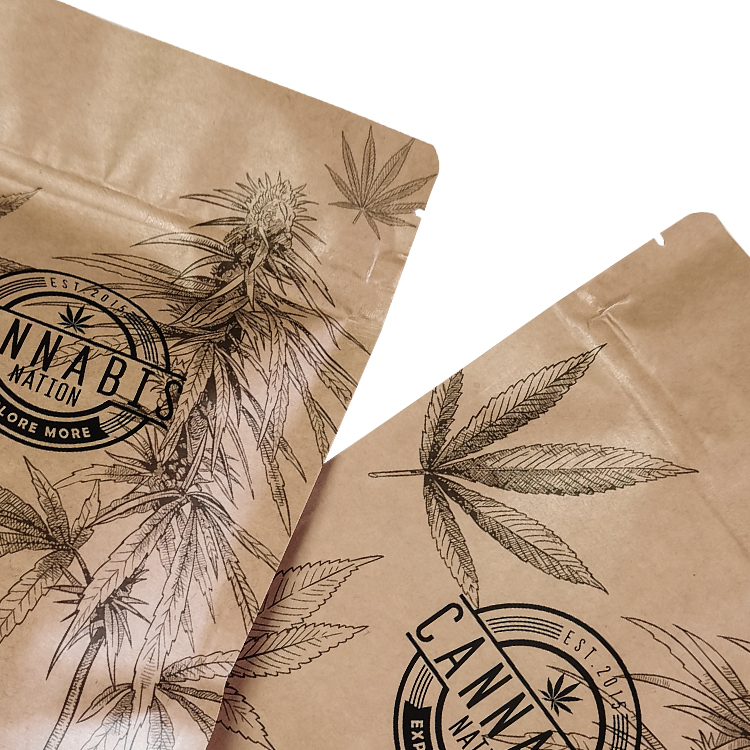
The right next question is not whether every paper-led pouch will be identical. It is whether the planned artwork, information areas, window idea if any, pouch size, closure, and fill process are appropriate for the actual project. A natural-looking surface may be central to a brand's visual direction, while an internal product or packing requirement may create a different set of questions. Make both visible in the brief rather than letting one visual word decide the entire pouch.
If the visual system is still being developed, the material discussion should run beside artwork planning rather than after it. Our cannabis packaging design guide explains how pouch panels, finish direction, artwork files, and production handoff should be considered together.
PET / Aluminized Laser (Holographic) / PE: treat a reflective effect as a project direction
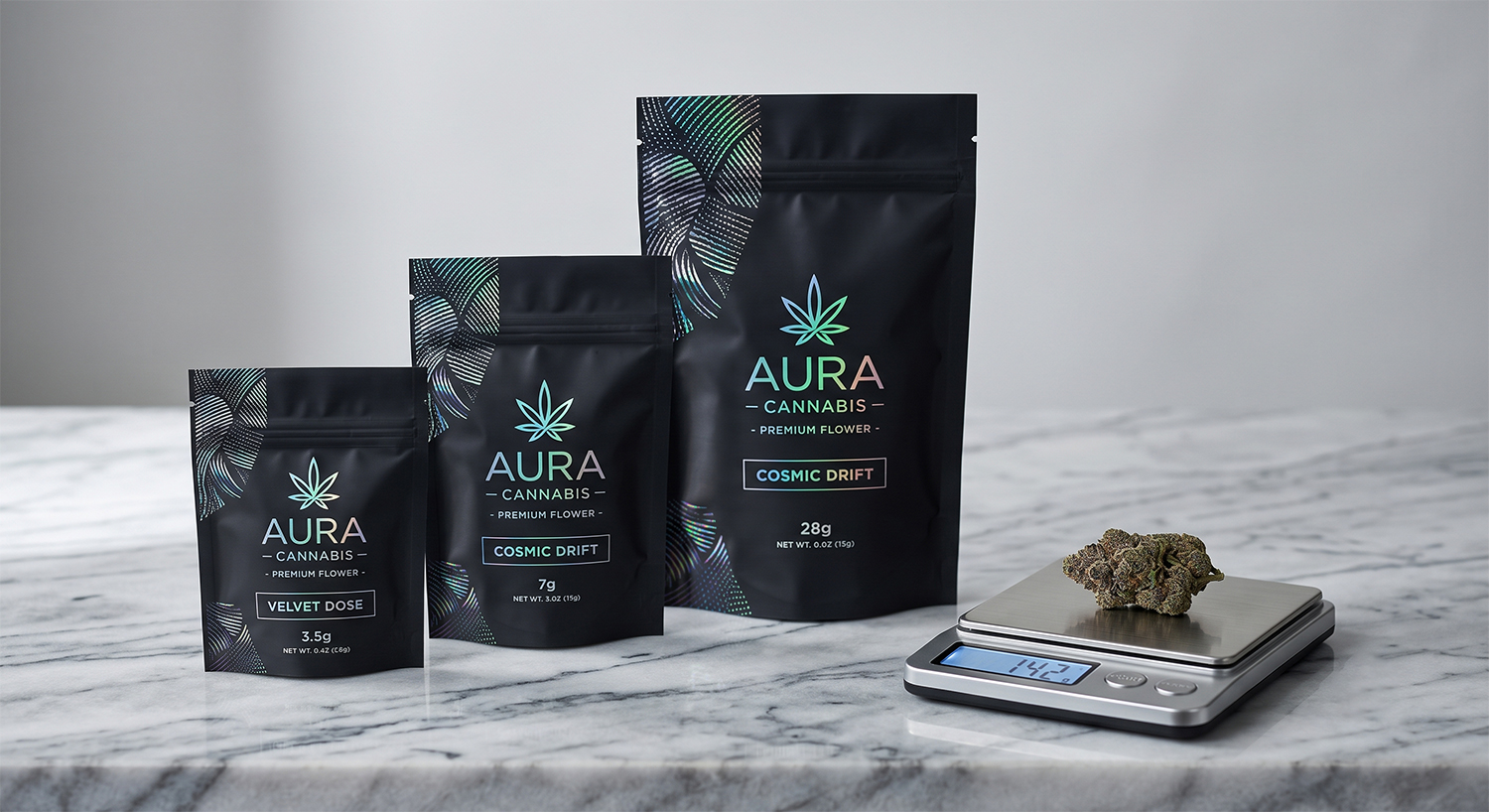
A published holographic stand-up pouch record lists PET / Aluminized Laser (Holographic) / PE, digital printing, and spot UV. This is a strong example of why a finish direction is part of the material brief instead of a generic visual filter. A reflective effect needs to be discussed with the proposed pouch format, artwork coverage, available panels, and how the package will be seen in the intended retail context.
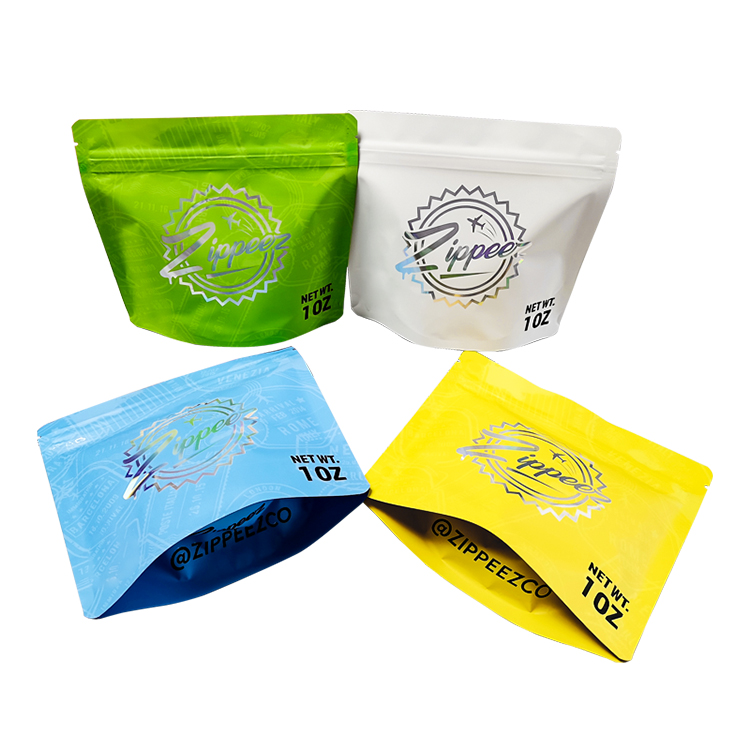
The listed project is a reference for a specific material and visual direction. It does not make every reflective pouch suitable for every cannabis product, nor does it promise a commercial outcome. The purpose of the example is to help a buyer request an intelligible comparison: what is the selected material direction, which print or finish choices are being considered, what does the pouch need to show, and what must be reviewed on a sample before production?
Material selection also has to fit conversion and packing
An empty pouch is only one stage of the project. The specified material direction has to be converted into the chosen pouch, reviewed with the intended artwork, and considered with filling, top sealing, closure use, secondary packing, and sample approval. This is where a useful material conversation becomes a packaging-system conversation.
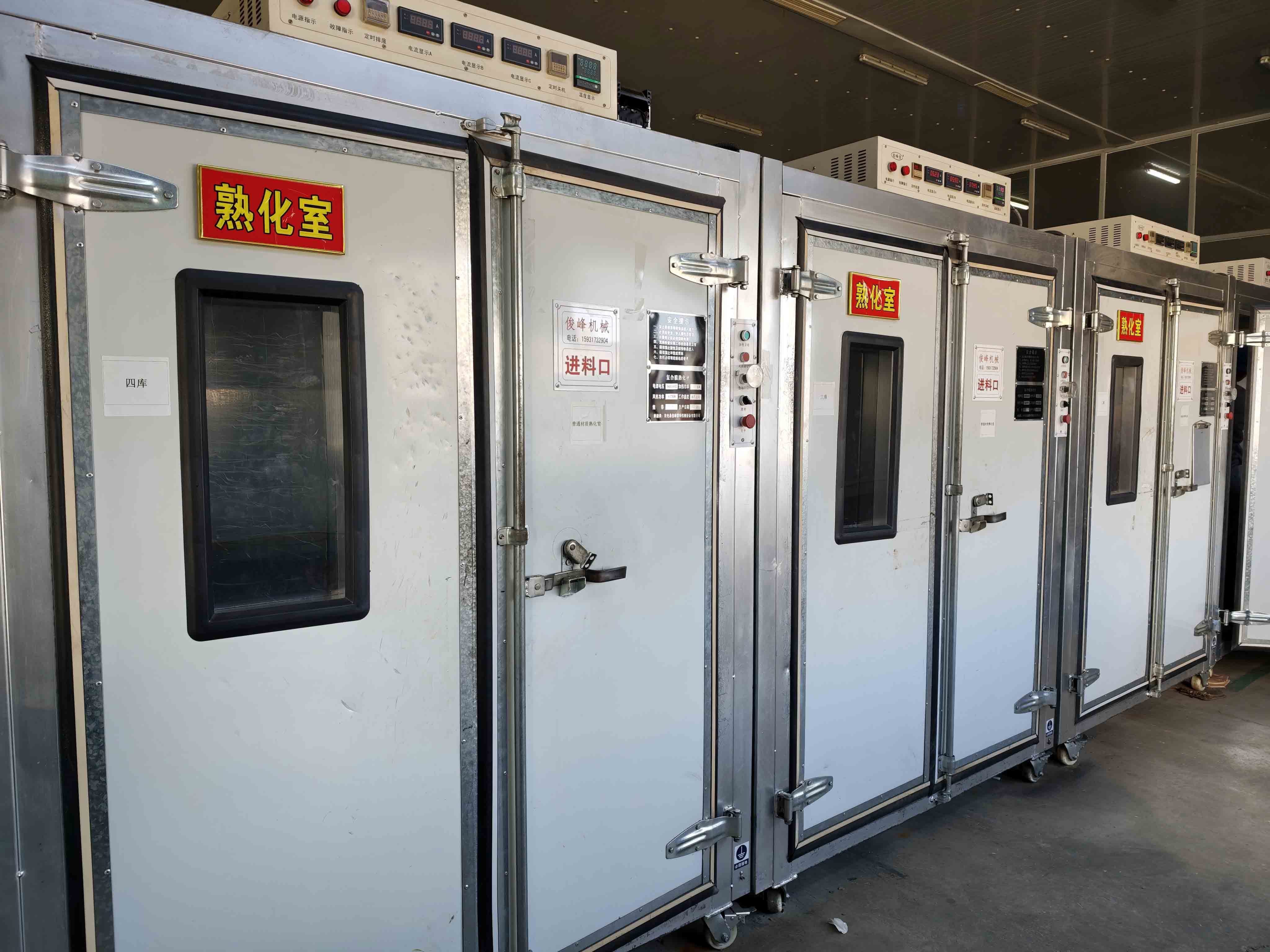
The factory image above provides process context only. It does not document a test result, a customer project, or a conclusion about the proposed pouch. Its relevance is simpler: once layers and finishing directions are specified, they have to be made into a pouch that the brand can actually fill, seal, present, and review.
For a resealable format, distinguish the zipper from the top heat-seal plan. A zipper is a feature intended to support resealing after opening; it does not determine how much clean material a particular filling process must leave above it. A top heat seal is a separate process-created closure. The selected pouch, sealant-side material, product flow, equipment, fill height, and trial criteria all need to work together. The heat-seal, zipper, and packaging QA guide covers that production discussion in more detail.
Do not let a material choice become detached from the actual operation. A pouch can look appropriate in a sample review yet still need project-specific questions answered about the fill, the product's physical volume, the top-seal area, the position of a closure, print placement, label space, or the way the finished pack moves into secondary packaging. Those are not reasons to avoid a material discussion. They are reasons to document it clearly.
Ask for evidence that matches the question you are asking
Different material questions call for different evidence. A surface sample can help a team discuss a visual direction. A pouch sample can help it review overall proportion and layout. A stated laminate structure can make it possible to compare like with like. A relevant test method can help define what a material measurement means under stated conditions. None of these items should be stretched into an unrelated promise.
The same restraint applies to printed and coated surfaces. ASTM F2252/F2252M describes a practice for evaluating ink or coating adhesion to flexible packaging materials using tape. Its description makes clear that acceptance criteria are to be determined by the user and producer; it is not a universal "pass" label for an arbitrary pouch. Use it when an actual project needs to define a relevant ink or coating question. ASTM F2252/F2252M provides the method boundary.
The goal is not to make every buyer run material tests. It is to prevent a generic material adjective from standing in for the evidence a particular product, process, or market needs. If performance or documentation matters to the project, ask what can be provided for the proposed structure, under what conditions, and what still needs to be reviewed with the finished package.
Turn the comparison into a concise material brief
Once a team has compared material directions, it should record the result in a short brief that another colleague or supplier can understand without guessing. This is especially useful when a brand has a clear creative preference but has not yet fixed every technical choice. Instead of saying "we want a premium Mylar pouch," the brief can state which directions are being compared and what decision each sample or supplier response needs to support.
Keep the brief divided into confirmed inputs and open inputs. The confirmed side might include the product category, approximate fill or representative sample, expected pouch format, number of launch designs, target market, and a visual reference. It might also state that the team is comparing an opaque printed direction against a paper-led or reflective direction. The open side can identify questions about final dimensions, a window, closure placement, usable top-seal area, filling method, test information, or market-specific content. An open question is not a weakness in the inquiry. It is a useful signal that the supplier should not silently turn an assumption into a finished specification.
This brief should be specific enough to make like-for-like comparison possible. If two suppliers receive different descriptions, their replies may differ because they are evaluating different pouches, not because one material is necessarily better. Ask each supplier to restate the proposed pouch format, listed material stack, surface or finish direction, closure arrangement, and assumptions that remain unresolved. That makes it easier to see where the comparison is actually about cost, appearance, process fit, or another project variable.
When samples are involved, identify the exact question each one must answer. One sample may be for panel proportion and artwork contrast. Another may be for a paper-led tactile direction. A third may be for the way a reflective finish reads under the intended lighting. A filled and sealed sample may be necessary to review aspects of the real packing process that an empty display pouch cannot show. Recording the purpose protects the team from treating a collection of attractive packages as a technical decision by itself.
Recommended packaging configuration: start with a material direction, then specify the pouch
For a brand that already has a general product and visual direction, a useful recommendation is to compare specific pouch directions rather than choose a generic "best cannabis bag." An opaque PET / VMPET / PE stand-up pouch direction may be worth discussing when the brief calls for a dark printed presentation. A MATOPP / kraft paper / VMPET / PE direction may be worth discussing when a paper-led surface is central to the visual plan. A PET / Aluminized Laser (Holographic) / PE direction may be worth discussing when the brand is evaluating a reflective effect.
These are starting points, not promises. The final configuration should be discussed against the actual product, target fill, pouch format, artwork, closure and top-seal expectations, filling process, target market, and documentation questions. A Custom Cannabis Packaging conversation can turn those known inputs into a project-specific pouch and sample direction.
To make that inquiry useful, send what you know: product category, approximate fill or a representative sample, target market, preferred pouch format, artwork or visual reference, number of variants, material/finish directions to compare, closure idea, filling and sealing context, and the questions that must be answered before production. If one detail is still open, label it as open. Discuss a project-specific pouch direction when you are ready to review the options with a supplier.
Frequently asked questions
What material is used for cannabis packaging bags?
Cannabis packaging can use different flexible-pouch structures. Instead of relying on a broad term such as "Mylar," ask for the complete listed material structure, then compare it with the product, pouch format, surface direction, closure and seal plan, filling process, and sample questions for the actual project.
Is PET / VMPET / PE the same as every metallized cannabis pouch?
No. A listed PET / VMPET / PE structure is a specific material description, not a universal description of every metallized pouch. The final pouch can still differ in format, dimensions, print/finish direction, closure arrangement, seal area, product fit, and project-specific evidence needs.
How should I compare kraft paper cannabis pouches with other pouch materials?
Compare the complete listed structure, not just the word "kraft." A paper-led direction may involve outer film, paper, metallized, and sealant-side elements. Then review the proposed pouch format, artwork, closure, filling process, and the questions that need to be checked on a project-specific sample.
Does a holographic pouch use a different material structure?
It can. A public Mylarbag project lists PET / Aluminized Laser (Holographic) / PE, which gives a buyer a concrete material and visual direction to discuss. That listed structure does not by itself establish how every reflective pouch will look, perform, or fit a different product and process.
What should I ask a supplier about cannabis pouch materials?
Ask for the complete proposed structure, pouch format, intended dimensions, visual/finish direction, closure and top-seal plan, filling process, available sample approach, relevant documentation, and any material question that needs a stated test method or project acceptance criterion.
Can a pouch material name prove shelf life or compliance?
No. A material name or a pouch photograph cannot by itself prove a fixed shelf life, market compliance, or a finished-package result. If a project needs specific evidence, define the exact question, the proposed structure, relevant conditions, and the parties responsible for the appropriate review.